
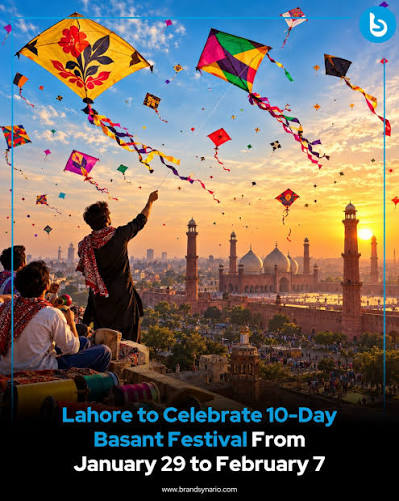

Punjab Chief Minister Maryam Nawaz Sharif has approved an extended 10-day Basant festival for Lahore, running from January 29 to February 7, 2027. The revised schedule replaces an earlier plan for a shorter, three-day celebration in March and brings the city’s kite-flying tradition back for a much longer stretch.
Background
Basant, also known as Jashn-e-Baharaan, is a centuries-old Punjabi spring festival associated with kite flying, bright yellow clothing and traditional music. The celebration has deep roots in Lahore’s cultural identity, with historical accounts tracing organised festivities in the city back hundreds of years, gaining particular prominence during the Mughal era.
The festival had been banned in Punjab for around two decades due to safety concerns linked to dangerous kite strings, including chemical-coated and metallic varieties that caused fatal accidents. That ban was lifted earlier in 2026 through a provincial ordinance, allowing Basant to return to Lahore for the first time in roughly 25 years, with celebrations held from February 6 to 8 under strict safety rules.
Details
The newly approved schedule significantly expands on that limited return. Under the revised plan, Basant 2027 will run for 10 days, from January 29 to February 7, with celebrations paused for one day on February 5 to observe Kashmir Solidarity Day before resuming through to February 7.
This extended version replaces an earlier announcement that had planned a shorter, three-day festival for March 12 to 14, 2027. Officials say the change was made to give Lahore residents a longer celebration marking the start of the new year, rather than spreading festivities later into the spring season.
As with the 2026 revival, authorities have reiterated that kite flying will only be permitted during the designated festival dates, and that chemical-coated, metallic and sharp strings remain strictly prohibited. The Lahore district administration is expected to continue enforcing these restrictions to prevent the kind of accidents that originally led to the multi-year ban.
Preparations for the extended event are also said to include cultural and beautification activities across the city, such as decorations along major roads, parks and green belts, along with cultural displays and events intended to showcase Lahore’s heritage to a wider audience.
Quotes
Maryam Nawaz Sharif described the extended celebration as a gift for the people of Lahore to mark the arrival of the new year. She said the longer festival would help promote Punjab’s cultural colours and Lahore’s ancient historical tradition to audiences well beyond the city itself. She also urged residents to repeat the responsible conduct shown during the shorter 2026 celebrations, framing safe participation as important for the festival’s continued future.
Impact
The decision carries both cultural and economic significance for Lahore. Earlier reporting around the 2026 Basant revival noted that the festival had generated substantial economic activity, running into billions of rupees, through tourism, retail sales of kites and related goods, and hospitality spending. A 10-day celebration is likely to amplify that impact considerably compared with the earlier three-day format.
The move also signals the Punjab government’s intent to position Basant as a flagship cultural event capable of drawing both domestic and international attention, rebuilding a tradition that had been dormant for a generation due to safety concerns.
Conclusion
With the festival now officially rescheduled, attention will turn to how authorities balance an extended celebration with the safety measures that made the 2026 revival possible in the first place. If the 10-day format proceeds smoothly, it could set a long-term precedent for how Basant is celebrated in Lahore going forward, though some observers have noted that managing a longer event may prove more challenging for authorities than the shorter three-day version held earlier this year.
Frequently Asked Questions
What is the 10-day Basant festival in Lahore?
The 10-day Basant festival is an expanded version of Lahore’s traditional spring kite-flying celebration, approved by Punjab Chief Minister Maryam Nawaz Sharif for 2027. It builds on Basant’s long cultural history in the city, which includes kite flying, vibrant yellow clothing, music and community gatherings marking the arrival of spring. Unlike the shorter three-day format used during the festival’s 2026 revival, this version extends the celebrations across a full 10 days, with the government describing it as a cultural gift to mark the start of the new year and a way to showcase Lahore’s heritage internationally.
How long will Basant celebrations last in Lahore?
According to the approved schedule, Basant 2027 celebrations will run for 10 days, from January 29 to February 7, 2027. The festivities will include a one-day pause on February 5 to mark Kashmir Solidarity Day, after which celebrations are set to resume and continue through to February 7. This is notably longer than the three-day celebration held in February 2026, when Basant returned to Lahore for the first time in around 25 years, and also replaces an earlier plan that had proposed a separate three-day event in March 2027.
Where will the Basant festival take place?
The festival will take place across Lahore, Punjab’s provincial capital and the city most closely associated with Basant’s cultural history in Pakistan. Celebrations are expected to be held in homes, rooftops and open spaces throughout the city, alongside organised cultural activities and beautification efforts along major roads, parks and green belts. As with the 2026 celebrations, kite flying is expected to be restricted to designated festival dates and areas, with authorities continuing to enforce bans on dangerous chemical-coated, metallic and sharp kite strings to help prevent accidents.