

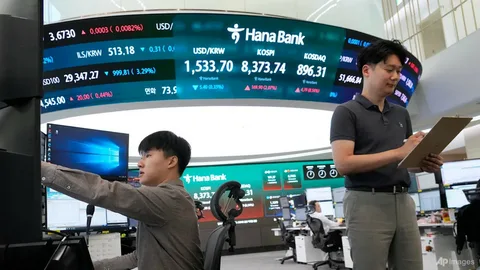

Asian markets opened the week in cautious territory as investors digested Federal Reserve Chair Kevin Warsh’s remarks from the Jackson Hole Economic Policy Symposium, with Japan’s Nikkei and South Korea’s Kospi showing mixed movement in early trade. The Asian stock market today reflects a broader global recalibration around US interest rate expectations heading into September.
Background
Markets across the region spent last week bracing for Warsh’s first major Jackson Hole address since being confirmed as Fed chair in May 2026, succeeding Jerome Powell after one of the most contentious confirmation votes in the central bank’s history. Investors were looking for clarity on whether a September rate cut remains likely given recent signs of labor market softness alongside persistently elevated inflation data.
Ahead of the speech, Asian shares traded choppily, with South Korean stocks leading regional gains while the US dollar held relatively steady. Japan’s core inflation data released the same week came in slightly ahead of estimates, adding another data point for traders trying to gauge the Fed’s next move.
Details
Asian Stock Market Open Today: How Major Indexes Performed
Heading into this week, Japan’s Nikkei 225 closed Friday’s session 0.30% lower at 66,016.36, giving back some of its earlier weekly gains as global bond yields rebounded. South Korea’s Kospi bucked the regional softness, rising 0.88% to close at 6,912.95, supported by continued strength in semiconductor names.
Australia’s benchmark S&P/ASX 200 slipped 0.27% to 9,058.90, while Hong Kong’s Hang Seng Index traded higher in the final hour of Friday’s session. Mainland China’s CSI 300 also posted modest gains, reflecting a broadly mixed but stable tone across the region heading into this week’s trading.
Why the Asian Stock Market Index Is Watching the Fed Closely
The rebound in global bond yields ahead of Warsh’s speech reflected growing uncertainty about the pace of future rate cuts under the new Fed leadership. The US 10-year Treasury yield traded around 4.7% last week, erasing earlier declines, while Japan’s own benchmark 10-year yield also moved higher, a dynamic that tends to weigh on Asian equities given the region’s sensitivity to US monetary policy shifts.
Commonwealth Bank of Australia currency strategist Carol Kong noted ahead of the speech that markets were “on edge” given how much weight investors were placing on any hints about a September policy move, a sentiment that has carried into this week’s trading as analysts parse Warsh’s comments for further clues.
Asian Stock Market Predictions for the Week Ahead
Strategists remain divided on the near-term outlook. Some analysts expect continued choppiness as markets fully price in Warsh’s policy signals, particularly given his history as a vocal critic of the Fed’s previous approach to monetary policy under Powell. Others point to resilient corporate earnings across Japan and South Korea, particularly in the technology and semiconductor sectors, as a reason for cautious optimism heading into September.
Broader 2026 outlooks from regional strategists have pointed to continued strength in technology and consumer-focused Asian equities, with some price targets for indexes like the Hang Seng suggesting room for further gains later this year, assuming global monetary policy conditions remain broadly supportive.
Quotes
Carol Kong, an economist and currency strategist at Commonwealth Bank of Australia, said ahead of Warsh’s address that markets were on edge given the significance investors were placing on the Jackson Hole speech for signals about the Fed’s next moves on interest rates.
Reuters market reporting noted that Korean stocks led gains in Asia in the run-up to the speech, with the dollar holding steady as traders positioned cautiously rather than making major directional bets before Warsh’s remarks were delivered.
Analysts covering Japan’s equity market have pointed to the country’s technology and industrial exporters as key swing factors for the Nikkei’s near-term direction, given their sensitivity to both currency movements and US demand conditions.
Impact
The tone set by this week’s Asian stock market open carries implications well beyond the region itself. Moves in Japanese and South Korean equities often serve as an early signal for how global markets may react once European and US trading sessions begin, particularly during periods of heightened uncertainty around Fed policy.
For investors specifically tracking the Asian stock market index live today, the divergence between Japan’s more cautious tone and South Korea’s tech-driven strength shows just how unevenly global rate uncertainty is being absorbed across different economies and sectors within the region.
The broader impact also extends to currency markets, where a steadier dollar following the Jackson Hole speech has implications for emerging Asian economies that carry significant dollar-denominated debt, making Fed policy signals a closely watched variable well beyond Wall Street itself.
Conclusion
With Warsh’s Jackson Hole remarks now fully in the market’s hands, attention turns to how Asian indexes digest the message over the coming sessions, and whether today’s mixed, cautious tone gives way to clearer direction. Investors will be watching upcoming US economic data alongside regional corporate earnings for further clues on where markets head next.
Frequently Asked Questions
Why are Asian markets falling?
Asian markets have shown mixed, sometimes weaker performance recently largely due to uncertainty surrounding US Federal Reserve policy under new chair Kevin Warsh, along with a rebound in global bond yields that tends to make equities relatively less attractive to investors. Specific factors have also included concerns about the pace of future interest rate cuts, elevated oil prices tied to geopolitical tensions, and cautious investor positioning ahead of major economic data releases and central bank speeches. It’s worth noting that “falling” isn’t uniform across the region, since different Asian markets, such as Japan’s Nikkei versus South Korea’s Kospi, have often moved in opposite directions depending on their specific sector exposures.
Who owns 90% of the stock market today?
Ownership of stock markets varies significantly by country, but in the United States, research has repeatedly shown that the wealthiest households hold a disproportionate share of total stock market wealth, with various studies estimating that the top 10% of households by wealth own somewhere around 80-93% of directly and indirectly held stock market value, depending on the methodology and year measured. This concentration reflects broader wealth inequality trends rather than a literal, fixed percentage, and figures can shift over time as markets rise and fall and as retirement account participation among middle-income households changes.
Which country is No. 1 in the stock market?
By total market capitalization, the United States remains the world’s largest stock market by a wide margin, home to the New York Stock Exchange and Nasdaq, which together list many of the world’s most valuable companies. China holds the second-largest position globally through its Shanghai and Shenzhen exchanges, followed by Japan’s Tokyo Stock Exchange as a significant third player, particularly within the Asian stock market landscape. Rankings can shift somewhat based on whether measurements use total market capitalization, trading volume, or number of listed companies, but the US has consistently held the top position by capitalization for decades.