

What is the religious and political messaging behind Khamenei’s funeral?
The Islamic Republic is leaning into religious imagery to hone its political messaging locally and across the region.
Iran’s state funeral for Supreme Leader Ayatollah Ali Khamenei has become more than a national mourning ceremony, serving as a carefully choreographed display of religious devotion and political resilience as the Islamic Republic seeks to reinforce its authority at home and project influence across the Middle East.
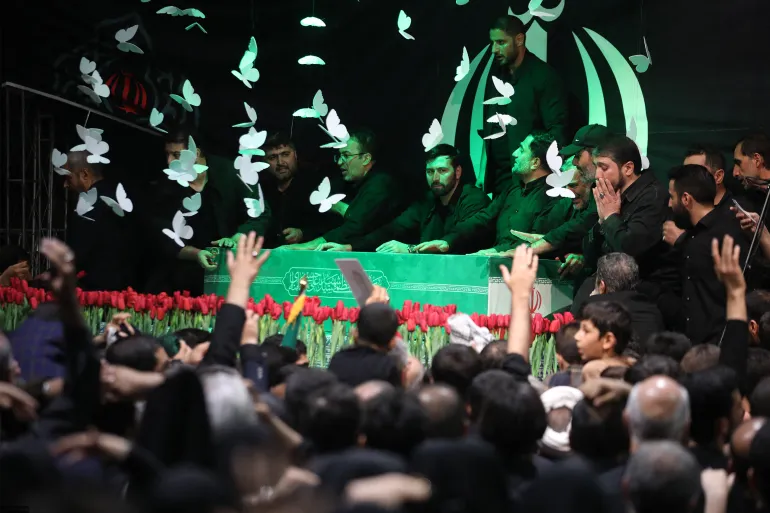
The week-long ceremonies, held in Tehran before continuing through major Shiite religious centres, have drawn hundreds of thousands of mourners, senior clerics, military commanders and foreign delegations from across the region. The funeral has been presented by Iranian authorities as both a religious obligation and a demonstration of national unity following months of conflict and political uncertainty.
Throughout the ceremonies, officials have relied heavily on Shiite religious imagery associated with martyrdom, sacrifice and resistance. Red flags, black mourning banners, Quran recitations and religious processions have been combined with revolutionary slogans to portray Khamenei as a martyr whose legacy should inspire continued resistance against external adversaries. The symbolism closely mirrors ceremonies previously held for prominent Iranian figures such as military commander Qassem Soleimani.
Political analysts say the messaging is aimed at reinforcing the Islamic Republic’s ideological foundations while strengthening public support for the country’s leadership during a sensitive transition period. By linking religious rituals with state institutions, Tehran seeks to emphasise that its political legitimacy remains rooted in the principles of the 1979 Islamic Revolution.
The funeral has also carried a strong regional message. Delegations from allied governments and organisations attended the ceremonies, while Iranian leaders highlighted themes of resistance, solidarity and support for groups aligned with Tehran across the Middle East. Officials described the gathering as evidence that Iran continues to play a central role in the so-called “Axis of Resistance” despite recent military and diplomatic challenges.
Domestically, the large-scale ceremonies are intended to demonstrate stability following Khamenei’s death and reassure supporters that state institutions remain firmly in control. Authorities have organised extensive security measures and nationwide commemorations while state media continues to portray the public turnout as a sign of enduring loyalty to the Islamic Republic.
Observers note that while supporters view the funeral as a powerful expression of faith and national unity, critics argue it also functions as a political event designed to consolidate authority during a period of uncertainty. Regardless of perspective, the funeral has underscored how religious symbolism remains central to Iran’s political identity and its messaging both within the country and across the wider region.