

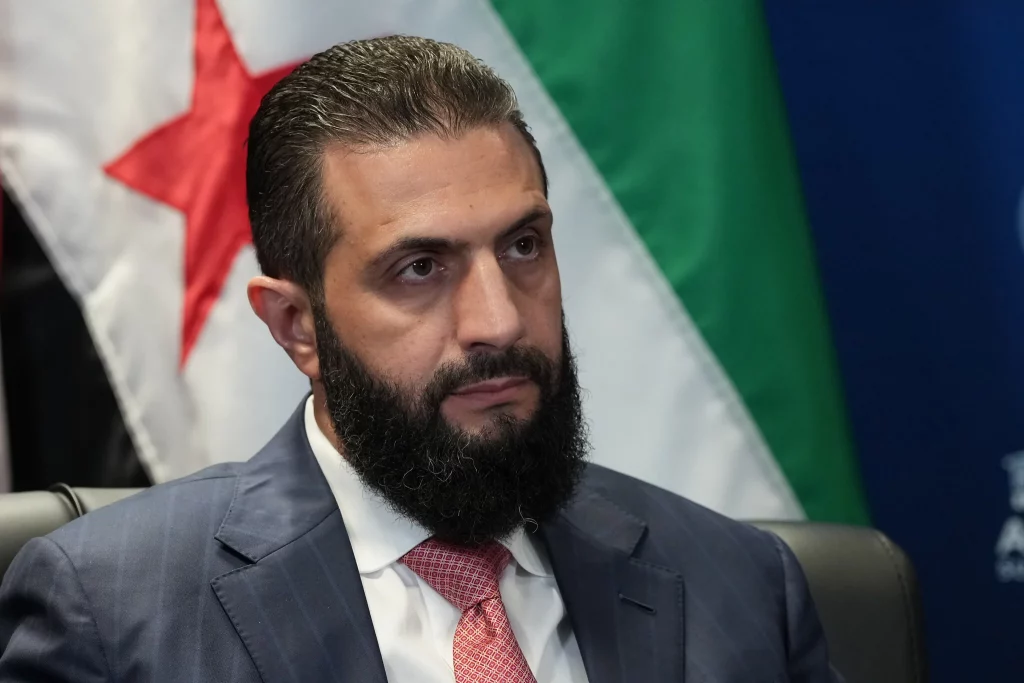

Syrian President Ahmed al-Sharaa has revealed that his government is actively working toward a Syria Israel security agreement, describing the initiative as a potential first step toward achieving broader regional peace without compromising Syria’s territorial rights.
In an exclusive interview with Al Jazeera’s Al Muqabala programme, al-Sharaa said Damascus is engaged in discussions with the participation of several countries to establish a security arrangement with Israel. The full interview is scheduled to air at 19:00 GMT.
The Syrian president expressed hope that the proposed Syria Israel security agreement could serve as a gateway to a comprehensive peace process, while stressing that Damascus would never relinquish its claim to the occupied Golan Heights.
“We are seeking stability through diplomacy, but Syria’s sovereign rights over the occupied Golan Heights remain unchanged,” al-Sharaa said.
Syria Seeks Stability Through Diplomacy
Al-Sharaa emphasized that Syria is deliberately avoiding direct military confrontation with Israel despite repeated Israeli airstrikes and military incursions in southern Syria since his administration assumed power in December 2024 following the collapse of Bashar al-Assad’s government.
According to the Syrian leader, a carefully negotiated Syria Israel security agreement could reduce tensions, improve regional stability, and create conditions for broader diplomatic engagement.
He noted that the talks are being supported by several international parties, although he did not disclose which countries are participating in the mediation efforts.
Despite discussing security coordination, al-Sharaa firmly rejected any suggestion that Syria would abandon its long-standing claim to the Golan Heights.
Israel has occupied the strategic territory since the 1973 Arab-Israeli conflict, and Syria continues to regard the area as occupied land under international law.
The Syrian president insisted that any future understanding with Israel would not affect Syria’s legal and political position regarding the disputed territory.
During the interview, al-Sharaa also addressed growing speculation regarding Lebanon, dismissing reports that Syria was considering military intervention in its neighboring country.
He said Damascus has no intention of deploying forces into Lebanon and is instead working with Lebanese authorities to help the country navigate its ongoing political, economic, and security challenges.
The president reiterated Syria’s support for Lebanon’s sovereignty and stressed that decisions concerning war and peace should remain exclusively under the authority of the Lebanese state.
Al-Sharaa also voiced support for strengthening Lebanon’s state institutions by ensuring that all weapons and security decisions remain under government control.
His remarks come as Lebanon continues to face tensions along its southern border, where Israeli forces remain present in several disputed areas following months of clashes with Hezbollah.
The Syrian leader said regional stability requires stronger state institutions, dialogue, and political solutions rather than military escalation.
The latest comments reflect a notable shift in Syria’s diplomatic approach as Damascus seeks greater regional engagement after years of conflict.
While significant differences remain between Syria and Israel, al-Sharaa suggested that confidence-building measures and security arrangements could eventually contribute to a wider peace process across the Middle East.
Observers say any progress toward a Syria Israel security agreement would represent one of the most significant diplomatic developments in the region in recent years, although major political and territorial disputes remain unresolved.