
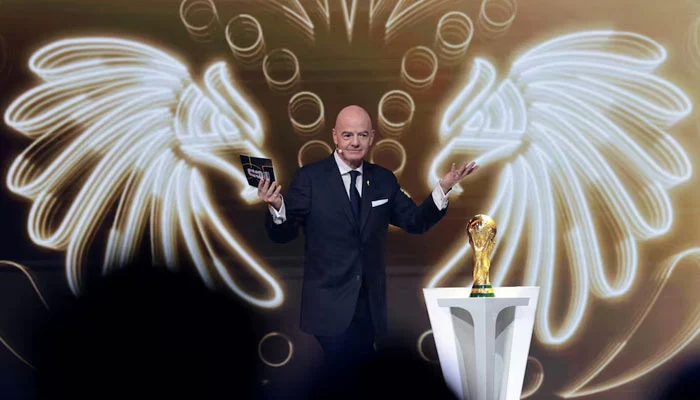

ZURICH: FIFA President Gianni Infantino is facing one of the most serious challenges of his decade-long leadership after growing opposition from major football confederations cast doubt over his bid for a fourth term in office.
The pressure follows the collapse of a controversial proposal to bring private equity investment into the FIFA World Cup, a move that prompted strong resistance from several leading football associations and regional governing bodies.
European football governing body UEFA and the Confederation of North, Central America and Caribbean Association Football (CONCACAF) have publicly expressed a lack of confidence in Infantino’s leadership.
Despite the criticism, Infantino has confirmed that he intends to seek a fourth term as FIFA president at the organization’s Congress scheduled for April next year.
However, analysts believe mounting pressure from influential football nations could intensify well before the election takes place.
The Football Association of Wales has become the first national football federation to officially withdraw its support for Infantino.
Meanwhile, UEFA has confirmed that it has formally written to the FIFA president, informing him that it is considering legal action over the proposed private equity investment plan.
The proposal sparked widespread concern among European football authorities, who argued that it could fundamentally alter the governance and commercial structure of the FIFA World Cup.
Under FIFA’s statutes, an Extraordinary Congress can be called if 20 percent of FIFA’s 211 member associations submit a written request.
Such a meeting would have to be convened within three months, potentially opening the door for rival candidates to challenge Infantino’s leadership before the scheduled presidential election.
With 55 member associations, UEFA alone has enough votes to trigger an Extraordinary Congress if all of its members support the move.
Although Europe remains one of football’s most influential regions, every FIFA member association has one equal vote, regardless of the country’s footballing success, financial resources, or international standing.
This system could work in Infantino’s favour.
Rather than relying solely on support from traditional football powers such as England, France, Germany, Spain, or Italy, the FIFA president may depend on backing from smaller football nations across Asia, Africa, Oceania, and the Caribbean.
Countries with developing football programs often rely heavily on FIFA funding to improve infrastructure, organize competitions, and support grassroots development.
Under FIFA’s current development programme, each member association can receive up to $3 million for football development projects during the 2023–2026 World Cup cycle, representing a significant increase from the previous funding period.
While such funding represents only a small portion of the budgets of major football nations, it is considered crucial for smaller associations seeking to expand the sport and improve facilities.
Observers note that these development programmes have strengthened Infantino’s relationships with many emerging football nations during his presidency.
The controversy surrounding the proposed World Cup investment plan has created the biggest political challenge of Infantino’s tenure.
Although he still enjoys support from many smaller member associations, opposition from powerful football organizations such as UEFA and CONCACAF has raised questions about the future of his leadership.
Whether the growing criticism results in an Extraordinary Congress or simply shapes next year’s presidential election, the coming months are expected to be among the most significant in FIFA’s recent history as the governing body navigates a period of internal political uncertainty.