

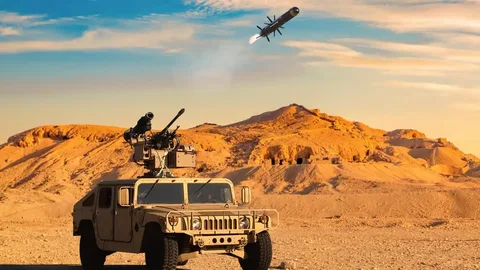

India has signed a government-to-government agreement with the United States to procure the FGM-148 Javelin anti-tank guided missile system for the Indian Army, marking one of the most significant defense deals between the two countries this year. The agreement was confirmed by the US Mission in India on Friday, deepening a defense partnership Washington has described as growing “deeper, more capable, and more consequential.”
Background
The Indian Army signed a Letter of Offer and Acceptance for the Javelin system through the US Foreign Military Sales process, the standard government-to-government channel the United States uses for major weapons exports. The move follows a formal approval process that began last November, when the US State Department cleared the possible sale through its Defense Security Cooperation Agency.
This deal builds on a broader 10-year Major Defense Partnership framework signed between India and the United States, aimed at deepening interoperability across land, sea, air, space, and cyberspace. India has steadily expanded its inventory of American-made platforms in recent years, including Apache and Chinook helicopters, C-17 and C-130J transport aircraft, P-8I maritime patrol aircraft, and M777 howitzers.
Details
India to Buy Javelin Missiles: Price and Package Details
The State Department had estimated in November that the Javelin missile system and related equipment could cost approximately $45.7 million when it first approved the possible sale. According to the DSCA notification, India requested 100 FGM-148 Javelin missiles, one fly-to-buy round, and 25 command-launch units, along with training aids, simulation rounds, spare parts, and full lifecycle support.
The same package of approvals also cleared 216 Excalibur tactical artillery projectiles for an estimated $47.1 million, bringing the combined value of this round of US arms sales to India to roughly $93 million. A defense source confirmed the Javelin agreement had been signed but declined to comment publicly on the final procurement cost.
What Is the FGM-148 Javelin Missile System?
The Javelin is a portable, medium-range, fire-and-forget anti-tank guided missile system designed for use against armored vehicles and fortified positions. The system consists of two main components: a reusable Lightweight Command Launch Unit and a missile round housed in a disposable launch-tube assembly, allowing infantry soldiers to carry and fire the weapon without a vehicle-mounted platform.
The Javelin missile range extends up to roughly 5 kilometers, according to Indian defense reporting, giving ground troops the ability to strike armored targets well beyond the effective range of most enemy tank guns. The system uses an automatic guidance mechanism that tracks its target after launch, letting the operator take cover or reposition immediately after firing rather than remaining exposed.
The Javelin is manufactured by the Javelin Joint Venture, a partnership between US defense contractors RTX and Lockheed Martin, and is already used by the US Army, US Marine Corps, and numerous allied nations around the world.
Beyond Javelin: Other Weapons Systems on India’s Radar
The Javelin deal arrives alongside a broader pattern of defense procurement activity for India. Israeli firm Rafael has separately offered India its Sky Sting missile, a long-range beyond-visual-range air-to-air missile, or BVRAAM, for potential integration onto the Indian Air Force’s Su-30MKI and Tejas Mk1A fighter fleets, as India looks to close a capability gap in long-range aerial engagement.
On the air defense side, India continues receiving deliveries under its existing 2018 agreement with Russia for the S-400 Triumf system, a long-range surface-to-air platform. India has already inducted four of the five S-400 squadrons ordered under that roughly $5.43 billion deal, with the fifth and final squadron expected by late 2026 or early 2027.
India also continues to field the shoulder-fired Stinger missile in parts of its air defense inventory, a US-origin man-portable system used against low-flying aircraft, helicopters, and drones, though it operates independently of the current Javelin negotiations.
Quotes
US Ambassador to India Sergio Gor described the significance of the Javelin agreement directly, saying, “This agreement reflects a defense partnership that is growing deeper, more capable, and more consequential.” He added that the deal “demonstrates the depth of US support for the Indian Army and creates new opportunities for our defense industries to work together.”
An official American readout following the signing stated that the milestone “further strengthens the US-India Major Defense Partnership” and “opens discussions on mutually beneficial co-production and additional opportunities to strengthen the defense industrial bases of both countries.”
Gor also referenced remarks made by US Secretary of War Pete Hegseth at the May 2026 Shangri-La Dialogue, saying the latest Javelin development would further reinforce the broader trajectory of US-India defense ties discussed at that forum.
Impact
The deal carries direct significance for India’s ground forces, giving Indian Army infantry units a proven, combat-tested anti-tank capability already fielded by dozens of allied militaries worldwide. It also opens the door to potential co-production arrangements, which could eventually allow India to manufacture Javelin components domestically under its broader defense self-reliance goals.
Regionally, the agreement adds another layer to India’s rapidly diversifying weapons procurement strategy, which now spans American, Israeli, Russian, and domestically produced systems simultaneously. New Delhi appears intent on cutting its dependence on any single supplier while modernizing capabilities across ground, air, and missile defense at the same time.
For the broader US-India relationship, the Javelin agreement signals continued momentum in defense trade even as both countries work through separate discussions on arms transfer regulations and technology-sharing frameworks, including reviews of the International Traffic in Arms Regulations governing US weapons exports.
Conclusion
With the Letter of Offer and Acceptance now signed, attention turns to how quickly the Javelin systems will be delivered and whether the agreement leads to the co-production arrangements both governments have floated. Combined with ongoing S-400 deliveries from Russia and the pending Rafael Sky Sting evaluation, India’s defense modernization program looks set to stay one of the most closely watched procurement stories in the region through the rest of the year.
Frequently Asked Questions
How many S-400 missiles is India buying?
India signed a $5.43 billion deal with Russia in October 2018 for five full squadrons of the S-400 Triumf air defense system, rather than a specific missile count, since each squadron includes multiple launchers, radars, and missile types. As of mid-2026, India has received four of the five squadrons, with the first becoming operational in December 2021 near the Punjab sector and the fourth arriving around May 2026. The fifth and final squadron is expected to complete the contract by late 2026 or early 2027, giving India a full layered air defense shield capable of engaging aircraft, drones, cruise missiles, and ballistic missiles at ranges up to around 400 kilometers.
How much do Javelin missiles cost?
The US State Department estimated in its formal approval notice that India’s Javelin package, covering 100 missiles, 25 command-launch units, training equipment, and lifecycle support, could cost approximately $45.7 million in total. This figure represents the full government-to-government package rather than a simple per-unit missile price, since the cost includes launch units, spare parts, simulation rounds, and long-term maintenance support alongside the missiles themselves. The exact final procurement value has not been officially disclosed by Indian defense officials following the signing.
Which country supplies Javelin missiles?
The Javelin anti-tank guided missile system is manufactured in the United States by the Javelin Joint Venture, a partnership between defense contractors RTX and Lockheed Martin. The system is exported to allied nations through the US government’s Foreign Military Sales process, the same channel used for India’s recent procurement agreement, and is currently in service with the US Army, US Marine Corps, and numerous international militaries beyond just the United States itself.