

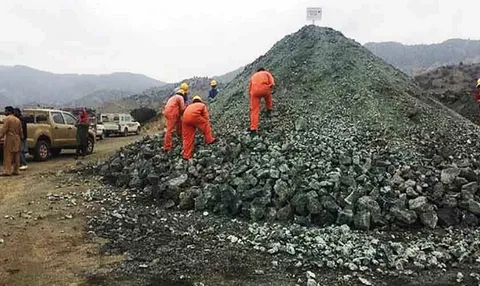

Pakistan’s mineral wealth keeps making headlines, most recently when Planning Minister Ahsan Iqbal put a figure on it: more than $7 trillion. The claim reopened a familiar conversation about what Pakistan actually has underground, where it sits, and why so little of it has turned into real economic output so far.
Background: A Country Sitting on Resources It Hasn’t Used
Iqbal made the $7 trillion claim during a conversation with the Asia Society Policy Institute in New York in late August 2026, framing Pakistan’s mineral endowment as a potential turning point for the economy. He didn’t explain exactly how the figure was calculated, and independent estimates of Pakistan’s mineral wealth have varied considerably over the years, which is part of why the number drew scrutiny rather than applause.
What isn’t in dispute is that Pakistan has genuine geological potential. The Geological Survey of Pakistan has documented around 92 known minerals nationwide, of which roughly 52 are currently mined commercially. That’s a meaningful base, even if the dollar value attached to it depends on who’s doing the counting.
Details: Where Pakistan’s Minerals Actually Are
Balochistan carries most of the weight here. The province covers about 55 percent of Pakistan’s mineral-bearing outcrop area and holds more than half of the country’s discovered metallic and non-metallic deposits, which is why it’s often described as Pakistan’s mineral heartland.
The best-known projects are Reko Diq and Saindak, both copper-gold deposits in Chagai district, discovered back in the 1970s. Reko Diq in particular is considered one of the largest undeveloped copper-gold mines in the world, and it’s the project most often cited whenever officials talk about the country’s mining potential.
Beyond copper and gold, Balochistan produces chromite, coal, lead-zinc, and barite, and together these nine or so minerals account for roughly 95 percent of everything the province extracts. Chromite mining in Muslim Bagh actually dates back to 1903, making it one of the oldest continuously worked mineral sites in the country.
Khyber Pakhtunkhwa contributes chromite and marble from areas like Kohistan and Zhob, along with one of Pakistan’s few emerald deposits. Punjab and Sindh hold their own share too: iron ore around Chiniot and Kalabagh, and the Thar coalfields in Sindh, which rank among the largest coal reserves anywhere in the world. Uranium in small quantities has also been found near Dera Ghazi Khan.
For anyone building a quick reference list, ten minerals commonly cited as found across Pakistan are copper, gold, chromite, coal, iron ore, lead, zinc, barite, marble, and rock salt, with the Khewra Salt Mine in Punjab among the largest salt deposits on the planet.
Quotes and Official Positions
Iqbal told his New York audience that exploiting this mineral wealth would require heavy upfront investment and long project timelines, and that Pakistan’s “volatile political climate” was the main thing keeping international resource developers away. He pointed to steps already taken to attract foreign partners, including a memorandum of understanding with US Strategic Metals and ongoing talks around EXIM financing.
Dawn’s editorial board pushed back on that framing in its response to the minister’s comments. It argued security, not politics alone, is the real obstacle, pointing out that Pakistan’s mineral wealth is concentrated precisely in Balochistan and KP, the two provinces where instability has kept foreign capital away the longest. The paper also noted that mining currently contributes only a small share of national GDP, despite the scale of what’s technically available underground.
Impact: Why the Gap Between Wealth and Output Matters
There’s a real cost to leaving this potential idle. Both the US and China have already signaled serious interest in Pakistan’s mineral sector, from American financing tied to Reko Diq to Chinese investment in Saindak, but neither relationship has yet translated into large-scale value-added industry inside Pakistan. Much of what does get extracted is shipped abroad as raw material rather than processed locally, which limits the number of jobs and the tax revenue any given ton of ore actually generates for the country.
That pattern dig it up, ship it out, process it somewhere else shows up in a lot of resource-rich developing economies, and it’s exactly what critics warn could turn Pakistan’s mineral wealth into a “resource curse” instead of a real growth driver.
Conclusion: What Would Need to Change
Most analysts land on the same short list: better security in Balochistan and KP, policy continuity so investors aren’t spooked by shifting rules, and a real push toward local processing instead of raw export. Whether the $7 trillion figure survives closer scrutiny or not, the resources underneath it are real. What’s missing is the stable ground needed to turn them into something the economy can actually count on.
FAQs
What are the 7 most important minerals in Pakistan?
Based on their economic weight and export potential, the minerals most often highlighted are copper, gold, chromite, coal, iron ore, lead-zinc, and barite. Copper and gold matter most because of Reko Diq and Saindak, two of the country’s flagship projects, while Thar’s coal reserves are considered strategically important for domestic energy production. Chromite has industrial significance for stainless steel manufacturing, and barite is widely used in oil and gas drilling operations, which keeps steady demand for it even without major new discoveries.
Which province of Pakistan is rich in minerals?
Balochistan is by a clear margin the most mineral-rich province in the country. It holds more than half of Pakistan’s discovered mineral deposits and around 50 different minerals have been identified there, with 39 currently under commercial extraction. Khyber Pakhtunkhwa comes next, known for chromite, marble, and a rare emerald deposit, while Punjab and Sindh contribute meaningfully through iron ore, rock salt, and the Thar coalfields, even though neither matches Balochistan’s overall scale.
What country is richest in minerals?
There’s no single agreed answer, since it depends on whether you’re measuring proven reserves, total estimated value, or diversity of minerals present. The Democratic Republic of Congo is frequently cited as having the world’s largest known mineral wealth, largely due to its cobalt and coltan reserves, while Russia, Australia, and South Africa also regularly appear near the top of most rankings. Pakistan’s own claimed $7 trillion figure would place it competitively on paper, but unlike the countries usually named richest, Pakistan hasn’t yet built the extraction and processing infrastructure to convert that potential into comparable output.