

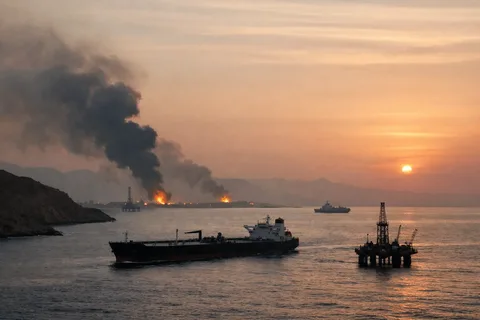

Oil prices rose again on Wednesday, extending a sharp surge from the previous session, after the United States and Iran exchanged fresh military strikes overnight. The renewed exchange has revived fears of a major supply disruption in the Middle East, pushing both benchmark crudes higher for a second straight day.
Summary: Where Prices Stand Right Now
Brent crude futures climbed $1.03, or 1.1%, to reach $95.68 a barrel by 0605 GMT on Wednesday. US West Texas Intermediate crude rose 61 cents, or 0.7%, to $90.83. Both benchmarks had already jumped more than $4 apiece on Tuesday, Brent’s biggest one-day gain since July 24 and WTI’s largest since July 23, meaning the market has now strung together two consecutive sessions of sharp gains.
Background: A Conflict That Won’t Stay Contained
This isn’t a fresh shock out of nowhere. The US and Iran have been locked in an escalating conflict since early this year, one that briefly sent oil above $100 a barrel back in March for the first time since 2022, before prices eased somewhat as fighting settled into an uneasy stalemate. What changed overnight is that the stalemate broke. The US carried out a fresh round of airstrikes against targets inside Iran, and Tehran responded within hours, marking the most serious flare-up between the two countries in weeks.
The reason markets react so strongly to this particular conflict comes down to geography. Iran sits directly on the Strait of Hormuz, the narrow shipping lane that has historically carried around a fifth of the world’s oil supply. Iran has effectively closed the strait to commercial shipping during the standoff, and Wednesday’s strikes raise the odds that whatever limited traffic remains could be squeezed further.
Details: What Happened Overnight
According to reporting on the strikes, the US launched its attacks against Iranian targets overnight, and Iran’s Islamic Revolutionary Guard Corps responded by claiming it had targeted a US military base in Jordan with ballistic missiles, alleging significant American casualties. Jordan’s military said its air defences intercepted 10 of 13 missiles that entered its airspace. Iranian state media separately reported a large drone attack on a US base in Bahrain, while Kuwait said its own forces were responding to hostile drone activity in the area.
Two US officials said no American casualties had been confirmed from the attacks as of Wednesday morning, though the situation remained fluid. The scale of the exchange, spanning strikes and counter-strikes across Jordan, Bahrain, and Kuwait alongside the core US-Iran confrontation, is what’s driving traders to price in a higher risk premium rather than treating this as an isolated incident.
Separately, data from the American Petroleum Institute showed US crude inventories fell by 2.6 million barrels in the week ending August 28, while distillate stocks, which include diesel and heating oil, dropped by 265,000 barrels. Tightening inventories on top of the supply-disruption fears added further support to prices heading into Wednesday’s session.
Quotes: What Analysts Are Saying
“Developments in recent days brought risks to regional oil supplies back into focus,” ING analysts wrote in a client note reacting to the overnight escalation. They added that oil has continued flowing through the Strait of Hormuz despite the broader standoff between Washington and Tehran, but that rising tensions clearly put those crossings at greater risk going forward.
That view sums up the market’s mood pretty well right now: nobody’s saying the strait has actually shut down, but the direction things are heading is enough to keep traders bidding prices higher, session after session.
Impact: What This Means Beyond the Trading Floor
A sustained rise in Brent and WTI doesn’t stay contained to futures markets for long. Higher crude prices typically feed through to fuel costs at the pump, airline ticket prices, and shipping costs within weeks, which is why a conflict thousands of miles from most consumers still shows up in household budgets. For oil-importing countries, including Pakistan, a prolonged run-up in international crude prices tends to pressure the currency and add strain to fuel subsidy or pricing decisions made by the government, even though that’s a separate process from what’s driving Brent and WTI on the open market today.
Globally, the bigger concern is how far this escalation goes. Since roughly a fifth of the world’s seaborne oil has historically passed through the Strait of Hormuz, any move that meaningfully disrupts that flow would ripple through energy markets well beyond the Middle East, affecting everything from European gas prices to shipping insurance costs.
Conclusion: What to Watch Next
For now, traders seem to be treating this as an escalation worth watching rather than proof of a full supply shock, given that oil has kept moving through Hormuz despite the tension. But two straight days of sharp gains say they’re not ruling out a worse outcome either. Whether prices keep climbing likely depends on what happens in the next 48 to 72 hours: further strikes, any sign of de-escalation talks, or concrete evidence that shipping through the strait is actually being disrupted rather than just threatened. Markets will also be watching for an official reaction from OPEC producers and Gulf states caught in the crossfire.
FAQs
When was oil $140 a barrel?
Oil crude never quite settled at $140, but it came close in the summer of 2008, when both WTI and Brent hit record intraday highs near $147 a barrel amid a combination of surging global demand, a weak US dollar, and tight spare production capacity. Prices collapsed sharply within months as the global financial crisis hit demand, and crude has never returned to that level since, even during the sharpest spikes tied to the Russia-Ukraine war in 2022 or the current US-Iran conflict.
How much did oil prices rise today?
As of Wednesday morning trading, Brent crude was up $1.03, or 1.1%, to $95.68 a barrel, while WTI crude rose 61 cents, or 0.7%, to $90.83. That follows an even sharper move on Tuesday, when both benchmarks jumped more than $4 in a single session, so the two-day gain is considerably larger than Wednesday’s move alone. These figures reflect early trading and will keep shifting through the day as the situation develops.
When was the last time oil was $100 a barrel?
Oil actually crossed back above $100 a barrel as recently as March this year, for the first time since 2022, as the US-Iran conflict escalated and disrupted shipping and production across the Middle East. Brent briefly traded above $101 during that spike before easing back as the fighting settled into a temporary stalemate. Before that, the last sustained period above $100 was in 2022, following Russia’s invasion of Ukraine, when Brent and WTI both traded in triple digits for several months before falling back through the second half of that year.