

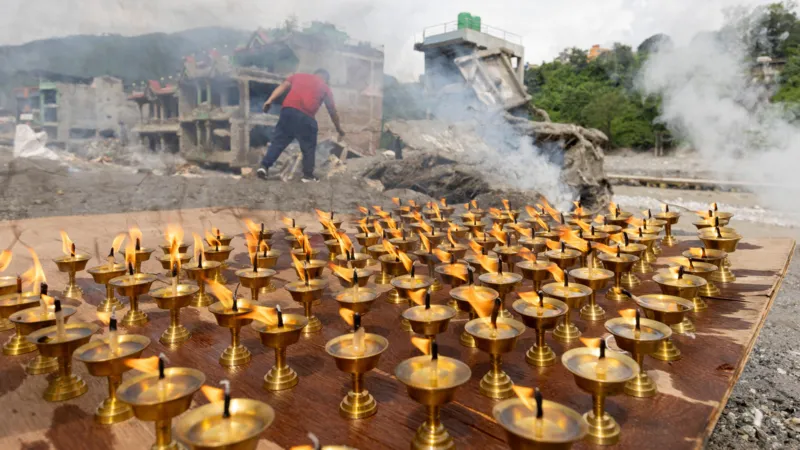

KATHMANDU, September 7, 2026: Nepal observed a national day of mourning on Monday for victims of a devastating flash flood that killed at least 1,287 people, as rescue teams continued searching for more than 5,000 people still missing nearly two weeks after the disaster.
The mourning period coincided with the final day of the traditional 13-day Hindu mourning period. National flags were flown at half-mast, while official commemorations were scaled back as emergency crews remained focused on search and rescue operations.
Candlelight vigils were also planned across the country on Monday evening to honour those who lost their lives.
Phanindra Paudel of Nepal’s National Emergency Operation Centre (NEOC) said the government would not organise formal programmes because rescue and search operations were still underway in the affected areas.
“No government programmes [will be] organised as the rescue and search operation is still going on in the flood-hit areas,” Paudel told Reuters.
Nepalese President Ram Chandra Paudel toured areas devastated by the floods on Monday, according to an aide who spoke to Reuters.
The Home Ministry said government offices and Nepalese diplomatic missions abroad would fly the national flag at half-mast to mark the final day of mourning.
The flash flood swept through villages in a Himalayan valley along the Nepal-Tibet border. The disaster is believed to have been triggered by a glacial collapse, sending a powerful surge of water and debris through populated areas.
At least 1,287 people are confirmed dead, while more than 5,000 remain missing, according to the latest figures cited in the report.
The scale of the disaster has made rescue and recovery operations particularly challenging, with damaged infrastructure and difficult Himalayan terrain complicating efforts to reach affected communities.
Nepal’s army said search operations were continuing at the same intensity as they had since the first day of the disaster.
Army spokesperson Raja Ram Basnet said rescuers were searching for survivors on the ground, from the air and inside tunnels.
“Our focus is on search and rescue at three levels — on ground, by air, and in the tunnels,” Basnet told Agence France-Presse.
“We are making sure that no one is still stranded,” he added.
Rescue teams continue to search areas where there may still be a possibility of finding survivors.
Among the most closely searched locations are tunnels connected to hydropower stations in the disaster-hit region.
Hundreds of hydropower workers are reportedly among those still missing, raising hopes that some could have survived inside the tunnels.
Rescue teams face a difficult race against time as they continue clearing mud and debris and inspecting areas that could contain survivors.
The ongoing operation comes as Nepal marks the final day of its national mourning period, with families and communities across the country remembering those killed in one of the country’s deadliest recent natural disasters.