

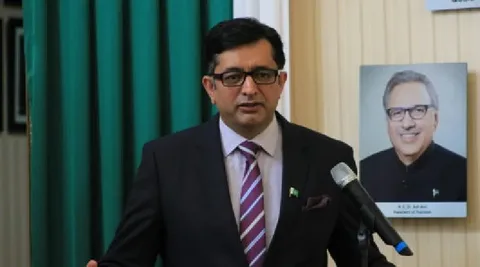

Pakistan’s Foreign Office has once again clarified that the Makkah defence pact signed with Saudi Arabia and Turkiye is purely defensive. Speaking at a weekly briefing on Thursday, the FO spokesperson said there is no plan right now to bring new countries into the arrangement. He added that the three founding members first want to strengthen their own coordination before opening the door to others.
Summary
The Foreign Office spokesperson, Sajjad Haider Khan, told reporters that the Makkah Defence Alliance between Pakistan, Turkiye and Saudi Arabia remains “defensive” in character. He said expansion of the Pakistan Saudi defence pact is “not on the cards” at this stage. According to him, the three states are already holding consultations at various levels within the existing framework.
Background
The Makkah Joint Defence Agreement was signed in Makkah on August 7 by Saudi Crown Prince Mohammed bin Salman, Turkish President Recep Tayyip Erdogan, and Pakistani Prime Minister Shehbaz Sharif. The agreement built on an earlier Strategic Mutual Defence Agreement that Pakistan and Saudi Arabia had signed in September 2025.
The pact states that an armed attack on any one of the three signatories will be treated as an attack on all of them. This kind of language is common in mutual-defence treaties and mirrors the logic used in Article 51 of the UN Charter, which recognises the right of individual and collective self-defence.
The timing mattered too. The Saudi Pakistan defence agreement was signed just as tensions were running high between the US, Israel and Iran. Days later, Yemen’s Houthi movement claimed an attack on Saudi Aramco’s Jazan refinery, which only added to questions about the pact’s scope and how quickly it might be tested.
Details
At Thursday’s briefing, the FO spokesperson said the three countries need to consolidate their own organisation and cooperation before thinking about bringing anyone else in. He added that once that consolidation happens, the agreement will eventually be open to “all countries that share similar stances and perspectives.”
He was careful to note that no formal discussions on expansion are currently taking place. Meetings connected to the pact, he said, will continue to be held in different member countries as part of ongoing coordination. Khan also confirmed that the agreement is already in effect and that Pakistan will meet its obligations under it.
The spokesperson used the briefing to condemn the Houthi strike on the Jazan refinery, describing it as regrettable and expressing solidarity with the Saudi people. He reaffirmed that Pakistan stands behind Saudi Arabia’s sovereignty, security and territorial integrity, and said defence cooperation between the two countries continues on a separate track from the trilateral pact.
Quotes
Deputy Prime Minister and Foreign Minister Ishaq Dar has repeated, more than once, that the pact is “defensive in nature and not directed against any country.” In an earlier message following the signing, Dar said the accord’s purpose was to strengthen collective deterrence against outside aggression and to protect the sovereignty of the member states.
Turkish Foreign Minister Hakan Fidan struck a similar note when he said the pact was not aimed at Iran or at any other country. He did say, however, that President Erdogan would like to see the framework grow over time, and named Egypt as one country that could potentially join once certain technical questions are worked out.
Impact
For Pakistan, the pact adds another layer to a defence relationship with Saudi Arabia that already runs deep, from decades of military training exchanges to Pakistani personnel serving in the Kingdom. Formalising a mutual-defence clause with two regional powers gives Islamabad more diplomatic weight at a time when tensions across the Middle East remain unsettled.
For Saudi Arabia, the timing lines up with a broader push to diversify its security partnerships beyond its traditional reliance on the United States. Bringing Turkiye and Pakistan into a formal defence framework signals that Riyadh wants more than one option on the table if regional threats escalate further.
The wider region is watching closely too. Gulf capitals, Iran, and Western governments are all trying to work out what the pact actually commits its members to in a real crisis, and whether “defensive” is a promise that will hold if tested. That uncertainty is likely to keep driving analysis and commentary in the weeks ahead.
Conclusion
For now, Pakistan’s position is consistent: the Makkah defence pact is a shield, not a weapon aimed at anyone. Whether that stays true depends a lot on how the region evolves over the next few months, particularly around Iran and Yemen. Expansion talk with countries like Egypt suggests the alliance could grow, but Islamabad and its partners appear content to move carefully rather than rush that process.
FAQs
What is the Saudi-Pakistan defence pact?
The Saudi-Pakistan defence pact refers to the security arrangement between the two countries that was formalised through the Strategic Mutual Defence Agreement signed in September 2025 and later expanded into the trilateral Makkah Joint Defence Agreement in August 2026, which also includes Turkiye. Under this framework, an armed attack against Pakistan, Saudi Arabia, or Turkiye would be treated as an attack against all three states, obligating them to respond collectively. Pakistani officials have repeatedly stressed that the agreement is defensive and does not target any specific country, and that its core aim is to strengthen deterrence and protect the sovereignty of each member.
Is Saudi Arabia an ally of Pakistan?
Yes, Saudi Arabia has long been considered one of Pakistan’s closest allies, with a relationship built on decades of military, economic and religious ties. The Kingdom has historically supported Pakistan during periods of economic difficulty, and the two countries have maintained close defence cooperation, including joint military training and Pakistani military advisers stationed in Saudi Arabia. The recent Makkah defence pact and the earlier bilateral mutual-defence agreement have further deepened this alliance by adding a formal collective-security commitment on top of the existing relationship.
Is the Pakistan Army going to Saudi Arabia?
Pakistan has for many years maintained a military presence in Saudi Arabia in the form of training missions, advisory personnel and cooperation programmes, and officials have said this defence cooperation will continue under the new arrangement. The Foreign Office has confirmed that Pakistan will fulfil its role in line with the requirements of the Makkah pact, though it has not announced any large-scale new troop deployment tied specifically to this agreement. Any future movement of forces would depend on how the alliance evolves and on decisions made jointly by the three member states.