

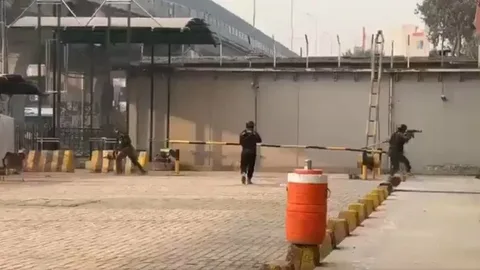

Militants have started using commercially available drones, fitted with explosives, to strike Peshawar police installations from a distance while staying out of sight themselves. At least two such drone attacks have been reported in the city over the past few weeks, according to police sources cited by The Express Tribune.
The shift marks a meaningful change in how militant groups are operating in Khyber Pakhtunkhwa, moving away from direct assaults toward remote strikes that are harder to predict and even harder to stop in real time.
Background: A Province Already Under Strain
Peshawar around 34 police stations and 84 check posts scattered across the city, many of them in areas that are difficult to reinforce quickly. Equipping every single location with anti-drone guns, thermal cameras, and night-vision systems isn’t realistic given current resources, which leaves gaps that militants appear to be exploiting.
This isn’t an isolated Peshawar problem either. Police records show militant groups have increasingly turned to drones across Malakand, Lakki Marwat, Bannu, Karak, Tank, Hangu, and Bajaur as well, alongside Peshawar itself. Between January and July this year, police recorded more than 250 attempted drone attacks across these districts, a number that signals just how widespread the tactic has become in a relatively short span of time.
The broader toll has been severe. Separate police data covering the same period shows 156 police personnel were killed in militant attacks across Khyber Pakhtunkhwa and its tribal districts, with violence concentrated most heavily in Hangu, Bannu, Karak, Tank, Lakki Marwat, Dera Ismail Khan, and Khyber.
What’s Actually Changed on the Ground
Drones give attackers something conventional assaults never could: distance, and a way to stay hidden. A police official deployed at a sensitive check post in Mattani, speaking to The Express Tribune, said a drone can appear overhead almost without warning and drop explosives before anyone on the ground has a real chance to react.
That’s a fundamentally different threat than the ones police stations were built to handle. Conventional attacks, however dangerous, at least allowed personnel to see who they were dealing with and respond directly. A drone strike removes that entirely, and the official noted it’s made isolated posts especially vulnerable, since backup often can’t arrive in time to matter.
Militants have also paired drones with thermal imaging technology, which lets them scout police positions at night or through poor visibility, something that was far harder to pull off before this equipment became cheap and widely available. Much of it is sold openly at electronics shops across the province, according to reporting from AFP, which found drones for sale in roughly a dozen stores inside Peshawar shopping malls alone.
Quotes From Officials
Senior Superintendent of Police (SSP) Operations Peshawar, Farhan Khan, confirmed that detailed security instructions have gone out to every police station in the city. “Police stations are implementing SOPs at their own level to counter threats from drones and other aerial surveillance devices,” he told The Express Tribune.
Khan acknowledged the equipment gap directly, noting that the sheer number of check posts makes it impractical to station heavy anti-drone hardware everywhere. “Wherever there is a need, police use night vision, thermal technology and anti-drone systems. These technologies have already proved useful for Peshawar Police,” he said, framing the current approach as targeted deployment rather than blanket coverage.
Khyber Pakhtunkhwa’s police chief, Inspector General Zulfiqar Hameed, has spoken more broadly about how quickly the threat has evolved. He’s previously described the force as standing firm despite limited resources, while pushing for more advanced technology and better protective equipment for officers on the front line.
Impact: A Force Playing Catch-Up
The financial and human cost of this shift is already visible. Roughly 30 percent of police stations in the province still don’t have their own anti-drone equipment, according to a senior officer quoted by The Japan Times, which means officers at those locations are essentially relying on vigilance and improvised defenses rather than dedicated technology.
Some stations have started hanging protective netting across their buildings, a tactic lifted straight from the war in Ukraine, where similar mesh barriers have been used to catch incoming drones before they reach their target. Seeing that kind of battlefield improvisation show up on Pakistani police posts says something about how seriously officers are taking the threat, and how far the available resources still lag behind it.
Beyond Peshawar, the pattern is pushing Khyber Pakhtunkhwa police toward more structural changes. The province has stood up a specialised drone unit trained in both surveillance and electronic warfare against hostile UAVs, with a data centre in Peshawar meant to track quadcopter activity in real time and coordinate responses across law enforcement agencies.
What Happens Next
Provincial officials have said additional long-range drones and anti-drone systems are being rolled out to high-risk districts, alongside plans to expand specialised UAV units beyond Peshawar to district-level teams in the areas facing the most frequent attacks. Whether that keeps pace with how quickly militants are adapting their own tactics remains an open question.
For now, individual police stations are left implementing standard operating procedures with whatever equipment they have, while provincial leadership works on closing the wider technology gap. Given how fast the tactic has spread across multiple districts in under a year, more incidents are likely before the equipment and training catch up to the threat.
FAQs
What drones do police use to counter these attacks?
Peshawar police currently rely on a mix of anti-drone guns, thermal imaging cameras, and night-vision systems, though these are deployed selectively rather than at every station due to resource constraints. The provincial force has also established a specialised UAV unit trained in electronic warfare against hostile drones, and officials have said more advanced, longer-range drones are being introduced for high-risk districts going forward.
What’s actually happening with drones in Peshawar right now?
Militant groups have been using commercially available drones fitted with explosives to strike police installations from a distance, with at least two such attacks reported in Peshawar in recent weeks. Police say the wider region, including Malakand, Bannu, Hangu, and several other districts, has seen more than 250 attempted drone attacks between January and July, making this one of the fastest-growing security threats the province is currently facing.
What’s happening in Peshawar right now, security-wise?
Beyond the drone threat specifically, Peshawar police are actively rolling out countermeasures including protective netting at exposed check posts, expanded thermal and night-vision coverage, and a dedicated UAV response unit based in the city. Senior police officials have confirmed that standard operating procedures have been issued to every station, even as they acknowledge that equipping all 84 check posts with heavy anti-drone technology isn’t currently feasible with existing resources.