

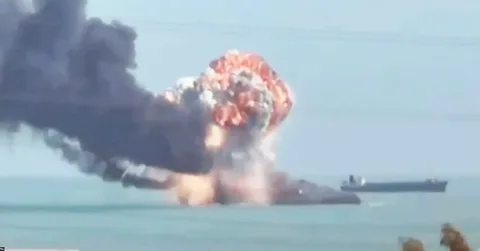

The phrase US strikes Iran after attack on cargo ship points to a specific flashpoint from late June 2026, but it’s really one chapter in a war that has run for more than six months and shows no sign of a clean resolution. Here’s how that incident happened, and how it connects to the bigger picture.
Background How the War Started
The 2026 Iran war began on February 28, when the United States and Israel carried out coordinated strikes against Iran following the breakdown of nuclear negotiations. The opening attacks reportedly targeted top Iranian officials directly, and Iran responded with missile and drone strikes against Israel and against countries in the region that host American military bases.
What followed was a war that never settled into a single steady rhythm. Instead, it moved through cycles of intense fighting, negotiated pauses, and renewed escalation, with the Strait of Hormuz consistently at the center of the most dangerous flashpoints.
The June Ceasefire That Didn’t Hold
In mid-June, the presidents of the US and Iran signed what became known as the Islamabad Memorandum, an agreement aimed at lifting a dual blockade and de-escalating hostilities. A ceasefire briefly followed on June 28, but tensions resurfaced quickly, and by July 8, the agreement had effectively collapsed after both sides accused each other of violations.
Details The Cargo Ship Incident Explained
The specific event tied to the US strikes Iran after attack on cargo ship headline happened in late June 2026, right as the fragile ceasefire framework was being tested. An Islamic Revolutionary Guard Corps drone struck a Singapore-flagged commercial vessel in the Strait of Hormuz, an attack that prompted the International Maritime Organization to temporarily pause its vessel evacuation operations in the region.
The US response came the next day. American forces launched strikes against Iranian targets, with President Trump saying the drone attack on the cargo ship amounted to a ceasefire violation. Iran’s Revolutionary Guard called the American response a provocation and threatened a swift retaliation, later claiming it had struck US-linked sites in the Gulf region in response.
Not an Isolated Case A Pattern of Ship Attacks
The cargo ship strike was far from a one-off. Over the course of the war, dozens of commercial vessels, tankers, and dhows have been attacked, damaged, or sunk in and around the Persian Gulf and the Strait of Hormuz. Some incidents involved unclear attribution, while others were directly claimed by either US forces or Iran’s Revolutionary Guard.
By early September, the pattern had escalated further. The US began striking Iranian government-owned tankers directly under what officials described as a new “tanker for tanker” retaliation policy, marking the first time Washington targeted Iranian tankers specifically in response to Iranian attacks on shipping, rather than simply to enforce its blockade.
Quotes What Both Sides Have Said
At the time of the cargo ship strike, US Vice President JD Vance posted publicly that Iran should communicate through official channels if it had disagreements about the ceasefire, warning that further violence would be met with more of the same. Iran’s Revolutionary Guard, for its part, described its retaliatory actions as a response to what it called American aggression, rather than framing its own drone strike on the cargo ship as the initial provocation.
Later in the tanker war, US Central Command framed its strikes on Iranian tankers as targeting what it called a shadow network funding Iran’s Revolutionary Guard and its regional allies, arguing the vessels themselves were legitimate military-linked targets rather than purely commercial shipping.
Iranian officials have consistently rejected the idea that their side is escalating unprovoked, instead describing their actions in the strait as a defensive response to what they call an illegal US naval blockade.
Impact Why Shipping Attacks Matter Globally
The Strait of Hormuz carries roughly a fifth of the world’s oil supply on a normal day, so any sustained disruption there has consequences well beyond the region. Attacks on tankers and cargo vessels have repeatedly pushed oil prices upward and forced shipping companies to reconsider routes, insurance costs, and safety protocols for crews passing through the area.
There’s also a broader diplomatic impact. Each ship attack tends to reset the clock on ceasefire negotiations, since both sides treat maritime incidents as serious enough to justify military retaliation rather than diplomatic protest alone. That pattern helps explain why agreements like the Islamabad Memorandum have struggled to hold for more than a few weeks at a time.
Conclusion Where the Conflict Stands Now
As of mid-September, the tanker war around the Strait of Hormuz remains active, even as President Trump has suggested the broader conflict may be nearing an end through direct talks with Tehran. Given how many previous ceasefire attempts have collapsed after a single maritime incident, any claim that the war is winding down is likely to be tested again the next time a ship comes under attack.
For now, incidents like the cargo ship strike serve as a useful reminder that this conflict has never really paused for long. Even during periods described as ceasefires, the underlying disputes over Iran’s nuclear program and control of the Strait of Hormuz have continued to generate new flashpoints roughly every few weeks.
Frequently Asked Questions
Why did the U.S. attack Iran?
The US-Israeli campaign that started this war on February 28, 2026, followed the collapse of negotiations over Iran’s nuclear program, and reports indicated the initial strikes targeted senior Iranian leadership directly. Since then, individual US strikes, including the response to the June cargo ship attack, have generally been framed by American officials as retaliation for specific Iranian actions, whether that’s an attack on shipping, a strike on US military assets, or an alleged ceasefire violation. The nuclear dispute remains the underlying cause, even as the immediate triggers for each new round of strikes have varied throughout the war.
How successful were the U.S. strikes on Iran?
Judged purely on immediate military terms, US officials have pointed to specific successes, including damage to Iran’s nuclear fuel production capacity and the disabling or destruction of multiple Iranian naval vessels in various strikes. Judged by the broader goal of ending the conflict, the results are far less clear-cut, since the war has now run for more than six months through multiple failed ceasefires, and incidents like the cargo ship attack show that either side can restart hostilities on short notice. A UN-backed investigation has also found that at least one early US strike killed well over 150 civilians in an incident it classified as a war crime, which complicates any straightforward claim of military success.
What is the issue between the U.S. and Iran?
The dispute began with Iran’s nuclear program and years of unsuccessful negotiations aimed at limiting it, but the war has since broadened considerably. Control of the Strait of Hormuz has become just as central to the conflict as the original nuclear dispute, with Iran using attacks on shipping as leverage and the US responding with a naval blockade and direct strikes on Iranian tankers. Each side blames the other for repeatedly breaking ceasefire agreements, which has left the conflict without a clear off-ramp even as both sides have occasionally signaled interest in ending it.