


With North Korea back in the headlines after its latest launch toward the East Sea, a lot of people are searching for basic context: how far can these missiles actually travel, what’s in North Korea’s arsenal, and who is really running the country. This explainer breaks all three down using publicly available, verified information.
Background Decades of Steady Missile Development
North Korea’s missile program didn’t appear overnight. It dates back to the late 1990s, when an attempted satellite launch using a multi-stage rocket first signaled Pyongyang’s ambitions toward long-range weapons capable of threatening distant targets, including the continental United States.
Since Kim Jong Un took power, testing has accelerated sharply. In 2017 alone, North Korea carried out more than twenty missile tests, including its first successful intercontinental ballistic missile and an intermediate-range missile capable of reaching Guam, Hawaii, and Alaska. That pace has largely continued in the years since, with 2026 already seeing more than a dozen recorded launches.
A Correction Worth Making North Korea Doesn’t Have a “President”
A common misconception shows up constantly in search results for “North Korea president,” but it’s worth clearing up directly. North Korea does not have a president in the way most countries use that term. Kim Jong Un holds several formal titles instead, including General Secretary of the Workers’ Party of Korea and Chairman of the State Affairs Commission, which functions as the country’s top decision-making body. He is widely referred to as North Korea’s supreme leader, a description that better reflects how power is actually structured in Pyongyang.
Details What’s Actually in North Korea’s Missile List
North Korea’s arsenal spans several missile classes, generally sorted by range and intended use.
Short-range ballistic missiles, or SRBMs, make up the bulk of North Korea’s testing activity. This category includes the Hwasong-5, Hwasong-6, Hwasong-9, and the more modern KN-23 and KN-24 systems, several of which are designed to fly on lower, harder-to-track trajectories aimed at evading regional missile defenses. These are the systems most frequently used in the short-notice launches that make headlines throughout the year, including recent tests from the Wonsan area.
Intermediate-range systems, like the older Musudan, were built with a longer reach in mind, with publicly estimated ranges in the thousands of kilometers, putting U.S. military installations in the Pacific within theoretical striking distance. North Korea’s newer intercontinental systems, including the Hwasong-17, Hwasong-19, and the more recently unveiled Hwasong-20, sit at the top of the arsenal in terms of range and are the systems most closely tied to Pyongyang’s claimed nuclear deterrent against the U.S. mainland.
North Korea’s Hypersonic Missile Push
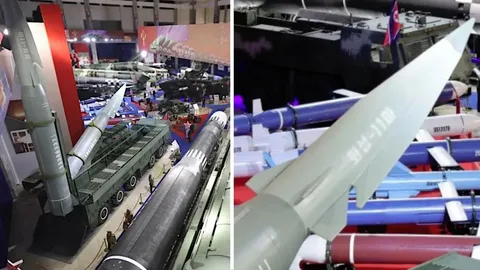
Hypersonic weapons have become a specific point of emphasis for Pyongyang in recent years. Systems like the Hwasong-8 and the newer Hwasong-11Ma are built around hypersonic glide vehicles, warheads that separate from their booster rocket and then maneuver unpredictably at very high speed, making them significantly harder for missile defense systems to intercept compared to a standard ballistic trajectory.
North Korea unveiled the Hwasong-11Ma publicly at a Pyongyang arms exhibition, describing it as part of an expanding effort to hold what it calls key regional targets at risk. Independent defense analysts have generally been more cautious than North Korean state media, noting that a functioning hypersonic glide vehicle and a genuinely operational, reliable hypersonic weapons system are two very different things.
Quotes What’s Been Said Publicly
Kim Jong Un has spoken directly about the reasoning behind some of these newer systems. During remarks at a weapons exhibition covered by state media, he pointed to the increasing U.S. military presence around South Korea as a factor shaping where Pyongyang directs what he called its special assets.
Independent defense researchers tracking North Korea’s programs have struck a more measured tone. Assessments cited by outlets covering the Hwasong-11Ma system have generally concluded that meaningful uncertainty remains around how mature North Korea’s hypersonic capability truly is, even as the missiles themselves continue to be publicly showcased.
Impact Why Missile Range and Type Actually Matter
The specific class of missile North Korea tests changes how neighboring countries respond. A short-range launch from Wonsan primarily concerns South Korea and nearby Japanese waters, while a long-range ICBM test triggers a completely different level of concern in Washington, given the implied reach toward the U.S. mainland.
This is also why past instances of North Korea firing a missile over Japan, rather than just toward the sea, have drawn such a sharp regional reaction historically. A launch that crosses over Japanese territory, as has happened in past years including a notable 2017 test and again in 2022, forces Japan to activate emergency alert systems for its own population, a very different scale of disruption compared to a missile landing safely offshore.
Conclusion What to Watch Going Forward
Given the pace of testing seen throughout 2026, further launches, potentially including additional hypersonic or intermediate-range systems, would fit the pattern North Korea has followed for years. Analysts will likely keep watching closely for any test explicitly designed to demonstrate progress on missile defense evasion, since that remains a clear stated priority for Pyongyang’s weapons program.
For now, understanding North Korea’s arsenal requires separating confirmed test data from state media claims, since the two don’t always align, particularly when it comes to newer hypersonic systems still being evaluated by independent defense researchers.
Frequently Asked Questions
Did North Korea fire a ballistic missile?
Yes, and this has happened repeatedly throughout 2026, with the most recent confirmed launch coming from the Wonsan area toward the East Sea. South Korea’s Joint Chiefs of Staff and Japan’s government both confirmed detecting the launch independently, tracking it in coordination with the United States. North Korea has carried out more than a dozen missile launches so far this year, ranging from short-range systems to tests tied to its longer-range and hypersonic weapons programs.
Which is the strongest missile in the world?
This depends heavily on how you define “strongest,” since range, payload, speed, and accuracy don’t always move together. Among established nuclear powers, heavy intercontinental ballistic missiles fielded by Russia and the United States are generally regarded as the most powerful in terms of combined range and destructive payload. North Korea’s newest systems, including the Hwasong-19 and Hwasong-20, are specifically designed for intercontinental range and multiple-warhead capability, but independent analysts continue to question how consistently reliable and accurate these systems actually are under real operational conditions, as opposed to controlled test environments.
Why did North Korea launch a missile?
North Korea’s stated reasons for testing vary by launch, but a few recurring themes show up consistently across the past several years. Pyongyang has repeatedly pointed to joint U.S. and South Korean military exercises as a trigger for what it calls responsive action, framing its own tests as defensive rather than provocative. North Korea has also used missile launches to reinforce its self-declared identity as a nuclear-armed state, particularly following international pressure like recent IAEA resolutions calling for it to halt nuclear activity. In some cases, launches also appear tied to testing and refining specific new systems, such as hypersonic glide vehicles, rather than being a direct political response to a single event.