


The opposition movement of thumb is the action that lets the tip of your thumb touch the tip of any other finger on the same hand. It is the single motion that turns a simple hand into a gripping, writing, buttoning, tool-using hand.
This movement depends on a saddle-shaped joint at the base of the thumb, three small muscles, and the median nerve. When any of these fail, everyday tasks like holding a cup or turning a key become surprisingly difficult.
Background: Why the Thumb Is Built Differently
Most fingers move in a fairly simple way. They bend, straighten, spread apart and come back together, and that is roughly the limit of their range.
The thumb is different because of its joint. At its base sits the first carpometacarpal joint, a saddle joint formed between the trapezium bone of the wrist and the first metacarpal bone.A saddle joint allows movement in two planes plus a twisting motion. That extra rotation is exactly what allows the thumb pad to turn inwards and face the other fingers.
Anatomists often say the opposable thumb separates human hands from the hands of most other mammals. Primates share it to varying degrees, but the human thumb is longer and more mobile relative to the fingers.
What Is Opposition Movement in Simple Words
In plain language, opposition means bringing two things face to face. In the hand, it means bringing the pad of the thumb face to face with the pad of another finger.Try it yourself. Touch your thumb tip to your little finger tip without bending your wrist. That combined bending, rotating and pulling-across motion is opposition.It is not one single motion in one direction. It is a blend of flexion, abduction and medial rotation happening together in a smooth arc.Because it is a combined motion, doctors and physiotherapists test it as a whole rather than measuring it in simple degrees.
Opposition Movement Anatomy
The Joint Involved
The main action happens at the first carpometacarpal joint. Smaller contributions come from the metacarpophalangeal joint and the interphalangeal joint of the thumb.The saddle shape of the trapezium allows the metacarpal to glide and rotate at the same time. This is why the thumb can sweep across the palm instead of only bending forward.
The Muscles That Produce Opposition
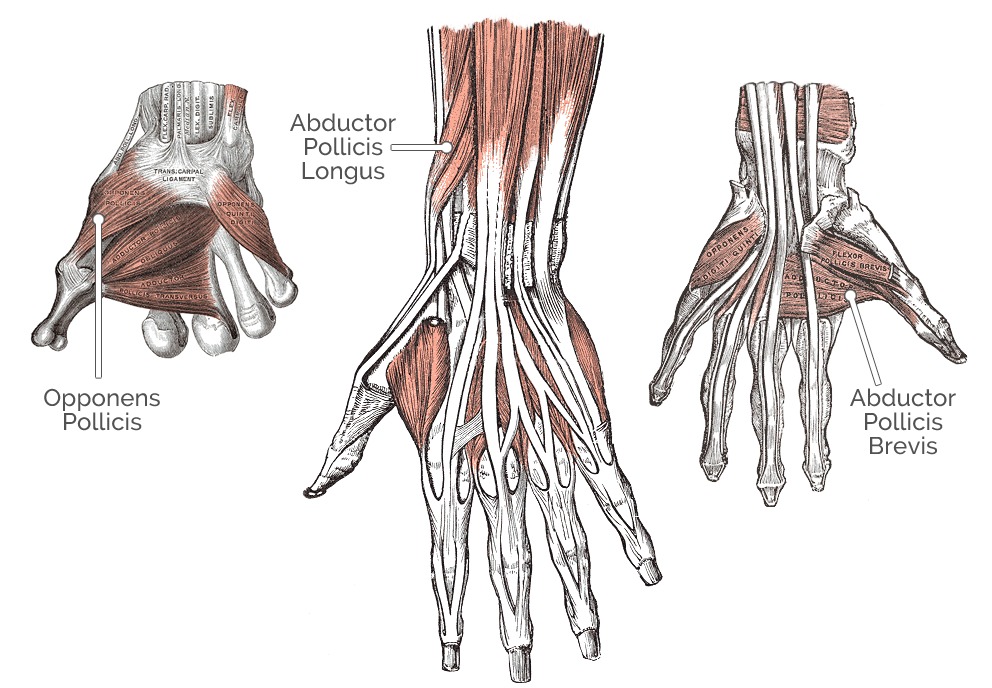
Three muscles in the thenar eminence, the fleshy bulge at the base of the thumb, do most of the work.
- Opponens pollicis — the primary muscle, which rotates and pulls the first metacarpal across the palm.
- Abductor pollicis brevis — lifts the thumb away from the palm so it can swing across.
- Flexor pollicis brevis — bends the thumb and assists the rotation.
The adductor pollicis and flexor pollicis longus help complete the movement, especially when force is needed for a firm pinch.
Supporting Structures
Ligaments around the carpometacarpal joint keep the thumb stable while it rotates. Without them, the joint would slip during heavy gripping.
The thick fat pad and skin of the thumb tip also matter. They give the friction and sensory feedback needed for a precise grip.
Opposition of the Thumb Nerve Supply
The median nerve is the key nerve for thumb opposition. Its recurrent branch supplies the thenar muscles, including opponens pollicis and abductor pollicis brevis.The flexor pollicis brevis often has a split supply, receiving fibres from both the median and ulnar nerves. Adductor pollicis is supplied by the ulnar nerve.This is why median nerve damage shows up so clearly in the hand. In advanced carpal tunnel syndrome, the thenar muscles waste away and the thumb lies flat beside the fingers.Clinicians call this an ape hand deformity, because the thumb loses its ability to rotate into opposition. Grip strength and pinch strength drop sharply as a result.
Opposition and Reposition Movement
Reposition is the return journey. It is the movement that brings the thumb back from opposition to the normal anatomical position beside the index finger.
Together, opposition and reposition form a complete cycle. One closes the hand for gripping, the other opens it to release an object.A healthy hand switches between these two states hundreds of times a day without any conscious thought.
What Are the Four Types of Movement
Anatomy textbooks usually group joint movements into four broad categories. These help describe what a joint can and cannot do.
- Gliding movements — flat bone surfaces slide over one another, as in the wrist and ankle bones.
- Angular movements — the angle between two bones changes, including flexion, extension, abduction and adduction.
- Rotational movements — a bone turns around its own long axis, such as rotation of the head or forearm.
- Special movements — motions unique to certain joints, including opposition, reposition, inversion, eversion, protraction and retraction.
Opposition sits firmly in that fourth group. It is classified as a special movement because no other joint in the body performs it.
Dorsiflexion Movement Explained
Dorsiflexion is the movement that reduces the angle between the top of the foot and the front of the leg. In simple terms, it is pulling your toes up towards your shin.The tibialis anterior is the main muscle responsible, with support from the extensor digitorum longus and extensor hallucis longus. The deep fibular nerve supplies these muscles.
Dorsiflexion is essential during walking. It lifts the front of the foot so the toes clear the ground in the swing phase of each step.When this action is lost, the foot drags and the person develops a condition known as foot drop. The same term also applies at the wrist, where dorsiflexion means bending the hand backwards.
Circumduction Movement Explained
Circumduction is a circular movement produced by combining flexion, abduction, extension and adduction in sequence. The limb traces a cone shape in the air.It is not a separate muscle action but a smooth blend of four existing ones. The shoulder joint performs it best because of its ball and socket design.
The hip, wrist and the base of the thumb can also circumduct, though with a smaller range. Bowling a cricket ball and drawing a circle with an outstretched arm are both examples.People sometimes confuse circumduction with rotation. The difference is simple: in rotation the bone spins in place, while in circumduction the limb sweeps around a cone.
Opposition as a Medical Term
Outside anatomy, the word opposition has other meanings in politics, debate and even astronomy. In medicine it has one specific meaning tied to the hand.Clinically, the term describes the functional test of whether the thumb can meet each fingertip. Therapists score it using scales such as the Kapandji index, which grades how far down the hand the thumb can reach.
Surgeons also use the term when planning an opposition transfer, a procedure in which a working tendon is rerouted to restore thumb function after nerve injury.So when a report mentions loss of opposition, it is describing a measurable loss of hand function, not a vague weakness.
Expert and Clinical Perspective
Hand surgeons frequently point out that the thumb contributes roughly forty to fifty percent of total hand function. Losing thumb opposition is therefore far more disabling than losing a single finger.Occupational therapists describe opposition as the foundation of two essential grips: the precision pinch used for picking up a coin, and the key pinch used for turning a lock.Rehabilitation after carpal tunnel release or nerve repair usually begins with gentle thumb-to-finger touch exercises. The aim is to restore the rotation first, and strength afterwards.Most clinicians agree that early movement, within safe limits set by the treating doctor, gives better long-term results than prolonged immobilisation.
Impact on Daily Life and Health
The practical impact of thumb opposition is enormous. Writing, cooking, dressing, driving and using a phone all rely on it.Thumb base arthritis is particularly frequent in older adults, especially women after the age of fifty. It causes pain at the base of the thumb during pinching and gripping.Because the loss develops gradually, many people adapt without noticing until simple tasks like opening a jar become painful or impossible.
Conclusion and What to Watch For
The opposition movement of thumb is a small motion with a very large role. It is built on a saddle joint, powered by the thenar muscles and controlled largely by the median nerve.Understanding it helps explain why hand injuries are taken so seriously, and why rehabilitation focuses on this one movement before anything else.If you notice numbness in the thumb, weakness when pinching, or visible flattening of the muscle bulge at the thumb base, it is worth getting it checked. Early assessment usually gives better outcomes than waiting.
Research in hand surgery continues to improve tendon transfer techniques and nerve repair, so the outlook for restoring lost opposition keeps getting better.
Frequently Asked Questions
What is opposition hand movement and how does it occur?
It occurs mainly at the first carpometacarpal joint, a saddle joint between the trapezium bone of the wrist and the first metacarpal bone of the thumb. The saddle shape allows the thumb to bend, move away from the palm and rotate inwards at the same time.Three thenar muscles drive the action. Opponens pollicis produces the rotation, abductor pollicis brevis lifts the thumb clear of the palm, and flexor pollicis brevis bends it. The median nerve supplies these muscles through its recurrent branch.Because it combines several directions of motion at once, opposition is classed as a special movement in anatomy rather than a simple flexion or rotation.
What are the four types of movement?
The four broad categories used in anatomy are gliding, angular, rotational and special movements. Each describes a different way that bones can move relative to one another at a joinGliding movements happen when flat bone surfaces slide across each other, as in the small bones of the wrist and ankle. Angular movements change the angle between bones and include flexion, extension, abduction, adduction and circumduction.Rotational movements involve a bone turning around its own axis, such as turning the head from side to side or rotating the forearm. These are limited to joints built with a pivot or ball and socket design.Special movements are actions that only certain joints can perform. This group includes opposition and reposition of the thumb, inversion and eversion of the foot, and protraction and retraction of the jaw and shoulder blades.
What does opposition mean in simple terms?
In simple terms, opposition means placing two surfaces directly facing each other. When applied to the hand, it means turning the thumb so that its pad faces the pad of another finger and the two can touch.You can demonstrate it in a second. Keep your wrist still and touch your thumb tip to the tip of your little finger. The sweeping, twisting path your thumb follows is opposition.The opposite action is called reposition, which returns the thumb to its resting position alongside the index finger. Together these two movements open and close the hand for grasping.