

The UK Opposition is the second-largest party in the House of Commons, formally known as His Majesty’s Most Loyal Opposition. Its job is to challenge the government, question its policies and present itself as a credible alternative. Kemi Badenoch, leader of the Conservative Party, has held the position of Leader of the Opposition since November 2024.
The role comes with a dedicated salary, a shadow cabinet of senior MPs, and significant influence over how Parliament scrutinises government business. This article explains who pays opposition MPs, who currently holds the key shadow posts, and why the Opposition matters to how Britain is governed.
Background
Britain’s opposition tradition stretches back over two centuries, but the modern, salaried role of Leader of the Opposition was only formalised by statute in 1937. Since then, the office has been held by MPs from whichever party comes second in general elections, most recently the Conservatives after Labour’s 2024 win.Kemi Badenoch has served as Leader of the Opposition since 2 November 2024, having won the Conservative leadership contest that followed the party’s election defeat.. That August 2026 reshuffle came amid speculation about an early general election, though Prime Minister Andy Burnham had already ruled one out.
Details: Role and Significance of the Opposition
The Opposition exists to hold the government to account in public, in Parliament, and through the media. Constitutionally, it is understood to have three main functions: opposing the government, criticising it, and seeking to replace it. This adversarial role is treated as a core part of how British democracy functions, not simply as political theatre.Shadow ministers are expected to develop policy alternatives alongside their scrutiny work. In practice, this means every government minister, from the Chancellor down to junior ministers, has a shadow counterpart tracking their decisions and challenging them in the Commons.
Who Pays Opposition MPs
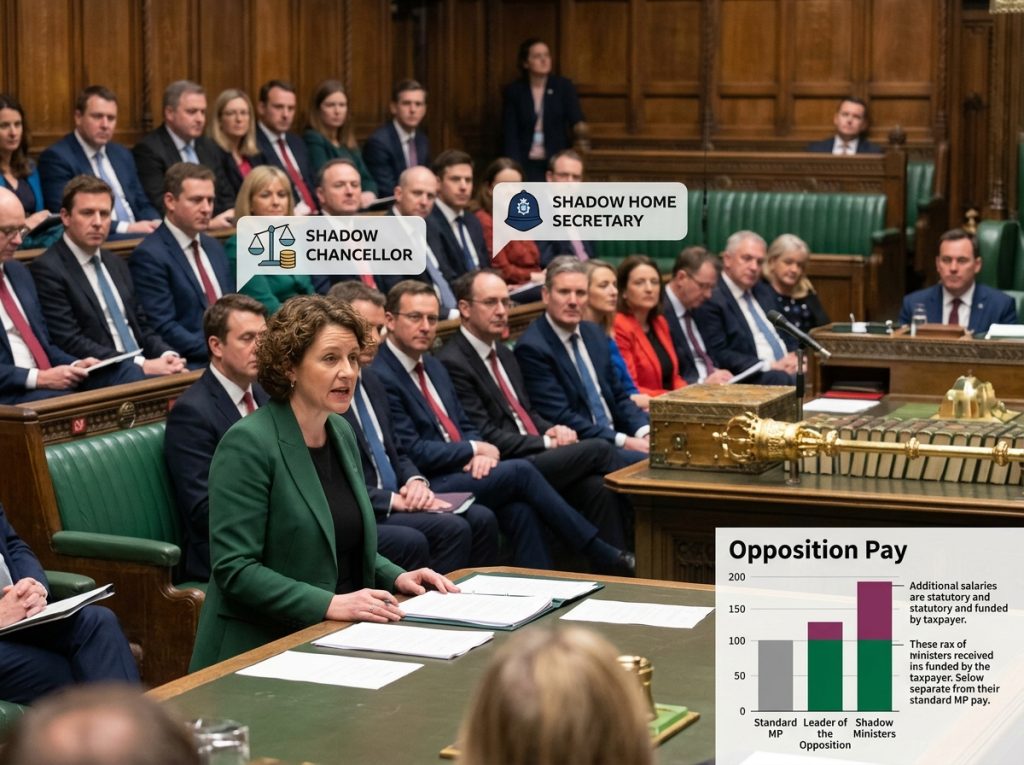
Ordinary opposition backbench MPs are paid the same basic parliamentary salary as any other MP, funded through the Independent Parliamentary Standards Authority. It is only senior opposition figures — the leader, the chief whip, and a handful of others — who receive an extra top-up salary on top of that base pay, set out in law under the Ministerial and Other Salaries Act 1975.
Under that Act, up to six paid posts exist across the opposition offices, including the Leader of the Opposition in the Commons, the Leader of the Opposition in the Lords, the Opposition Chief Whip in both Short Money does not cover MPs’ salaries or office costs, which are handled separately by the Independent Parliamentary Standards Authority. Political parties also raise money independently through membership fees and donations, though this is mostly spent on campaigning rather than parliamentary work.
Leader of the Opposition Salary
The Leader of the Opposition earns a top-up on their basic MP salary, reflecting the scale of the job. Current figures set the additional Commons salary at £63,098 on top of the standard MP salary. Combined with the basic MP salary, total pay for the role runs into six figures.The role is widely regarded as one of the hardest in British politics, arguably tougher than being Prime Minister in some respects. Even former Prime Minister Tony Blair and then-Leader of the Opposition William Hague reportedly agreed that leading the opposition was the harder of the two jobs.
Who Are the Shadow Ministers
Badenoch’s frontbench mirrors the structure of the government, with a shadow minister assigned to every major department. Following the August 2026 reshuffle, some of the key appointments include:
- Shadow Chancellor of the Exchequer: Andrew Griffith, who took over the role on 31 August 2026.
- Shadow Home Secretary: Chris Philp, holding the post since November 2024.
- Shadow Secretary of State for Defence: James Cartlidge.
- Deputy Leader of the Opposition: Alex Burghart, appointed in September 2026.
Claire Coutinho was named Shadow Secretary of State for Business, Innovation, Science and Trade, though she is currently on maternity leave, with Julia Lopez covering the brief. This is the closest current equivalent to a “Shadow Business Minister,” since the department now combines business with science, innovation and trade responsibilities.
Institute for Government analysis frames the constitutional purpose of the role in stark terms: the Opposition is expected to act as a “government in waiting,” ready to take over departmental briefs should there be a change of governing party. This principle shaped how Keir Starmer’s own shadow cabinet transitioned smoothly into government after Labour’s 2024 win, with most frontbenchers moving into the same policy areas they had shadowed.
Impact
A functioning, well-resourced Opposition is considered essential to accountable government in the UK. Without it, ministers would face far less scrutiny on policy decisions, spending, and legislation moving through Parliament. The shadow cabinet system also gives voters a preview of how an alternative government might be structured and who would likely hold senior office.The August 2026 reshuffle, alongside talk of an early election, signals that the Conservative frontbench is positioning itself for a renewed electoral challenge. Changes at the top of departments like the Treasury and Business brief often shape how a party’s economic and industrial policy is perceived by the public in the run-up to a vote.
Conclusion
The UK’s Opposition system, built on centuries of parliamentary tradition and formalised through statute, remains central to how British democracy operates. With Kemi Badenoch continuing to lead a reshuffled shadow cabinet through late 2026, expect further personnel changes and policy positioning as speculation about the next general election continues. Any snap election call would immediately test how effectively this shadow team can convert scrutiny into a credible governing alternative.
FAQs
What is the salary of the Leader of the Opposition in the UK?
The Leader of the Opposition receives a dedicated top-up salary in addition to their basic pay as a Member of Parliament. Under the Ministerial and Other Salaries Act 1975, this additional Commons salary is set at £63,098, on top of the standard MP salary that all backbenchers receive. Combined, total remuneration for the role runs well into six figures, reflecting the scale of responsibility involved in leading the official opposition and coordinating a full shadow cabinet.
Who are the Opposition members?
The Opposition is made up of MPs from the second-largest party in the House of Commons, currently the Conservative Party under Kemi Badenoch. This includes ordinary backbench MPs as well as the shadow cabinet, a team of senior figures each assigned to scrutinise a specific government department, such as the Treasury, Home Office, Defence and Business. Following the August 2026 reshuffle, the wider shadow frontbench includes around 70 MPs holding roughly 97 separate shadow ministerial roles, whips’ positions and party offices.
What does a Shadow Minister actually do?
A shadow minister’s core job is to scrutinise their government counterpart, questioning decisions in Parliament, in committee sessions and through the media, while also developing the party’s alternative policy in that area. Shadow ministers do not hold formal government power, but they are expected to be ready to take over their department’s responsibilities immediately if their party wins power, as seen when Labour’s shadow team moved into government in 2024.