
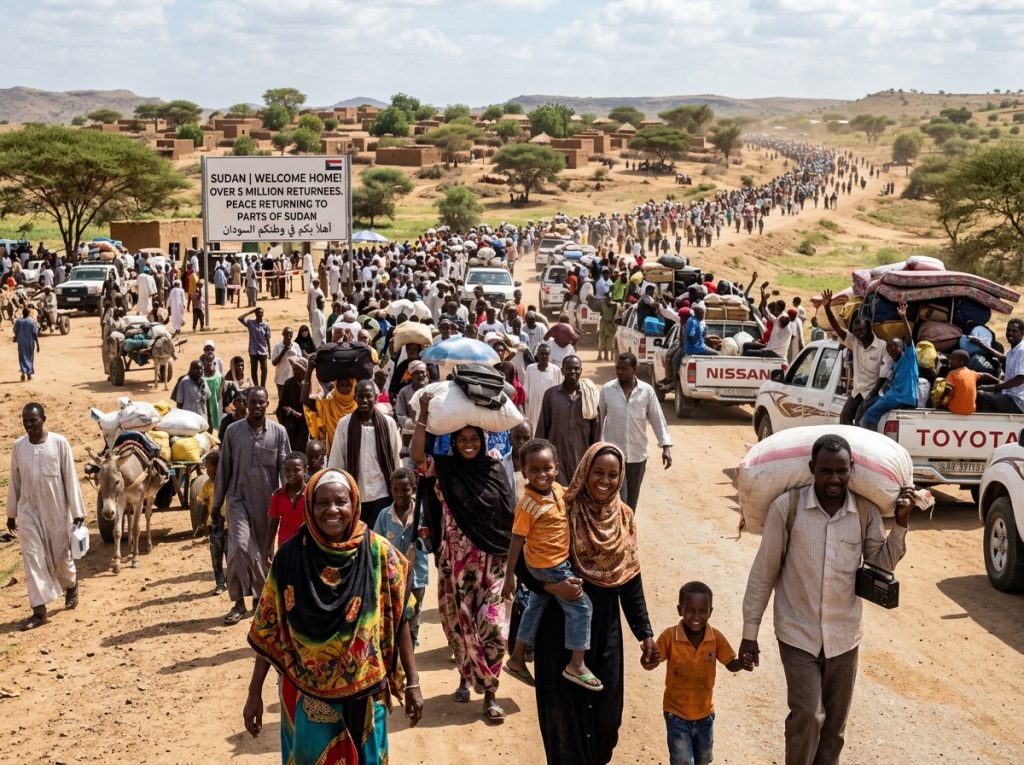

More than five million Sudanese returnees have gone back to their areas of origin, the International Organization for Migration (IOM) announced this week. The figure marks a rare milestone in a conflict that has driven the world’s largest displacement crisis since April 2023.
According to fresh IOM data, 5.15 million people have returned to 76 localities across nine Sudanese states. This number is up four percent from the previous month, signalling a steady, if fragile, trend of people going home.
Background: How the Sudan Conflict Triggered Mass Displacement
The war between Sudan’s regular army, the Sudanese Armed Forces (SAF), and the paramilitary Rapid Support Forces (RSF) erupted in April 2023. Fighting spread quickly from Khartoum into Al Jazirah, Kordofan, Darfur, and other regions.
At the height of the conflict, roughly 12 million people were displaced inside Sudan. Nearly five million others fled across borders into Egypt, South Sudan, Chad, and other neighbouring countries, according to the UN refugee agency.
Details: Where Sudanese Returnees Are Going and Why
IOM data shows that 82 percent of the 5.15 million returnees had been displaced within Sudan itself, while around 930,000 returned from abroad. Most of those crossing back into Sudan had been sheltering in Egypt, South Sudan, and Libya.Returns have been concentrated heavily in Khartoum and Aj Jazirah states, two of the areas hit hardest by the fighting. Families are citing improved security, the pull of family reunification, and worsening conditions in displacement camps as reasons for going home.At the same time, IOM reported that 8.58 million people remain displaced across Sudan, a figure that is down about one percent from the previous month and roughly a quarter lower than the peak of the crisis
Quotes: What Officials Are Saying About the Returns
IOM Director General Amy Pope welcomed the milestone as a sign of progress, while stressing that arriving home is only the first step for displaced families. She said returnees still need sustained support to avoid being displaced again.
Pope said returnees need continued investment so they “can rebuild their lives and stay.” IOM has separately warned that many returnees are arriving in areas where housing, hospitals, and schools remain badly damaged.
Impact: What the Returns Mean for Sudan and the Region
The return of more than five million people carries both promise and risk for Sudan’s recovery. On one hand, it reflects growing confidence in areas where security has stabilised, easing pressure on overcrowded displacement camps and host communities.The regional impact is also significant. Neighbouring countries such as Chad, and shifts in return patterns affect humanitarian planning across the wider region.
Conclusion: What Comes Next for Sudan’s Returnees
Humanitarian organisations expect the number of Sudanese returnees to keep climbing in the months ahead, particularly in Khartoum, where IOM projects more than two million additional returns during 2026. However, agencies stress that sustained funding and reconstruction support will determine whether these returns hold.
Sudan continues to host one of the largest displaced populations in the world, even as the returnee figures grow. Whether the current momentum turns into lasting recovery will depend on political stability, humanitarian funding, and the pace of rebuilding in the hardest-hit regions.
Frequently Asked Questions
How many Sudanese people have returned home so far? As of the latest IOM update, 5.15 million people have returned to their areas of origin across 76 localities in nine Sudanese states. This is up four percent from the previous month and marks the first time returns have passed the five-million mark since the conflict began in April 2023. Most of these returnees, around 82 percent, had been displaced within Sudan itself.
Where do most Sudanese live in the UK? Sudanese communities in the UK are concentrated mainly in Greater London, Brighton, and the West Midlands, with London historically home to the largest share of Sudanese-born residents. The UK is considered one of the oldest and largest Sudanese diaspora communities in the Western world, shaped by decades of migration linked to earlier conflicts, including Sudan’s civil wars.
What is the largest displacement crisis in the world? Sudan is currently recognised by the United Nations and IOM as the world’s largest displacement crisis. Despite recent returns, an estimated 8.58 million people remain displaced inside the country, while millions more remain as refugees in neighbouring states. displacement figures.