
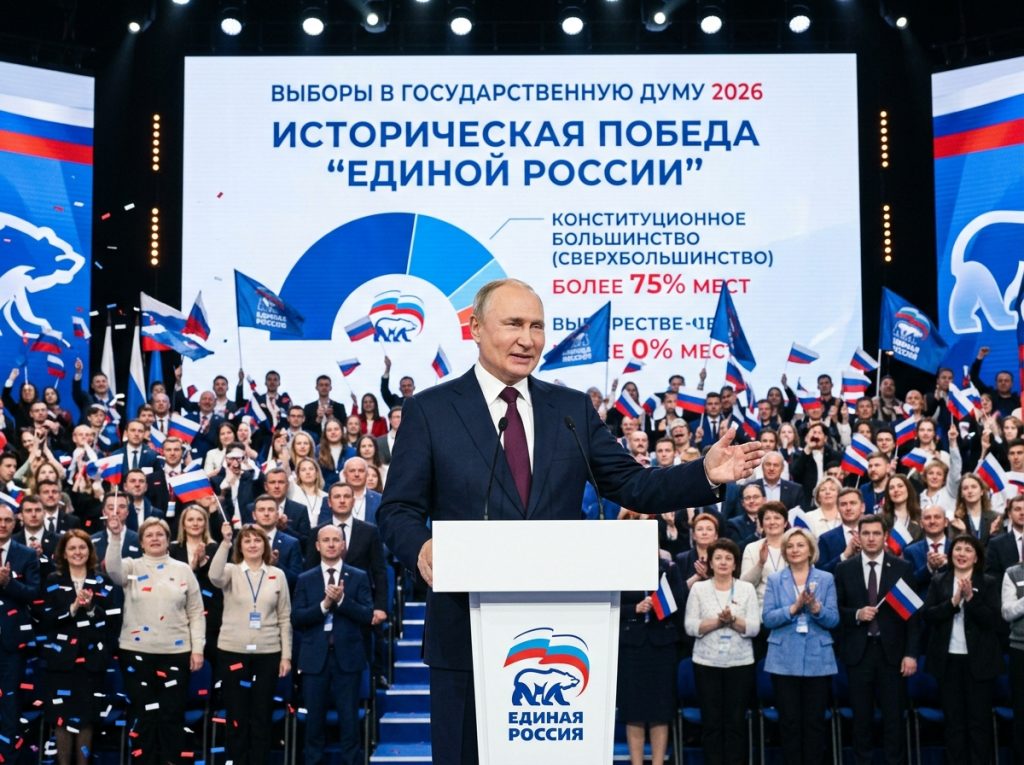

Russia confirmed final results of its State Duma election on Friday, with President Vladimir Putin’s United Russia party securing 349 of 450 seats. The outcome extends the party’s grip on parliament to a new record and comes amid a war in Ukraine that shows no signs of ending.
Background
Voting for Russia’s lower house of parliament took place over three days, from September 18 to 20, marking the country’s first parliamentary election since the full-scale invasion of Ukraine began in 2022. The Kremlin also organized voting in occupied areas of Ukraine, including parts of Donetsk, Luhansk, Kherson and Zaporizhzhia.
The vote was held without meaningful opposition on the ballot, with most antiwar candidates barred from running. Russia did not invite election observers from the Organization for Security and Co-operation in Europe, a body it has repeatedly criticized for what it calls double standards.
Details
Russia’s Central Election Commission head, Ella Pamfilova, announced that with all votes counted, United Russia had won 349 seats, surpassing the party’s previous record of 343. Early tallies had put the party’s vote share above 57 percent, with turnout topping 59 percent nationally, a record high for a Russian parliamentary election.
Other parties allowed to compete also picked up seats, though all of them broadly align with Kremlin positions in parliament. The Communist Party finished second with roughly 13.8 percent of the vote, followed by the nationalist Liberal Democratic Party and the New People party. A Just Russia rounded out the parties crossing the threshold needed for seats.
The result gives United Russia a two-thirds constitutional majority, a threshold that allows the party to amend the constitution without needing support from any other faction in parliament. That same mechanism was used after the last Duma term to extend presidential term limits, a change that allows Putin to remain in office until 2036 if he chooses to run again.
Officials also noted that around one-tenth of the incoming members of parliament are veterans of the war in Ukraine, reflecting how deeply the conflict has become embedded in Russian political life.
Quotes
Pamfilova, addressing reporters after the final count, said the president’s party had reinforced its supermajority and highlighted the number of war veterans entering the chamber for the first time. Kremlin officials have consistently framed the election as evidence of public support for the government’s direction, including its handling of the war.
Critics have offered a starkly different assessment. Officials in the European Union described the vote as a “sham election,” particularly given that voting took place in occupied Ukrainian territory, and said the bloc would sanction those involved in organizing it. Opposition figures living in exile, including Yulia Navalnaya, had urged Russians to vote for any candidate other than United Russia in an effort to weaken the ruling party’s position.
Impact
The result strengthens Putin’s political position domestically at a time when the war in Ukraine has dragged into its fifth year and placed growing strain on Russia’s economy. A constitutional supermajority gives the Kremlin wide latitude to pass legislation, including further changes to the political system, without needing to negotiate with rival parties.
Internationally, the election is likely to deepen criticism from Western governments already opposed to Russia’s actions in Ukraine, particularly given that new Duma seats were created for occupied Ukrainian regions. The vote also unfolded against the backdrop of intensified fighting, with Ukraine launching large-scale drone attacks on Moscow during the final days of voting.
Conclusion
With the new Duma now confirmed, attention shifts to how the incoming parliament will use its expanded majority, and whether it takes up further constitutional or legislative changes in the months ahead. The next major political milestone for Russia remains the 2030 presidential election, which will determine whether Putin, eligible under current rules to run again, seeks to extend his time in power even further.
Frequently Asked Questions
When is the next presidential election in Russia?
Russia’s next presidential election is scheduled for 2030. Vladimir Putin was re-elected in March 2024 for a six-year term under constitutional rules that took effect in 2012, meaning his current term runs until 2030. Under changes to the Russian constitution approved in 2020, Putin remains eligible to run for the presidency again after that, which would allow him, if he wins, to remain in office until 2036. Putin has publicly declined to confirm whether he intends to seek another term, saying it is too early to discuss those plans.
Who can vote in Russian elections?
Russian citizens aged 18 and older are generally eligible to vote in national elections, including presidential and State Duma elections, provided they are not serving a prison sentence following a court conviction or otherwise legally barred from voting. Roughly 109 million people are eligible to take part in a typical Russian national election. In recent elections, the Kremlin has also organized voting in Ukrainian territories under Russian occupation, a practice that has drawn strong condemnation from Ukraine and Western governments, which do not recognize the results from those areas as legitimate.
How often does Russia hold elections for president?
Russian presidential elections are held every six years. This interval was set by constitutional amendments passed in 2012, which extended the presidential term from four years to six. Prior to that change, elections were held every four years. Combined with the 2020 constitutional reforms that reset Putin’s term count, the six-year cycle means Russia’s next presidential vote is due in 2030, followed by a further election in 2036 if the current framework remains unchanged.