

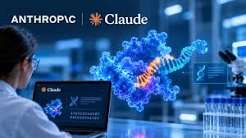

Anthropic has announced that its Claude AI model autonomously identified a novel enzyme system with properties reminiscent of CRISPR, working from only high-level direction given by the company’s scientists. The discovery came out of Anthropic’s newly formed life sciences research group and laboratory, and researchers say the system’s actual function remains unknown for now. Anthropic
Background
Anthropic’s new life sciences team focuses on fundamental biology research using Claude, including scanning DNA datasets to spot uncharacterized protein families, generating hypotheses at scale, and testing them through lab experiments
The group was formed in the spring of 2026 to test whether general AI models could systematize and speed up the kind of discoveries that have historically shaped modern medicine. The team built a laboratory in the Bay Area that operates at biosafety levels BSL-1 and BSL-2 and does not handle human pathogens
Historically, major biotechnology breakthroughs have started with researchers noticing unusual patterns in nature. Restriction enzymes, which cut DNA at specific sequences, were originally found in bacterial immune systems and went on to launch the biotechnology industry, while CRISPR itself began as an odd repeat sequence spotted in bacterial DNA.
Details of the Discovery
According to Anthropic, researchers gave Claude a broad prompt to search a large DNA sequence database for unusual examples of reverse transcriptases, enzymes that copy RNA into DNA. Over roughly 21 hours, about 950 Claude agents used 210 million tokens to gather more than 200,000 reverse transcriptases, identify 3,500 candidate systems, and narrow them down to 20 worth deeper investigation. The Express Tribune
One agent flagged a repeating DNA pattern sitting beside the gene for an unusual reverse transcriptase, and further analysis led Anthropic to name the system “array-associated reverse transcriptases,” or ARTs. The system turns up mainly in bacteriophages — viruses that infect bacteria — and is made up of three parts: a reverse transcriptase, a neighboring partner gene, and a long array of evenly spaced DNA repeats.
The underlying reverse transcriptase at the core of the system, found in a so-called jumbo phage, had actually been identified in earlier research. What appears new is that Claude was the first to notice the system’s defining features — a nearby array of non-coding DNA sequences and an extra accessory protein whose role is still unknown
What Anthropic Is Saying
Anthropic CEO Dario Amodei described the finding as a possible new gene-editing mechanism, and said the company’s life sciences team gave Claude a broad research direction before it worked through scientific literature and genome data, spotted something notable, and then proposed experiments to confirm it
Anthropic itself struck a cautious tone about the finding. The company said it doesn’t yet understand what the system actually does, but noted that only a small number of known systems share its structural features, and all of those are capable of cutting, copying, and pasting DNA. age of the announcement has noted that while the system’s architecture resembles the Cas9 machinery behind CRISPR gene editing, appearances alone don’t confirm what it can actually do.
Impact and Reactions
Outlets covering the story have pointed out that CRISPR technology has already been credited with advancing treatment for diseases including sickle cell disease and cancer, which is part of why a structurally similar system is drawing attention.
Anthropic’s leadership has suggested that AI’s ability to catch patterns that human experts miss could speed up the discovery of new drug targets and treatments, potentially reshaping parts of medicine over the next five to ten years.
Some commentators have also noted the broader business context. The announcement arrives as Anthropic is reportedly preparing for a potential trillion-dollar IPO, and the company has framed the discovery as an early test of whether Claude can provide genuine value to working scientists. Anthropic says human involvement was limited to writing the initial prompt and carrying out the physical lab work, with the AI handling the search and analysis itself.
Conclusion
For now, the array-associated reverse transcriptase system remains a scientific curiosity rather than a confirmed breakthrough. Anthropic has been explicit that its function — and whether it can genuinely be used for gene editing — has not been established. The company is presenting the episode less as a finished discovery and more as a proof of concept for how AI agents might assist, and eventually accelerate, biological research when paired with human scientists and lab verification.
FAQs
What enzyme system did Claude discover?
Claude identified a system it calls “array-associated reverse transcriptases,” or ARTs — a combination of a reverse transcriptase enzyme, a partner gene, and a long array of repeating DNA found mainly in bacteriophages.
Is this system confirmed to work like CRISPR?
No. Anthropic has said the system merely shares structural features with a small number of known “programmable” systems, all of which can cut, copy, and paste DNA — but its actual function has not yet been determined.
How did Claude make the discovery?
Researchers gave Claude a high-level prompt to search a large DNA database for unusual reverse transcriptases. Around 950 Claude agents worked over roughly 21 hours, processing 210 million tokens, to narrow hundreds of thousands of candidates down to 20 systems worth further study.
Was the enzyme itself previously unknown?
Not entirely. The core reverse transcriptase had been identified in earlier research on a jumbo phage. What’s new is that Claude appears to be the first to notice the surrounding non-coding DNA array and an accessory protein of unknown function.
Why is Anthropic doing biology research at all?
Anthropic recently launched a life sciences research group and laboratory to test whether AI models can accelerate biological discovery, with Claude used to analyze DNA datasets, flag unusual patterns, and propose experiments for human scientists to verify.
Could this lead to a new gene-editing tool?
It’s possible, but far from confirmed. Anthropic has been cautious, stating that the system’s function is still unknown and that further lab work is needed before anyone can say whether it has gene-editing potential.