
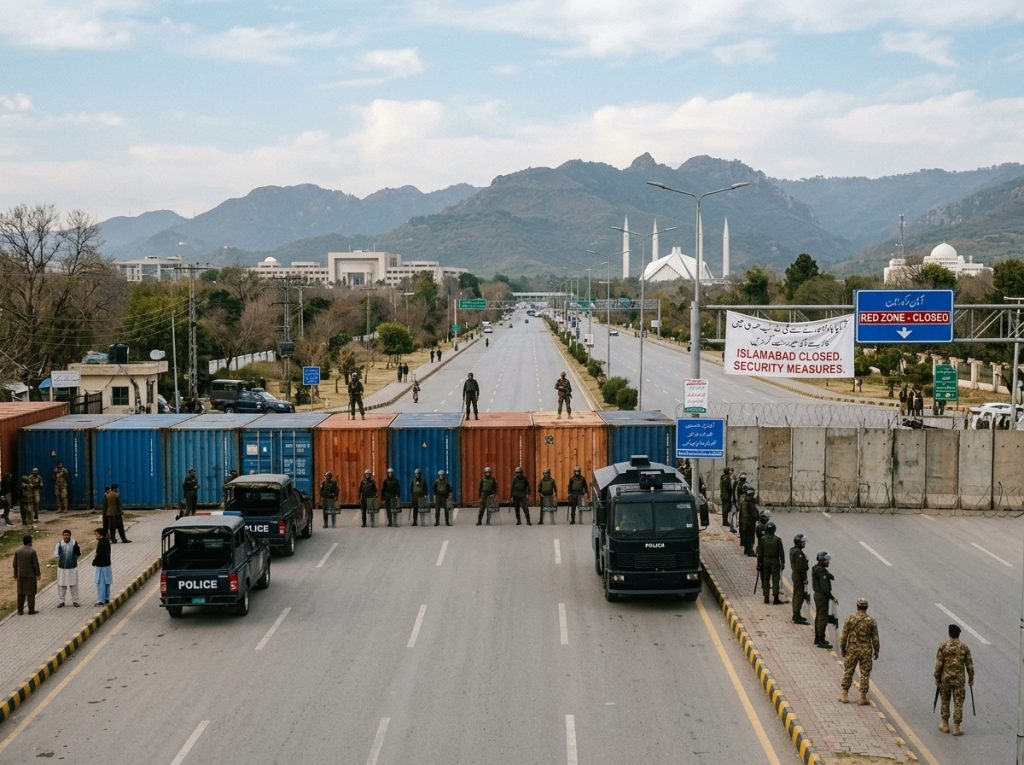

Shipping containers have once again reshaped Islamabad’s streets, lining major junctions and approaches to the Red Zone as the capital braces for possible protests. The barriers were put in place ahead of the Pakistan Tehreek-e-Insaf’s planned march, and have stayed put even after the party pushed its mobilisation back to October 4.
Background
The containers were originally positioned ahead of a PTI march that had been scheduled to reach Islamabad on September 27. Despite the party’s decision to delay the protest by roughly a week, the security infrastructure built around the capital has largely remained in place, reflecting how quickly Islamabad’s authorities mobilise, and how slowly they tend to stand down, whenever a major political mobilisation is on the horizon.
Details
The container cordon remains clearly visible at several of the capital’s key entry points, including Faizabad, 26 Number Chungi, T-Chowk and Margalla Avenue, with barricades continuing to guard multiple approaches to the high-security Red Zone that houses key government buildings and diplomatic missions.
While some traffic has been diverted onto alternative routes because of the placement of these barriers, major roads across Islamabad have not been fully closed, and normal traffic flow continues on several important corridors. This represents a partial rather than total lockdown of the capital, even as the visible security presence remains extensive.
According to a media report, the capital police had initially requested around Rs820 million to cover security arrangements tied to the protest, including the rental of containers, as well as accommodation and meals for police personnel brought in from Punjab and Sindh to reinforce local law enforcement. That budget estimate was calculated to cover a one-week deployment, based on an expectation that the protest and march would disperse by October 4.
Impact
The prolonged presence of containers on Islamabad’s roads, even after the underlying protest has been postponed, illustrates the significant financial and logistical cost of maintaining heightened security postures in the capital. With police personnel already deployed from other provinces and budgets running into hundreds of millions of rupees, each postponement or extension of a planned march effectively extends the bill footed by taxpayers.
Beyond the direct costs, repeated container blockades also affect daily life for residents and commuters, who must navigate diverted routes and reduced access to parts of the city for extended periods, even when a major disruption to the city has not yet materialised.
Conclusion
With the PTI’s march now rescheduled for October 4, Islamabad’s security posture is likely to remain largely unchanged in the coming days, with containers expected to stay in position rather than be removed and reinstalled. Whether the eventual march proceeds as planned, or faces further delay, will determine how much longer the capital continues operating under this partial state of containment.
Frequently Asked Questions
Why does Islamabad frequently see shipping containers used for security?
Shipping containers have become a common security tool in Islamabad because they are quick to deploy, difficult to move without heavy machinery, and effective at blocking vehicle access to sensitive areas such as the Red Zone. Authorities typically place them at major junctions and entry points into the capital whenever a large political march, protest or sit-in is anticipated, as a way of controlling crowd movement and protecting key government buildings and diplomatic missions without necessarily shutting down the entire city.
How much does Islamabad’s container security cost the government?
Based on figures reported around the PTI’s planned march, the capital police had sought approximately Rs820 million for a single week of security arrangements, covering container rentals as well as accommodation and meals for additional police personnel brought in from Punjab and Sindh. Costs can rise further if a protest is delayed or extended, since containers, barricades and reinforced police deployments often remain in place for longer than originally budgeted, adding to the financial burden on the capital’s administration.
What is the Red Zone in Islamabad?
The Red Zone is a high-security area in Islamabad that houses many of the country’s most important government buildings, including the Parliament, the Prime Minister’s Office, the Supreme Court and several foreign diplomatic missions. Because of its sensitivity, the Red Zone is subject to some of the strictest security measures in the capital, and access to it is often tightly restricted or completely blocked using containers and barricades whenever there is a heightened security concern, such as a planned political march or large-scale protest.