

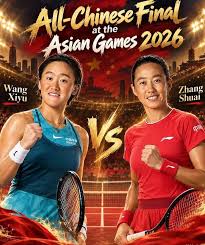

China’s Wang Xiyu won the women’s singles tennis gold medal at the Asian Games on Friday, defeating compatriot Zhang Shuai 6-2, 6-1 in Nagoya, Japan. The victory also handed the 25-year-old an automatic place at the 2028 Los Angeles Olympics.
Background
Tennis is one of seven sports at the Asian Games where gold medallists earn direct Olympic qualification, making the final about far more than just a medal. Wang arrived in the title match fresh off a gruelling win over Philippines top seed Alexandra Eala a day earlier, a contest that stretched to three sets and lasted two hours and 34 minutes before Wang edged through.
The all-Chinese final pitted Wang against the 37-year-old Zhang Shuai, a two-time Grand Slam doubles champion who has long been seen as a mentor figure to younger players on the Chinese tour, including Wang herself. The match took place at the Higashiyama Park Tennis Center as part of the Aichi-Nagoya Asian Games 2026.
Details
Friday’s final was a one-sided affair compared to Wang’s semi-final battle. She raced through the opening set in roughly 38 minutes, winning every point on her first serve, and needed less than half an hour to wrap up the second, with Zhang managing only two games across the entire match. The straight-sets win was completed in just 66 minutes.
The gold is China’s sixth consecutive Asian Games women’s singles tennis title, extending a run of dominance in the event. For Wang, the triumph also marks a career turnaround after a period hampered by injuries, something she credited in part to a strong run to the last 16 at the Cincinnati Open earlier this year.
Beyond the gold medal itself, the result carries direct consequences for 2028. Provided Wang remains inside the top 500 of the world rankings, the win guarantees her a provisional quota spot for the Los Angeles Olympics, where she will be making her second Olympic appearance after competing at Paris 2024.
Quotes
Wang reflected on the significance of the win after the match, saying she was very happy to have secured a quota place for the next Olympic Games. She also spoke warmly about her opponent and friend Zhang Shuai, describing her as a role model who has always been generous in sharing her experience with younger players on the team. Wang added that Zhang plays an important role in holding the group together and showing teammates how to support one another.
Impact
The result strengthens China’s already dominant position in Asian tennis, with the country now having won six straight Asian Games women’s singles golds. It also adds another experienced name to China’s growing group of Olympic-bound players heading toward Los Angeles 2028, at a time when Chinese women’s tennis continues to produce depth beyond its established WTA stars.
For the wider tournament, the final also drew attention because of Wang’s path to the title, having eliminated the Philippines’ Alexandra Eala, the top seed, in the semi-finals. Eala’s run still ended with a bronze medal alongside Kazakhstan’s Yulia Putintseva, while Zhang Shuai took silver.
Conclusion
With the women’s event now complete, focus at the Aichi-Nagoya Asian Games shifts to the men’s singles final on Saturday, where Hong Kong’s Coleman Wong faces China’s Wu Yibing for gold. For Wang, attention will now turn toward defending her ranking position over the coming two years to confirm her Los Angeles 2028 spot and building on the form that carried her to this title.
Frequently Asked Questions
Who won the Asian Games tennis gold medal?
China’s Wang Xiyu won the women’s singles tennis gold medal at the 2026 Asian Games in Nagoya, Japan. She defeated fellow Chinese player Zhang Shuai 6-2, 6-1 in the final, completing the match in just 66 minutes. It marked China’s sixth consecutive Asian Games women’s singles tennis title, continuing the country’s long run of success in the event, and capped a strong week for Wang after she had earlier beaten Philippines top seed Alexandra Eala in a hard-fought three-set semi-final.
What did Wang achieve at the Asian Games?
Wang won the Asian Games women’s singles tennis gold medal and, as a direct result, secured an automatic berth at the 2028 Los Angeles Olympics. Tennis is one of several sports at the Games where gold medal winners earn Olympic qualification outright, which made her final against Zhang Shuai significant beyond the medal itself. This will be Wang’s second Olympic appearance, having previously competed at the Paris 2024 Games, where she reached the third round before losing to then world number one Iga Swiatek.
How did Wang qualify for the Olympics?
Wang qualified for the Los Angeles 2028 Olympics by winning the Asian Games women’s singles tennis gold medal, since tournament winners in Olympic-qualifying sports at the Games receive a direct quota spot. Her path to the final included a tough three-set win over top seed Alexandra Eala in the semi-finals, followed by a dominant straight-sets victory over Zhang Shuai in the title match. The Olympic place is provisional and will be confirmed as long as Wang remains within the top 500 of the world rankings heading into the qualification period for the 2028 Games.