
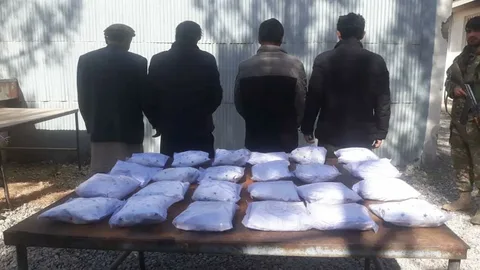

Pakistan’s Anti-Narcotics Force says its intelligence work played a direct role in taking down a drug trafficking network with roots in Afghanistan. The agency confirmed on Friday that it shared key information with American and Sri Lankan authorities, which led to a major narcotics seizure in Colombo.
The joint effort resulted in the recovery of roughly 463 kilograms of crystal methamphetamine, worth close to 21 million dollars. Several suspects, including Pakistani nationals, were taken into custody as part of the operation.
Background
Drug smuggling routes running through Afghanistan and into South Asian ports have troubled regional law enforcement for years. Pakistan’s Anti-Narcotics Force has repeatedly flagged the border areas near Torkham and Chaman as entry points for narcotics moving from Afghan territory into Pakistan.
From there, traffickers often push shipments toward Gulf states, East Africa, and increasingly toward Sri Lanka, using sea routes that are harder to monitor. This case fits that established pattern.Officials in Colombo have said for some time that most narcotics reaching Sri Lankan shores originate in Afghanistan and Pakistan. The country’s anti-narcotics campaign, running since last October, has already recovered close to 14 tonnes of illegal drugs.
Details of the Operation
According to the Anti-Narcotics Force, the breakthrough began with intelligence gathered between August 14 and 29 by its Special Investigations Cell, working alongside the US Drug Enforcement Administration’s Foreign Counterparts Unit. The two sides had been tracking suspicious maritime containers moving from Pakistani ports toward Colombo.
That groundwork was passed on to Sri Lanka’s Police Narcotics Bureau, which intercepted the shipment once it reached port. Inside the container, officers found the methamphetamine hidden inside ordinary bath towels, a concealment method meant to slip past routine cargo checks.
Sri Lanka’s deputy inspector-general of police, Ashoka Dharmasena, told reporters that two Pakistani men were arrested in connection with the seizure. A local suspect was also taken into custody separately, and Dharmasena said the operation followed a specific tip-off rather than a random inspection.The full case is now being handled jointly by Sri Lankan police and the US Drug Enforcement Administration’s New Delhi Country Office, which oversees regional counter-narcotics coordination.
Official Statements
The US Embassy in Colombo issued a statement describing the operation as proof of steady cooperation between Washington and Colombo. The embassy said the bust “underscores the strength of the US-Sri Lanka partnership” in tackling organized crime networks.The embassy also credited the US State Department’s Bureau of International Narcotics and Law Enforcement Affairs, saying the bust built on years of training and technical support given to Sri Lankan police and customs officers.Sri Lanka’s Public Security Minister, Ananda Wijepala, has separately told parliament that most narcotics entering the island nation trace back to Afghanistan and Pakistan, arriving mainly by sea rather than by air.
Regional and Global Impact
This bust adds weight to growing concern that Afghanistan-linked narcotics networks are shifting tactics, relying more on maritime routes and third countries like Sri Lanka to reach international markets. It also signals that intelligence-sharing between Pakistan, the US, and Sri Lanka is becoming more routine rather than occasional.
For Sri Lanka, the case lands amid a wider crisis. Officials estimate the island has around 400,000 drug users out of a population of 22 million, and methamphetamine use has been climbing alongside heroin and cocaine seizures.For Pakistan, the operation offers evidence that the Anti-Narcotics Force’s cross-border coordination efforts, including similar recent busts involving networks that funneled drugs through Qatar and other Gulf states, are producing measurable results rather than isolated headlines.
Conclusion
Investigators in Colombo say further arrests are possible as they trace the rest of the network’s supply chain back through Pakistan and into Afghanistan. Pakistani and American agencies are expected to keep sharing intelligence on suspicious shipping activity out of Karachi and other ports.Whether this cooperation expands into a more permanent regional task force remains to be seen, but for now, officials on all three sides are treating the bust as a working model for future operations.
Frequently Asked Questions
What is the largest drug trafficking country?
There is no single country officially labeled the world’s largest drug trafficking hub, since different regions dominate different drug categories. Historically, Afghanistan has been the top global source of opium and heroin, supplying a large share of the world’s illicit opium before the Taliban’s 2022 cultivation ban disrupted output. Mexico, meanwhile, remains the primary source of methamphetamine and fentanyl reaching North American markets, while Colombia continues to lead global cocaine production. Analysts generally avoid ranking a single “largest” country because trafficking networks span production, transit, and destination points across multiple continents.
What drugs is Afghanistan known for?
Afghanistan has long been associated with opium poppy cultivation and heroin production, at one point accounting for the vast majority of the world’s illicit opium supply. In recent years, reports from regional narcotics agencies, including Pakistan’s Anti-Narcotics Force, indicate a noticeable shift toward synthetic drug production inside Afghanistan, particularly methamphetamine made using the locally grown ephedra plant. This shift has made Afghan-linked networks harder to track, since synthetic drug labs are smaller, more mobile, and less dependent on visible crop cultivation than traditional poppy fields.
What drugs are used in Afghanistan?
Domestic drug use within Afghanistan includes opium, heroin, and increasingly methamphetamine, alongside cannabis-based products like hashish. Decades of conflict, displacement, and limited access to treatment facilities have contributed to rising addiction rates inside the country, with heroin and opium remaining the most commonly used substances among long-term users. Humanitarian organizations have repeatedly flagged Afghanistan’s addiction crisis as one of the more overlooked consequences of the region’s prolonged instability, compounded by the fact that many treatment centers operate with minimal funding and staff.