

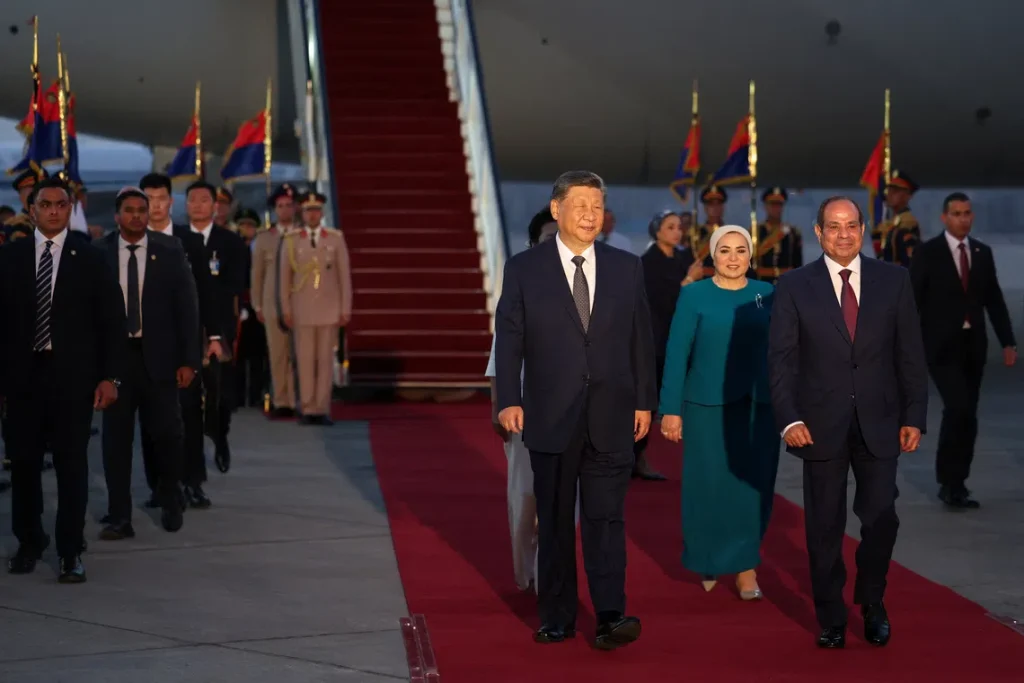

Chinese President Xi Jinping arrived in Cairo on September 1, 2026 his first visit to Egypt in a decade as China-Arab relations reach what Beijing is calling “the best ties in history.” The timing is deliberate. The six-month US-Israel war against Iran has upended the Middle East’s security architecture, pushed regional countries to reassess their partnerships, and created an opening for China to position itself as a stable alternative power in a region where America’s reliability is being openly questioned.
The Egypt visit, which marks 70 years since Cairo became the first country to recognise China in the Arab world, is as much a message about China’s Middle East relations broadly as it is about bilateral Egypt ties specifically.
Why Egypt And Why Now?
Cairo sits at the intersection of multiple pressure points. It borders Gaza. It controls the Suez Canal, through which a significant share of global trade flows. It has relationships across the Arab world, Africa, and the West simultaneously.China sees Cairo as a strategic power broker,” one analyst said, noting that Egypt’s “relations with both Washington and regional actors give Beijing both political access and diplomatic leverage across a region where China wants a much greater say.
The deeper context is the Iran war.The conflict began when the United States and Israel launched strikes against Iran on February 28, throwing the crucial trade region into crisis.The months of disruption that followed have forced every Middle Eastern government to think seriously about what their relationship with Washington is actually worth and whether they need to hedge more aggressively toward other powers.
First Country to Recognise China Egypt’s Historic Role
The 70th anniversary of China-Egypt diplomatic ties isn’t just a ceremonial milestone. It anchors a specific historical claim that Beijing is keen to emphasize.Egypt was the first Arab and African country to establish diplomatic ties with China 70 years ago,a fact that Egyptian state media has been trumpeting heavily in the lead-up to Xi’s visit. That status as the first country to recognise China in the Arab world gives Egypt a particular weight in Beijing’s China-Arab relations narrative a founding partner rather than a latecomer to the relationship.
China’s foreign ministry described relations with Egypt as being at “their best in history” before the visit, while also noting that it would “build on past cooperation while setting the direction for future ties.”
China-Arab Relations The Broader Picture
Xi’s Cairo visit doesn’t exist in isolation. It’s part of a sustained and deliberate expansion of China’s Middle East relations across multiple Arab states simultaneously.
China-Saudi Relations
China-Saudi relations have deepened considerably over the past five years. China is Saudi Arabia’s largest trading partner and a major buyer of Saudi oil. The two countries have expanded cooperation across energy, infrastructure, and technology, including discussions on settling some oil trades in yuan rather than dollars a development that carries geopolitical implications well beyond the transaction itself.
Saudi Arabia’s Vision 2030 has drawn significant Chinese investment interest in manufacturing, logistics, and renewable energy, creating an economic integration that goes beyond the traditional oil-for-goods model.
China-Africa Relations
China-Africa relations run through Egypt as much as anywhere. China has invested heavily across the African continent through the Belt and Road Initiative, with infrastructure, mining, and energy projects spanning from East Africa to West Africa.
Egypt itself benefits from this:Chinese investment in Egypt has surged in recent years, with billions flowing into sectors such as manufacturing, ports, solar energy, green hydrogen and satellite technology.The Suez Canal Economic Zone has attracted particular Chinese interest as a manufacturing and logistics hub connecting African supply chains to European and Asian markets.
China’s Strategic Partnerships List
China’s diplomatic toolkit relies heavily on tiered partnership designations. Its China strategic partnerships list in the Arab world includes:
- Egypt: Comprehensive Strategic Partnership (since 2014)
- Saudi Arabia: Comprehensive Strategic Partnership (since 2022)
- UAE: Comprehensive Strategic Partnership (since 2018)
- Algeria: Comprehensive Strategic Partnership
- Qatar: Strategic Partnership
These designations are more than symbolic they come with specific cooperation frameworks covering trade, investment, security, technology, and diplomatic coordination.
Foreign Relations of China Positioning as a Stabilizer
Foreign relations of China in the Middle East rest on a specific pitch that Beijing has refined over years: non-interference, economic partnership, and no military entanglements.Xi aims to present China as a stabilizer in the region and contrast it with the United States, which for decades has been militarily entangled there its six-month war with Iran being just the latest example.Whether that narrative fully holds up is debatable China has its own strategic interests in the region and has not been a passive actor. But as a messaging strategy, it resonates in a Middle East that is exhausted by years of US-led military conflict and skeptical about Washington’s long-term commitments.
Military Dimension The Air Exercise That Raised Eyebrows
The diplomatic story is only part of what’s happening.In August, China and Egypt held a multiday air exercise at several bases across Egypt the first-ever combat exercise for China’s J-16 fighter jets and Egypt’s French-made Rafale fighters.
That combination Chinese J-16s flying alongside French Rafales from Egyptian bases is not something that happened two years ago and reflects just how much Egypt’s security relationships are shifting. The exercise drew significant attention from military analysts and from Washington, where the sight of Chinese fighter jets operating from a key US-aligned Arab nation’s air bases is not a comfortable development.
Conclusion
Xi Jinping’s Egypt visit lands at a genuinely consequential moment in the foreign relations of China with the Arab world. The Iran war has disrupted the Middle East’s security order in ways that are still playing out, and China is moving quickly to position itself as the reliable, non-military partner that the region needs as it reassesses its options.
The China-Arab relations story of 2026 is one of accelerating integration more trade, more investment, more military exercises, more diplomatic coordination happening against a backdrop of US disengagement and regional instability that is creating space for Beijing to expand its influence faster than it might otherwise have managed.
FAQs
What is China doing in Egypt?
China is pursuing a broad, multi-sector expansion of its presence in Egypt that covers economic investment, military cooperation, and diplomatic coordination. On the economic side,billions of dollars have flowed into manufacturing, ports, solar energy, green hydrogen, and satellite technology in recent years, with the Suez Canal Economic Zone as a particular focus for Chinese investment. On the military side, China and Egypt conducted their first-ever joint combat air exercise in August 2026, involving Chinese J-16 fighter jets alongside Egyptian Rafales. Diplomatically, Xi Jinping’s September 2026 visit, his first to Egypt in a decade, is aimed at cementing the Comprehensive Strategic Partnership the two countries established in 2014 and setting the framework for cooperation through the next decade. China views Egypt as a gateway to both the Arab world and Africa, making Cairo a critical node in its broader Middle East and China-Africa relations strategy.
Is Egypt buying Chinese weapons?
Egypt has not publicly confirmed major Chinese weapons purchases, but the military relationship is clearly deepening. The joint air exercise in August 2026 the first time Chinese J-16 fighter jets conducted combat training exercises from Egyptian bases marked a significant step in practical military cooperation. Egypt currently operates a diverse mix of Western, Russian, and American military equipment, and has been diversifying its procurement sources for years. Chinese military technology, including drones, radar systems, and armored vehicles, has already entered Egyptian defense procurement, though Egypt is careful about publicizing deals that could complicate its relationships with Western military partners.
How close is Egypt to China?
The relationship is now, by most measures, closer than it has been at any point since Egypt became the first Arab country to recognise China diplomatically 70 years ago. China is one of Egypt’s largest trading partners and a major source of foreign investment, particularly in infrastructure and energy. Egypt has signed up to China’s Belt and Road Initiative, has established a Comprehensive Strategic Partnership with Beijing, has hosted Chinese military exercises, and has repeatedly supported China’s positions on sensitive diplomatic issues including Taiwan. President Sisi has visited China eight times since taking office in 2014 far more than most world leaders compared to Xi’s visits to Egypt, of which the September 2026 trip is only the second.