


Egypt and Pakistan have moved to expand their defence and security cooperation across several fronts this year, from counterterrorism training to arms industry talks, building on a relationship that stretches back to Pakistan’s earliest years as an independent state. The latest round of engagement covers everything from interior ministry cooperation to a formal visit by Egypt’s top diplomat to Pakistan’s military leadership.
Officials on both sides describe the relationship as historically close and largely insulated from political change, a framing that’s shown up consistently across meetings this year between defence ministers, foreign ministers, and military chiefs.
Background: A Relationship Dating Back to 1948
Egypt was among the first countries in the Middle East to formally recognize Pakistan, establishing diplomatic relations in 1948, just a year after Pakistan’s independence. Defence cooperation followed soon after and has continued through multiple changes of government on both sides, according to Pakistani officials who’ve repeatedly stressed how consistent the relationship has remained.
Over the decades, the two countries have worked together on counterterrorism, military training exchanges, and joint exercises. Pakistan has also assisted Egypt in specific technical areas, including experience with countering improvised explosive devices, drawn from Pakistan’s own counterinsurgency operations.
What’s Happening Now
The most substantial recent development came in late November, when Egyptian Foreign Minister Badr Abdelatty made a two-day official visit to Pakistan, meeting with President Asif Ali Zardari, Deputy Prime Minister and Foreign Minister Ishaq Dar, and Field Marshal Asim Munir. The talks covered military exchanges, training collaboration, and regional peace and stability, alongside a broader push on economic ties.
That visit produced concrete commitments rather than just goodwill statements. Pakistan agreed to provide Egypt with a list of 250 business enterprises for inclusion in Egypt’s trade “white list,” with another 250 to follow within six months. Both sides also agreed to establish a joint Pakistan-Egypt Business Council and finalized a new visa facilitation mechanism to ease travel between the two countries.
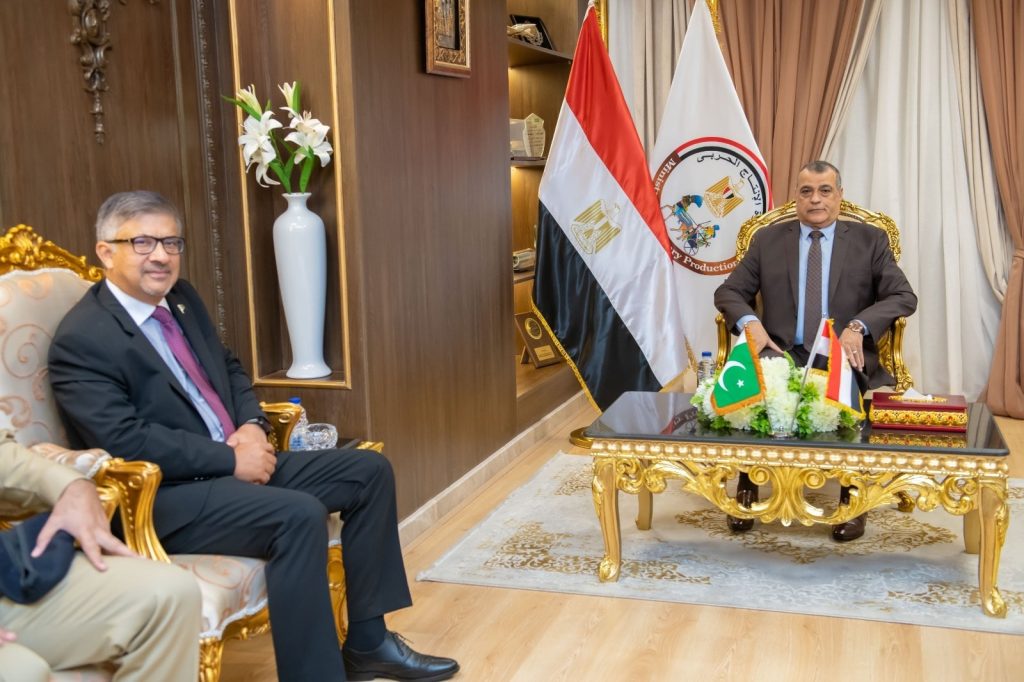
Separately, on the defence industry side, Egypt’s Minister of State for Military Production, Salah Gamblat, met with Pakistan’s ambassador to Cairo, Amer Shaukat, to discuss expanding cooperation in defence manufacturing and technology exchange. Egypt has invited Pakistan to participate in its international defence industries exhibition later this year, which officials on both sides have described as a platform for building longer-term strategic partnerships.
On the security side specifically, Pakistan’s Interior Minister Mohsin Naqvi hosted an Egyptian interior ministry delegation led by Major General Magdy Helal, with talks covering counterterrorism, anti-narcotics work, and cybercrime. The two sides agreed to strengthen joint officer training between Pakistan’s National Police Academy and its Egyptian counterpart.
Quotes From Officials
Deputy Prime Minister Ishaq Dar, speaking alongside Abdelatty during the November visit, said the two countries had decided to hold their first Joint Ministerial Commission meeting since 2010, with political consultations planned in Pakistan during the first quarter of 2026 and a follow-up forum in Cairo later that year.
Abdelatty, for his part, used the visit to convey condolences over recent terrorist attacks in Pakistan, saying Cairo “stands firmly with Islamabad” in its fight against terrorism, a statement that ties the security relationship directly to shared counterterrorism concerns rather than treating it as a purely ceremonial exchange.
On the interior ministry track, Naqvi said a Pakistani delegation would visit Egypt soon to explore further cooperation, while the Egyptian delegation described its visits to Pakistan’s Anti-Narcotics Force headquarters and National Police Academy as genuinely useful rather than a routine formality.
Impact: Why This Matters Beyond the Two Countries
Egypt and Pakistan sit in two different, strategically significant regions, and closer defence ties between them add another layer to the broader web of security relationships across the Middle East and South Asia. Pakistan’s growing defence industry ambitions benefit from access to Egyptian manufacturing know-how and the Egyptian market, while Egypt gains from Pakistan’s counterterrorism and IED-countering experience.
The economic dimension shouldn’t be understated either. The trade white-list expansion and business council reflect a relationship that’s trying to move beyond periodic military exchanges into something with more everyday economic substance, which tends to make defence partnerships more durable over time.
There’s also a regional security backdrop worth noting. With tensions elevated across the Middle East due to the Houthi-Saudi conflict and broader Iran-related tensions, countries like Egypt and Pakistan deepening bilateral security coordination fits a wider pattern of states hedging and reinforcing partnerships rather than relying on any single alliance structure.
Conclusion: What Comes Next
The near-term milestones to watch are the planned Joint Ministerial Commission meetings, the first in Pakistan and the second in Cairo, both expected in the first half of 2026, along with Egypt’s IDEAS defence exhibition where Pakistan’s defence industry is expected to participate. If the business council and trade white-list commitments actually translate into deal flow, that would mark a shift from a relationship defined mostly by symbolic visits to one with measurable economic output.
For now, officials on both sides continue to describe the relationship in largely positive terms, with no indication of friction on either the defence or economic tracks.