
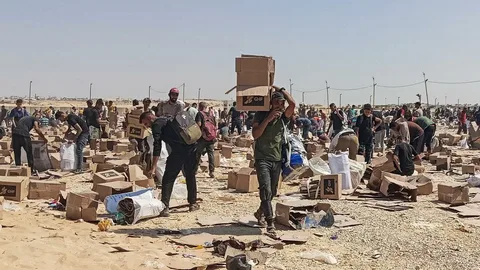

The Gaza humanitarian crisis 2026 is entering one of its most dangerous phases since the October 2025 ceasefire. Despite some improvement in food security after the ceasefire announcement, the United Nations now warns that gains are reversing fast. By July 2026, over 1.2 million people 59 percent of Gaza’s population remain in Crisis or Emergency levels of food insecurity. That figure is projected to rise to 1.4 million, or 67 percent of the population, by the end of the year.
Aid organizations including OCHA, UNICEF, and UNRWA have all flagged the same problems: funding shortfalls, Israeli access restrictions, and distribution breakdowns inside Gaza are combining to push a fragile population back toward catastrophe. The humanitarian crisis in Palestine remains one of the world’s most urgent and least resolved emergencies.
Background What Has Happened in Gaza Since October 2023
From Conflict to Ceasefire
The current Gaza humanitarian crisis is rooted in the conflict that began in October 2023. Over the following two years, Gaza’s civilian infrastructure hospitals, water systems, schools, and roads was largely destroyed or severely damaged.
A ceasefire was announced in October 2025, which created some breathing room for humanitarian operations. Aid access improved, more trucks entered the territory, and food security conditions stabilized in some areas. The ceasefire offered the first real window for systematic aid delivery in nearly two years.
Why the Situation Is Deteriorating Again in 2026
The improvement didn’t last. According to OCHA’s July 31, 2026 situation report, aid coverage has been declining since February 2026, and conditions are expected to worsen through the end of the year. The reasons are layered: funding constraints have forced several aid organizations to scale back or suspend services, Israeli access restrictions have limited how many trucks can enter and offload, and ongoing military operations continue in parts of the territory.
A July 2026 UNICEF report found that only 280 out of 633 UNICEF aid trucks from Egypt were able to offload during May and June just 44 percent of what was attempted. This isn’t a minor logistics gap. It means nearly half of the aid organized for Gaza’s children never reached them.
Gaza Humanitarian Crisis 2026 The Numbers That Define It
Food Insecurity
Between mid-April and late June 2026, over 1.2 million people in Gaza 59 percent of the population faced Crisis (IPC Phase 3) or worse levels of food insecurity. Of those, 212,000 were in Emergency (IPC Phase 4), the level just below full famine.
OCHA projects this will rise to 1.4 million people, or 67 percent of the population, between July and December 2026. The projection is driven by declining aid coverage, funding gaps, and the fragility of distribution networks inside Gaza itself.
Water and Sanitation
OCHA’s June 2026 assessment found that 63 percent of households in Gaza access less than six litres of drinking water per person per day. The minimum international standard for survival is typically considered 15 litres. Seventy-four percent collect water directly from trucks, often through irregular services under unsafe, overcrowded conditions.
Engine oil shortages are disrupting the generators that run water and sewage systems, creating a secondary public health crisis on top of the food emergency. Sewage overflow risks are rising, and solid waste is accumulating in residential and displacement areas.
Shelter and Displacement
Most of Gaza’s 2.1 million people remain displaced. Shelter assistance dropped by 37 percent from May to June 2026 due to funding shortfalls. Around 1.9 million people are exposed to ongoing health and environmental risks in overcrowded, damaged structures.
As of July 2026, site management was reaching only 33 percent of more than 1,600 displacement sites across Gaza meaning two-thirds of the places where displaced families are living have no systematic oversight of conditions or needs.
Children
UNICEF’s mid-year 2026 analysis documents the specific cost being paid by Gaza’s children. In the first half of 2026, despite significant operational constraints, UNICEF and partners reached over 1.15 million people with emergency water trucking, screened and treated 19,425 children for acute malnutrition, and provided infant feeding counselling to 163,000 caregivers.
These numbers show the scale of what aid organizations are trying to do. They also show how insufficient it remains.
The Access Problem Why Aid Is Not Getting Through
Israeli Restrictions and Crossing Closures
The most consistent theme in every major UN report on the Gaza humanitarian aid situation is access. UNRWA has been blocked by Israeli authorities from directly bringing humanitarian personnel and aid into Gaza since March 2025. The ban continues in 2026.
OCHA’s June 2026 report noted that the Zikim crossing was closed for two weeks, forcing all cargo to route through Kerem Shalom the last remaining cargo crossing through a newly established, congested checkpoint. The concentration of all aid delivery at a single crossing has created bottlenecks that slow everything from food delivery to medical supplies.
Aid Smuggling and Internal Distribution Problems
A separate problem has emerged inside Gaza. OCHA’s July 10 report flagged that external actors are exploiting humanitarian shipments to smuggle high-value items into Gaza, where the de facto authorities attempt to locate and confiscate them. This has created security concerns for aid workers and additional delays as shipments are inspected more carefully.
Reports of large food stockpiles existing alongside documented cases of food being spoiled or destroyed before reaching civilians point to serious inefficiencies in internal distribution. Aid reaching Gaza’s border does not automatically reach the people who need it most.
Funding Shortfalls
The humanitarian crisis in Gaza is also a funding crisis. Multiple UN reports in 2026 have cited funding shortfalls as a direct cause of service suspensions. Shelter assistance fell by 37 percent. Health services have been scaled back. The organizations doing the most to help have the least money to do it with.
Gaza Crisis Explained What Humanitarian Crisis Meaning Looks Like on the Ground
What Is a Humanitarian Crisis?
A humanitarian crisis meaning in formal terms refers to a situation where a population faces widespread threats to health, safety, and well-being that exceed the capacity of local response. Gaza has met this definition continuously since October 2023, and in 2026 the definition is still being exceeded daily.
In practical terms: families are collecting water from trucks in 40-degree summer heat. Children are being screened for malnutrition in damaged buildings. Aid workers are delivering food through a single cargo crossing while ongoing military operations continue nearby.
The West Bank Dimension
The humanitarian crisis in Palestine extends beyond Gaza. In the West Bank, settler attacks have become the leading cause of Palestinian injuries in 2026, accounting for 55 percent of all Palestinian injuries recorded through mid-year. More than 3,200 Palestinians have been displaced across the West Bank by settler attacks and demolitions an average of 17 people per day, double the daily rate of the previous three years.
International Response Who Is Helping and What Are They Doing
UN Agencies on the Ground
OCHA, UNICEF, UNRWA, WFP, WHO, and UNHCR are all operating in Gaza under difficult conditions. Their reports form the most reliable ongoing documentation of what is happening and what is failing.
UNRWA remains one of the largest providers of emergency learning and psychosocial support. Between October 2023 and July 2026, UNRWA’s social work teams served 279,731 displaced persons, including 3,400 unaccompanied children.
World Central Kitchen which lost staff members to Israeli strikes in previous years continues operating, though a WCK logistics driver was killed by Israeli forces on July 8, 2026, while transporting goods from Kerem Shalom within movement zones coordinated with Israeli authorities.
International Diplomatic Pressure
As the Gaza humanitarian crisis 2026 deepens, international pressure for sustained aid access has grown. Multiple governments and international bodies have called for the lifting of access restrictions and restoration of UNRWA’s operational capacity. So far, those calls have produced limited change in practice.
How Can I Go to Gaza and Help?
This question how can I go to Gaza and help comes from a genuine place, and deserves a direct answer.
You Cannot Independently Enter Gaza
Gaza is a closed territory with extremely limited and controlled entry points. Independent civilians from most countries cannot enter Gaza as volunteers. Entry requires coordination with recognized international organizations, and even those organizations face daily access restrictions.
H3: What You Can Do Instead
The most effective way to help the Gaza humanitarian crisis 2026 from outside is through established, accountable organizations with operations already inside Gaza:
- UNRWA — provides food, education, healthcare, and psychosocial support to Palestinian refugees
- UNICEF — focused on children’s needs including nutrition, water, and protection
- Médecins Sans Frontières (MSF / Doctors Without Borders) — medical teams operating in Gaza
- Islamic Relief — active in food distribution and emergency shelter
- Save the Children — children’s protection and emergency response
Donating directly to these organizations, advocating for government funding of humanitarian operations, and raising public awareness all contribute to the response in ways that are sustainable and actually reach people in need.
Conclusion
The trajectory heading into the second half of 2026 is concerning. OCHA projects food insecurity will worsen. Funding gaps are already causing service suspensions. Access restrictions show no sign of being systematically lifted. The summer heat adds another layer of risk for people living in damaged structures or tents without reliable water.
The October 2025 ceasefire created an opportunity that has been partially squandered not because the need went away, but because the political will and financial resources to respond at scale were not sustained. Whether that changes depends on decisions being made in capitals and donor countries, not in Gaza itself.What is certain is that 1.4 million people in Gaza cannot wait for those decisions indefinitely.
Frequently Asked Questions
What are the current humanitarian crises in the world in 2026?
The Gaza humanitarian crisis is consistently ranked among the most severe active humanitarian emergencies globally in 2026. Other major crises include Sudan, where a civil war that began in April 2023 has created one of the world’s largest displacement emergencies, with over 10 million people internally displaced and famine conditions in multiple regions. The Democratic Republic of Congo continues to experience chronic humanitarian emergency driven by decades of armed conflict, affecting millions in the east of the country. Haiti faces a severe compound crisis combining gang violence, political instability, food insecurity, and cholera. Yemen’s crisis, now in its second decade, remains one of the world’s most prolonged humanitarian emergencies. Climate-related disasters have also increased the frequency and scale of acute humanitarian situations across South and Southeast Asia in 2026.
Is humanitarian aid entering Gaza in 2026?
Yes, but not at the scale needed, and not reliably. Aid does enter Gaza through the Kerem Shalom crossing, which is currently the only operational cargo crossing after other crossings were closed or restricted. However, access is regularly delayed by Israeli-imposed restrictions, security incidents, and administrative impediments. UNICEF data from May-June 2026 shows that only 44 percent of its aid trucks from Egypt were able to successfully offload. UNRWA remains blocked from directly bringing personnel and aid into Gaza since March 2025. The gap between what enters and what is needed remains enormous, and the distribution of what does enter faces serious internal challenges including smuggling exploitation and management inefficiencies.
What country has the biggest humanitarian crisis?
There is no universally agreed single answer, since “biggest” depends on the metric: total people affected, severity of conditions, speed of deterioration, or death toll. Sudan is often cited as the world’s largest displacement crisis in 2026, with over 10 million internally displaced. Gaza has the highest concentration of severe food insecurity by percentage of population, with OCHA projecting 67 percent of residents will face Crisis or Emergency levels of food insecurity by year’s end. Yemen has the longest-running complex emergency. The DRC has one of the largest chronic crisis populations. Each reflects different dimensions of what humanitarian crisis means in practice. The Gaza humanitarian crisis 2026 stands out for the combination of severity, population density, and the documented obstruction of humanitarian access by a state actor.