

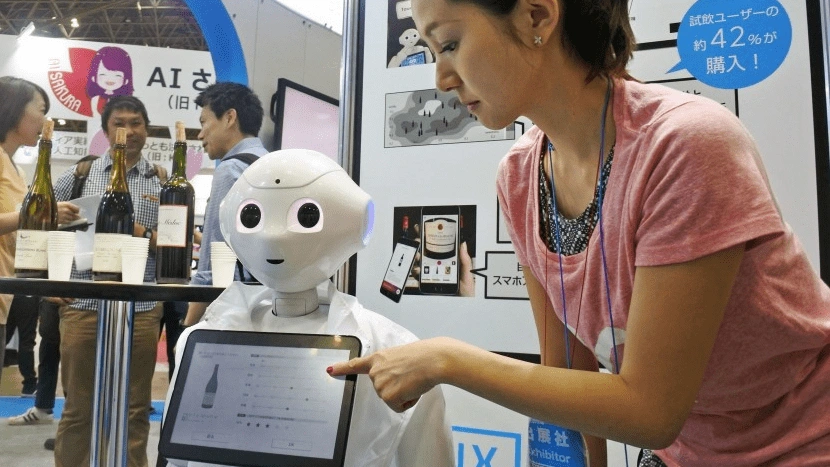

TOKYO: Japan is increasingly turning to artificial intelligence (AI) to tackle one of its most pressing economic challenges—a rapidly shrinking workforce caused by an aging population. From managing critical infrastructure to developing next-generation AI technologies, the country is embracing automation as a key pillar of its long-term economic strategy.
Beneath Tokyo’s bustling Otemachi business district, an ambitious AI-powered project is demonstrating how technology could help preserve expertise while improving operational efficiency. Deep underground, the Marunouchi Heat Supply Company operates a 30-kilometre network of heating and cooling pipelines that serve office buildings, commercial centres and transportation facilities across one of Japan’s busiest financial hubs.
To modernise its operations, the company has partnered with Tokyo-based AI developer Preferred Networks to introduce PlantPilot, an artificial intelligence system trained using decades of historical operational data and the knowledge of experienced engineers.
The AI platform continuously analyses sensor readings, predicts future operating conditions and provides recommendations to improve system performance. Rather than replacing engineers, PlantPilot is designed to support decision-making while ensuring valuable technical knowledge is preserved for future generations.
“Our biggest challenge is securing skilled personnel,” said Hidetaka Yagi, Assistant General Manager of Marunouchi’s Development and Engineering Department.
“As experienced workers retire, we risk losing years of operational knowledge. AI allows us to preserve that expertise and transfer it to younger employees.”
The company hopes to move toward more automated operations by 2027, making the project one of Japan’s most significant real-world applications of industrial artificial intelligence.
AI as a Solution to Japan’s Demographic Crisis
Japan has one of the world’s oldest populations, with declining birth rates and a rapidly aging society creating severe labour shortages across multiple sectors, including manufacturing, healthcare, logistics, construction and energy.
Unlike countries where AI is often viewed as a threat to employment, Japan increasingly sees artificial intelligence as a collaborative tool that can enhance human capabilities instead of replacing workers.
Experts say this human-centred approach allows companies to maintain productivity while addressing the shortage of experienced professionals.
The Marunouchi project reflects this philosophy by combining human judgment with AI’s ability to analyse massive amounts of operational data in real time.
Strengthening Japan’s Position in the Global AI Race
Beyond solving domestic labour shortages, Japan is also seeking to regain its competitive edge in the global technology industry, where the United States and China currently dominate AI innovation.
Despite its reputation for technological excellence, Japan has produced relatively few globally influential digital startups.
According to industry estimates, the United States is home to nearly 690 unicorn startups—private companies valued at more than $1 billion—while China has around 160. Japan, by comparison, has only about eight unicorn companies.
The gap has prompted policymakers and investors to increase support for AI startups capable of competing internationally.
Sakana AI Emerging as Japan’s AI Champion
Among the country’s fastest-growing artificial intelligence companies is Sakana AI, a Tokyo-based startup that has quickly gained attention within the global AI industry.
The company has expanded from approximately 50 employees to 150 within a year while moving beyond research into commercial AI applications.
Its growing portfolio includes products such as Sakana Chat, Sakana Marlin, and Sakana Fugu, reflecting Japan’s ambition to build globally competitive AI technologies.
Government officials believe encouraging companies like Sakana AI will help strengthen Japan’s innovation ecosystem while reducing dependence on foreign technology.
AI Seen as the Future of Japan’s Economy
As demographic pressures continue to intensify, Japan views artificial intelligence as more than just a technological advancement—it is becoming an essential tool for sustaining economic growth, preserving institutional knowledge and improving productivity.
By integrating AI into industries ranging from infrastructure management to advanced software development, Japan hopes to build a resilient digital economy capable of meeting the challenges of an aging society while remaining competitive in the rapidly evolving global AI landscape.