
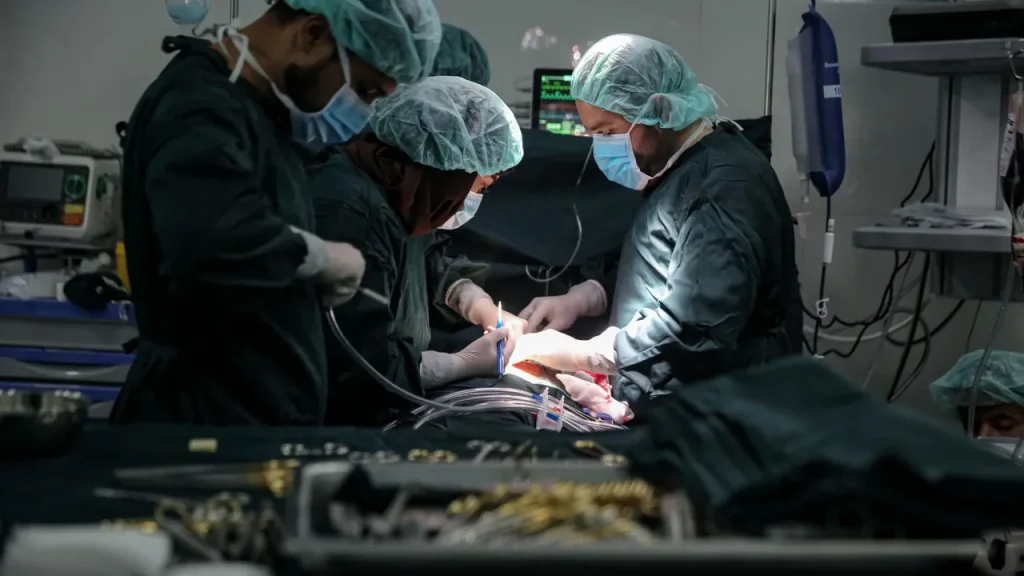

London: A major breakthrough in medical technology has been reported after surgeons successfully removed a brain tumour using live artificial intelligence assistance during surgery. The pioneering procedure allowed an AI system to analyse a live video feed of the operation and provide surgeons with real-time guidance while they worked around critical nerves and blood vessels.
The procedure was carried out at University College London Hospital on 48-year-old Rhys Hibbert, a father of two from Bedfordshire. Doctors said Hibbert could have lost his sight without the operation because of the location of the tumour.
Live AI-Assisted Brain Surgery Guides Surgeons
The most significant feature of the operation was the use of live AI-assisted brain surgery technology. During the procedure, the artificial intelligence system continuously analysed video from the operating field and helped surgeons identify important structures inside the brain.
The technology was designed to assist doctors in avoiding crucial blood vessels and nerves that can be difficult to identify during a complicated operation. By providing additional information in real time, the AI system helped the surgical team safely remove as much of the tumour as possible.
Brain surgery requires an extremely high level of precision because the brain contains delicate nerves, blood vessels and structures that control essential functions. Even a small injury to a critical area can potentially affect a person’s movement, vision, memory or other abilities.
The use of artificial intelligence in brain surgery could therefore provide surgeons with another layer of assistance during particularly challenging procedures.
AI Technology Provides Real-Time Surgical Assistance
Unlike conventional computer systems that may only provide information before an operation, the technology used in this procedure was able to analyse what was happening during surgery.
The AI system examined the live video and offered guidance that could help the surgeons understand the location of sensitive structures. This allowed the medical team to make use of additional information while operating.
Hibbert said the technology could offer important benefits from a patient-safety perspective. He explained that there are no obvious road signs inside the human head to guide surgeons through complex brain operations.
The successful procedure demonstrates how AI and medical surgery could increasingly work together, with artificial intelligence supporting doctors rather than replacing their clinical judgement.
Brain Tumour Was Discovered After Sudden Seizure
Until around 18 months ago, Hibbert was fit and healthy. The customer services manager regularly walked around two miles during his lunchtime break.
However, his life changed when he suddenly lost consciousness and suffered a seizure while walking on the road.
Doctors subsequently carried out brain scans and discovered an 11mm non-cancerous tumour growing on his pituitary gland.
The pituitary gland is a small organ located at the base of the skull. Despite its relatively small size, it plays an important role in controlling the body’s hormones.
The gland produces hormones involved in important functions such as growth, metabolism, blood pressure and regulation of body temperature.
Because of the tumour’s location, surgeons needed to operate with considerable precision to remove it while protecting surrounding nerves and blood vessels.
Artificial Intelligence Helps Remove Brain Tumour
The successful AI-assisted brain tumour surgery highlights the growing role of artificial intelligence in modern medicine.
During the operation, AI analysed the surgical footage and provided additional information to the medical team. Its role was to support surgeons as they navigated the complicated anatomy of the brain.
The technology did not replace the surgeons or make independent medical decisions. Instead, it acted as an additional tool that could help doctors identify important structures and improve their understanding of the operating area.
Experts believe this type of technology could eventually become useful in other highly complex surgical procedures.
Future of AI in Brain Surgery
The combination of artificial intelligence and brain surgery could become an important area of medical research in the coming years.
AI is already being explored and used in healthcare for medical-image analysis, disease detection, treatment planning, drug development and patient monitoring. Using AI during an actual operation represents another potentially significant step in the development of medical technology.
Real-time AI systems could eventually help surgeons perform highly precise procedures by identifying anatomical structures, highlighting potential risks and providing information that may not be immediately visible to the human eye.
However, experts will need to conduct further research and clinical testing before such technology can become widely used in hospitals.
Patient safety, accuracy and reliability will remain essential considerations as AI-assisted surgery continues to develop.
For Hibbert, the successful operation represents a major personal milestone as well as a potential breakthrough for modern medicine. His case demonstrates how advanced technology could help surgeons tackle some of the most challenging procedures involving the human brain.
The development of live AI-assisted brain surgery could ultimately open new possibilities for safer and more precise treatment of brain tumours and other neurological conditions.