
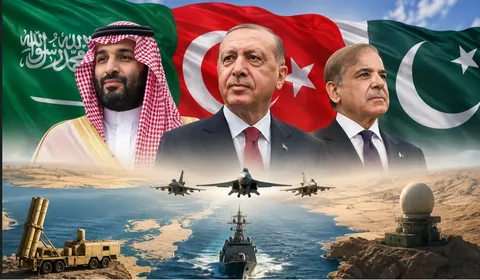

The Pak-Saudi alliance has moved from a historical friendship into something structurally different this year. On August 7, 2026, Pakistan, Saudi Arabia, and Turkey signed the Mecca Joint Defence Agreement the first mutual defence pact of its kind among Muslim-majority nations binding the three countries to treat an attack on any one of them as an attack on all three.
That agreement is now the backdrop to every diplomatic exchange between Islamabad and Riyadh, including Friday’s phone call between Deputy Prime Minister Ishaq Dar and Saudi Foreign Minister Prince Faisal bin Farhan Al Saud.The two ministers discussed regional developments and matters of mutual interest, including preparations for the upcoming R4 meeting, and Dar congratulated his Saudi counterpart on the election of Mauritania’s Ismail Ould Cheikh Ahmed as the new Secretary General of the OIC.
Background How the Pak-Saudi Alliance Reached This Point
A Relationship Built Over Decades
Pakistan and Saudi Arabia have maintained close ties since Pakistan’s independence, grounded in shared religion, economic interdependence, and security cooperation. Pakistan has long provided military training and technical assistance to Saudi forces, and Saudi Arabia has historically offered financial support to Pakistan during economic crises.
The two countries first formalized a bilateral collective-defence commitment through the Strategic Mutual Defence Agreement (SMDA), signed on September 17, 2025, at Al-Yamamah Palace in Riyadh by Crown Prince Mohammed bin Salman and Prime Minister Shehbaz Sharif.That bilateral pact set the stage for the trilateral agreement that followed less than a year later.
What Triggered the Mecca Pact
The Pakistan Saudi defence pact expanded into a three-way arrangement against a specific regional backdrop. Saudi Arabia was struck by Iranian drones following the opening of the 2026 Iran war, which threatened oil exports and stability.The security environment had deteriorated sharply enough that all three governments concluded a formal mutual defence commitment was necessary rather than optional.
By mid-2026, Pakistan had deployed several thousand troops, fighter aircraft, drones, and an air-defence system to Saudi Arabia, and opened talks with Kuwait in July 2026 on an expanded security arrangement.
The Mecca Joint Defence Agreement What It Actually Says
The Core Provision
The agreement stipulates that any armed attack against any one of the three states shall be regarded as an attack against them all.Turkish Foreign Minister Hakan Fidan drew explicit comparisons to NATO’s Article 5 collective defence clause, which carries the same principle.
The agreement is called the Turkey Saudi-Pakistan defence pact in some coverage, and the Mecca Joint Defence Agreement or Mecca Joint Deterrence Agreement in others all refer to the same document signed in Mecca on August 7.
What Each Country Brings
Together, the three countries combine nearly 1.4 million active military personnel, 3,400 aircraft, 6,000 tanks, and more than 340 naval assets according to the 2026 Global Firepower Index. Their combined defence budgets amount to about $124.4 billion annually Saudi Arabia leads at $63.9 billion, Turkey at $51.4 billion, and Pakistan at $9.1 billion.
What the numbers alone don’t capture is what each country brings distinctively. Turkey has NATO’s second-largest military, Saudi Arabia is the world’s top oil exporter, and Pakistan is the only Muslim nation with nuclear weapons.
What It Doesn’t Include
Not everyone is treating the pact as a transformation.The Mecca pact does not establish a central command system, any paths to achieve greater interoperability, or clear obligations in terms of defence spending and procurement. It also does not mention the use of nuclear weapons.
That’s a significant qualification. The collective defence principle is there, but the operational infrastructure that makes NATO functional shared command structures, standardized equipment, defined burden-sharing is not yet part of this agreement.
FM Dar Speaks to Saudi and Turkish Counterparts August 28 Update
The Phone Calls
Deputy Prime Minister and Foreign Minister Ishaq Dar held separate telephone conversations with Saudi Foreign Minister Prince Faisal bin Farhan Al Saud and Turkish Foreign Minister Hakan Fidan on Friday.
With Saudi Arabia,Dar and Prince Faisal discussed the evolving regional situation, matters of mutual interest, and preparations for the upcoming R4 meeting. Dar also congratulated his Saudi counterpart on the consensus election of Mauritania’s Ismail Ould Cheikh Ahmed as the new Secretary General of the OIC.
The New OIC Secretary General
The OIC election took place at the 23rd Extraordinary Session of the OIC Council of Foreign Ministers in Jeddah.Ishaq Dar expressed the resolve to work closely with Ismail Ould Cheikh Ahmed in cultivating strengthened partnerships and constructive cooperation among the Ummah, and wished him every success in fostering Islamic unity, peace, and collective action.
The OIC now has a new Secretary General just as the organization’s member states are dealing with one of the most volatile periods in the Muslim world’s recent history the Iran war, the Gaza conflict’s aftermath, and the new Mecca defence pact all demand active OIC engagement.
Pakistani Population in Saudi Arabia The Human Dimension
The Pakistani population in Saudi Arabia gives this alliance a dimension beyond governments and generals. Pakistan is one of the largest sources of expatriate workers in Saudi Arabia, with an estimated 2.6 to 2.7 million Pakistanis living and working there as of 2026.
Their remittances form a significant part of Pakistan’s foreign exchange earnings. The bilateral relationship therefore runs at multiple levels simultaneously: state-to-state defence cooperation, economic interdependence, and the daily lives of millions of Pakistani families whose livelihoods depend on the Gulf connection.
This is part of why Islamabad consistently prioritizes the relationship with Riyadh regardless of which government is in power in Pakistan. The stakes are not abstract they’re the remittances that flow into Pakistani bank accounts every month.
UAE Pakistan Defence Pact The Broader Gulf Picture
The Mecca agreement has also renewed attention on the UAE Pakistan defence pact question. Pakistan and the UAE already have strong bilateral defence cooperation, separate from the Saudi arrangement. The UAE has not joined the Mecca Joint Defence Agreement, but the two countries have deepened military training, equipment, and intelligence-sharing ties.
Analysts watching the region note that Pakistan is now operating in a more complex Gulf security environment than it was a year ago with formal defence obligations to Saudi Arabia and Turkey, growing cooperation with the UAE, and ongoing delicate balancing between the Gulf states and Iran, with whom Pakistan also shares a border and significant trade.
Saudi on India The Geopolitical Triangle
Saudi Arabia’s relationship with India adds complexity to the Pak-Saudi alliance. The Kingdom maintains extensive economic ties with India Indian workers form the largest expatriate community in Saudi Arabia, and trade between Riyadh and New Delhi runs into the hundreds of billions.
Saudi on India positioning has been carefully managed: Riyadh has not aligned with Pakistan’s position on Kashmir, and during periods of India-Pakistan tension, Saudi Arabia has generally called for dialogue rather than taking sides. The Mecca pact has not changed that fundamentally Pakistan’s FM Dar was explicit that the agreement is “purely defensive in nature” and not aimed at any specific country.
Impact What the Mecca Pact Means Regionally and Globally
A Shift in Middle East Geopolitics
The Mecca Joint Defence Agreement represents an inflection point in the emerging multipolar order in the Middle East and South Asia. For Ankara, this broadens an umbrella already opened to allies in Qatar, Syria, and Libya adding density and massive new resources to what amounts to a Muslim collective defence mechanism.
OIC Secretary General Hissein Brahim Taha welcomed the agreement and expressed hope that the pact would contribute to peace and prosperity in the region. He said the pact would serve as an important pillar for promoting security and stability in the region and the wider Muslim world.<
Conclusion What Comes Next
The Pak-Saudi defence pact has moved from bilateral to trilateral in the space of less than a year. The R4 meeting now on the diplomatic calendar which Dar and Prince Faisal discussed Friday will be one of the early institutional tests of how the Mecca framework actually operates.
Whether the pact develops into something with genuine operational capability, or remains primarily a political statement of solidarity, will become clearer over the next year. What’s already clear is that Pakistan’s strategic positioning in 2026 is significantly different from where it was in 2024 with formal defence commitments to the two most powerful Sunni-majority states, a nuclear backstop others in the pact don’t have, and a new Secretary General at the OIC with whom Islamabad has pledged close cooperation.
FAQs
Does OIC support Pakistan?
The OIC has consistently supported Pakistan’s position on Kashmir, calling for dialogue and a peaceful resolution based on UN Security Council resolutions. Pakistan is a founding member of the OIC and one of its most active participants. The organization has repeatedly passed resolutions expressing solidarity with the Kashmiri people and calling for their right to self-determination. However, OIC resolutions are not binding, and implementation depends on member states. The election of a new OIC Secretary General in August 2026 with Pakistan pledging close cooperation suggests Islamabad intends to keep the organization actively engaged on issues it cares about.
Who is Pakistan’s biggest friend?
China is Pakistan’s most comprehensive strategic partner, with deep cooperation across defence, infrastructure, trade, and diplomacy through CPEC and bilateral agreements. Saudi Arabia is Pakistan’s most important partner in the Muslim world, combining financial support, the Pak-Saudi alliance’s defence dimension, and a shared religious identity that gives the relationship a unique weight in Pakistani public opinion. Turkey has also emerged as a significant partner, particularly through the Mecca Joint Defence Agreement. The United States remains important economically and in terms of international financial institutions, but the relationship has been more transactional since 2021. No single country fits every dimension of “biggest friend” it depends on the domain being discussed.
Does Pakistan support Iran or Saudi?
Pakistan has consistently tried to balance its relationships with both Iran and Saudi Arabia, a position that requires real diplomatic skill given how sharp the rivalry between the two countries has been. Pakistan’s official position is that it will not take sides in any intra-Muslim conflict, and has at various points offered to mediate between Riyadh and Tehran. The Mecca Joint Defence Agreement has complicated that balance: Pakistan has now signed a formal mutual defence pact with Saudi Arabia, and its FM has been explicit that the agreement is not aimed at Iran. But the combination of deployed troops, fighter aircraft, and an air-defence system in Saudi Arabia is read differently in Tehran than in Islamabad. Pakistan maintains diplomatic and trade relations with Iran and shares a 900-kilometer border abandoning that relationship would carry real economic and security costs that Pakistani policymakers have no intention of accepting.