

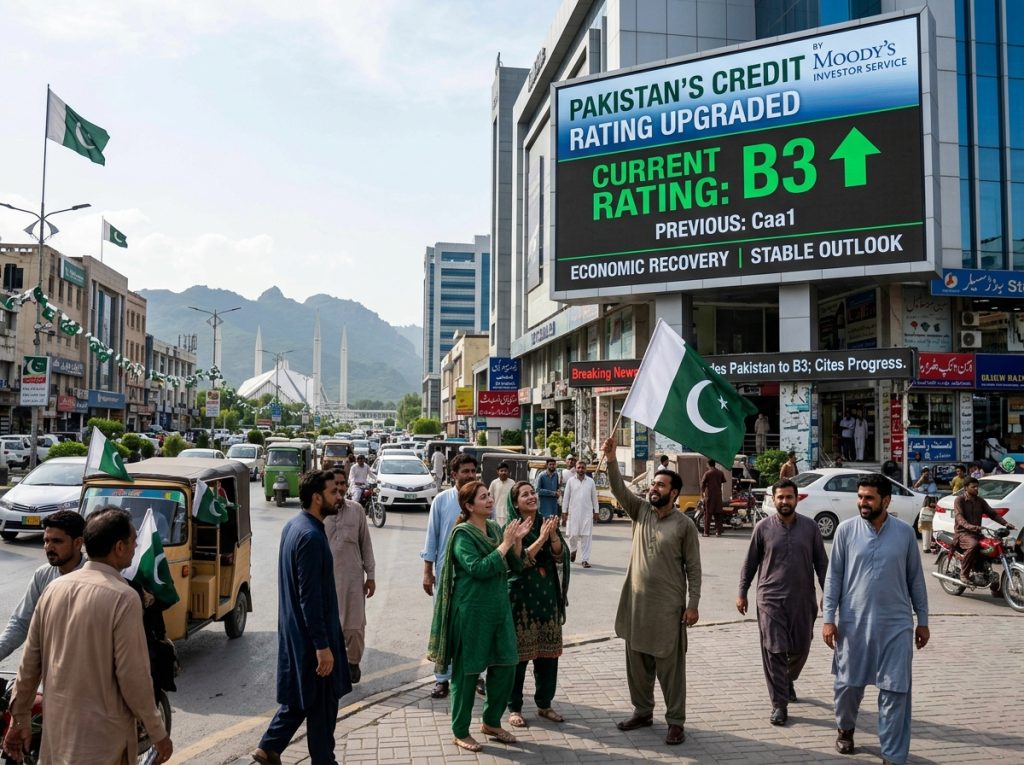

Moody’s Ratings has raised Pakistan’s sovereign credit rating a notch higher, moving it from Caa1 to B3 with a stable outlook. The upgrade reflects visible improvement in the country’s foreign exchange position and a lighter debt-servicing burden. It also marks another step in Pakistan’s slow climb back toward international credit markets.
Background
Pakistan’s credit standing had been under pressure for years due to a narrow revenue base, high debt costs, and repeated balance-of-payments crises. The situation began improving from 2024 onward as the country entered an IMF-backed reform programme. Moody’s had already lifted Pakistan’s rating to Caa2 from Caa3 in August 2024, before Fitch and S&P followed with their own upgrades over the next year. The latest Moody’s move continues that same upward trend.
Details
Moody’s Global Ratings upgraded Pakistan’s credit rating on August 24, 2026, to “B3” from “Caa1,” while maintaining a stable outlook. The agency pointed to stronger governance signals and growing confidence that recent gains in Pakistan’s external and fiscal position can hold steady over time.
Several numbers back up this optimism. Pakistan’s foreign exchange reserves rose to around $17 billion by the end of July 2026, up from roughly $14 billion a year earlier, giving the country close to three months of import cover. The external vulnerability indicator, a measure of how exposed a country is to short-term foreign payment pressure, improved to about 145% in 2026 compared with 230% in 2025.
The government’s own debt burden has also become easier to manage. Interest payments absorbed roughly 35% of government revenue in fiscal year 2026, down sharply from 49% in fiscal 2025. That decline gives Islamabad more fiscal room for development spending and social programmes going forward.Pakistan has also started testing international capital markets again after a long absence. The country issued a $750 million three-year Eurobond in April 2026, followed by its first Panda bond worth about CNY1.75 billion, roughly $250 million, in May. Both moves suggest that investor appetite for Pakistani debt is slowly returning.
What Officials Are Saying
Prime Minister Shehbaz Sharif congratulated the nation over the rating upgrade, describing it as a positive step for the economy. Moody’s, however, tempered the celebration with a note of caution. The agency said the one-notch elevation would not materially change Pakistan’s overall credit risk, since the country’s debt profile remains weak due to a fragile external position and limited investment growth.
The ratings agency also flagged governance concerns that continue to weigh on the outlook. International surveys still point to weak rule of law, limited control of corruption, and constrained government effectiveness in Pakistan. These structural issues remain separate from the purely financial metrics that triggered the upgrade.
Impact on the Economy and Region
A higher credit rating typically lowers the cost of borrowing, since lenders view the country as a smaller default risk. For Pakistan, this could translate into cheaper terms the next time it approaches global bond markets or seeks fresh loans. It may also encourage more foreign portfolio investment into government securities, which had slowed sharply during the worst years of the crisis.Regionally, the upgrade places Pakistan on a different trajectory from some of its neighbours, even as it remains well below investment-grade status. The improvement also arrives at a sensitive moment, as the government prepares to venture into western capital markets to raise fresh billions in financing. A better rating gives Pakistani officials a stronger hand when negotiating terms with international investors.
Conclusion
Pakistan’s B3 rating still sits deep in speculative-grade territory, several notches below the investment-grade threshold that attracts the most cautious global investors. Moody’s own language makes clear that the upgrade is incremental rather than transformative, and that risks around external financing and fiscal flexibility have not disappeared.Even so, three major agencies moving in the same direction within roughly two years signals a genuine, if fragile, turnaround. Analysts will now be watching whether Pakistan can sustain reserve growth, keep inflation contained, and stay on track with its IMF programme heading into the next fiscal year. Any slippage on these fronts could slow further progress, while continued discipline could open the door to additional upgrades down the line.
FAQs
Has Pakistan repaid its debt?
Pakistan has not repaid its overall external debt, which still runs into tens of billions of dollars, but it has kept up with its scheduled repayments and interest obligations without defaulting. In recent years, the country has successfully repaid maturing bonds and loan instalments on time, which is one of the reasons rating agencies have grown more confident in its finances. Improved reserves and lower interest costs as a share of revenue have made debt servicing more manageable, though Pakistan continues to rely heavily on fresh borrowing, rollovers, and IMF support to meet its obligations rather than paying down its total debt stock.
Which country has an AAA credit rating?
Several economies hold the top AAA rating from the major global agencies, including Germany, Switzerland, Singapore, Denmark, Norway, the Netherlands, Sweden, Luxembourg, and Australia. Canada is rated AAA by some agencies as well, though not uniformly by all three. These countries typically combine low government debt, strong institutions, stable currencies, and a long history of meeting financial obligations without disruption, which is why they sit at the very top of the sovereign credit scale, far above countries like Pakistan that remain in speculative-grade territory.
Does Pakistan have the highest debt?
No, Pakistan does not have the highest debt in the world, either in absolute dollar terms or as a share of its economy. Countries such as Japan, the United States, and several European nations carry far larger government debt loads relative to their GDP, but they are able to manage it comfortably because of deep domestic capital markets, stronger currencies, and higher-rated access to cheap financing. Pakistan’s challenge is less about the sheer size of its debt and more about its capacity to service that debt given a narrow export base, currency pressures, and reliance on external, dollar-denominated borrowing.