
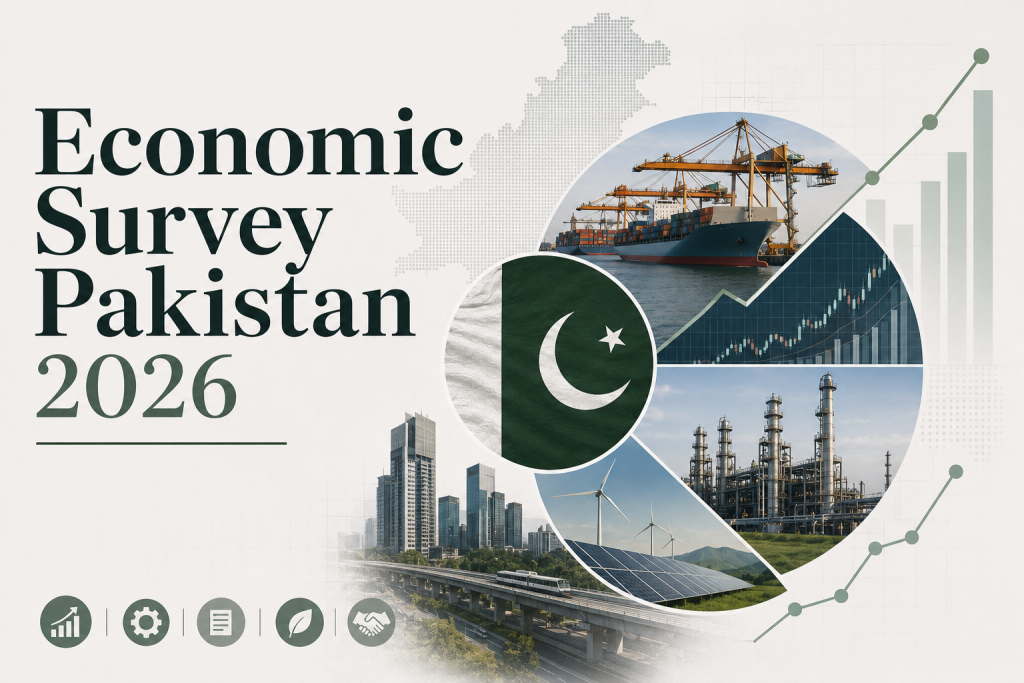

Pakistan’s economy grew 3.7 percent in the fiscal year that ended in June 2026, according to the government’s own Economic Survey, marking its fastest pace of growth in four years. The figure came in above last year’s 3.18 percent but still fell short of the government’s original 4.2 percent target for the year.
Background: A Decade of Ups and Downs
Pakistan’s growth story over the past ten years hasn’t been a straight line in either direction. State Bank of Pakistan data shows the economy expanding at a healthy 6.10 percent in FY2017-18, then sliding to 3.12 percent the following year as external debt pressures and a widening current account deficit forced policymakers to tighten spending.
Then came the pandemic. Growth actually turned negative, contracting by 0.94 percent in FY2019-20, the sharpest hit the economy had taken in years. It bounced back hard afterward, hitting 5.77 percent in FY2020-21 and 6.18 percent in FY2021-22, driven mostly by pent-up consumer demand and loose monetary policy in the aftermath of Covid lockdowns.
That recovery didn’t last. FY2022-23 brought another contraction, this time 0.21 percent, as floods, political instability, and a balance-of-payments crisis pushed Pakistan close to default and into a fresh IMF bailout program. Growth has been climbing back gradually since then: 2.62 percent in FY2023-24, 3.18 percent in FY2024-25, and now 3.7 percent in FY2025-26.
The Details: What’s Actually Driving Growth Right Now
Finance Minister Muhammad Aurangzeb presented the latest Economic Survey in Islamabad, framing the 3.7 percent figure as evidence of “resilience and discipline” after a year that started under the shadow of global tariff uncertainty. The fiscal deficit also narrowed sharply, dropping to 0.7 percent of GDP for the July-March period, down from 2.6 percent a year earlier.
Quarterly figures back up the improvement. The economy grew 3.89 percent in the October-December quarter of FY2025-26, up from 2.18 percent in the same period a year before. Industrial output led the way with 7.4 percent growth, helped along by a rebound in large-scale manufacturing and auto production, which climbed more than 61 percent, though largely because it was recovering from years of import restrictions that had crushed the sector.
Agriculture told a weaker story. The sector, which still employs a large share of the workforce, grew just 2.89 percent, and Dawn’s own analysts called that underwhelming for a sector meant to anchor rural incomes. Services stayed the biggest single contributor to overall growth, expanding on the back of wholesale trade, transport, and continued government and consumer spending.
Quotes From Officials and Economists
Dr. Aneel Salman, chair of Economic Security at the Islamabad Policy Research Institute, described Pakistan’s recovery as “fragile yet stabilising” when speaking to Dawn earlier in the cycle. He pointed to inflation falling sharply as a genuine bright spot, but cautioned that deep structural problems and a heavy external debt burden still limit how fast the economy can realistically grow.
The Asian Development Bank struck a similarly cautious tone in its April 2026 outlook, forecasting 3.5 percent growth for the fiscal year (later matched almost exactly by the actual 3.7 percent outcome) while flagging downside risk from global uncertainty and tensions in the Middle East. The bank projected growth accelerating further to 4.5 percent in FY2027 as manufacturing and investment continue recovering.
Impact: What This Means Regionally and for Households
A growth rate hovering around 3 to 4 percent beats the outright contractions Pakistan saw in FY2020 and FY2023, but it’s still not fast enough to meaningfully cut poverty or absorb a young, fast-growing population into the workforce. Dawn’s editorial desk made a fair point on this: much of the industrial rebound reflects bouncing back from a low base rather than genuine productivity gains, and that distinction matters for how sustainable the current growth actually is.
For everyday households, the bigger relief has come from falling inflation rather than GDP growth itself, since inflation dropped to as low as 0.3 percent in April 2025 after years of double-digit price increases. That’s given the State Bank room to ease interest rates, which in turn makes borrowing cheaper for businesses looking to expand.
Conclusion: What Comes Next
Forecasters broadly expect Pakistan’s growth to keep climbing gradually rather than jump sharply. The ADB has pencilled in 4.5 percent for FY2027, while independent projections put Pakistan’s compound annual growth rate at around 3.4 percent through 2030 if current reform momentum under the IMF program holds.
Much of that will depend on factors outside Pakistan’s direct control, including global trade conditions, regional stability, and how long the current period of fiscal discipline can be sustained without triggering public backlash over austerity measures. The next major checkpoint will be the FY2027 economic survey, due roughly a year from now.
FAQs
Did Pakistan hit 400 billion GDP?
Not yet, based on the most recent widely cited figures. Pakistan’s nominal GDP stood at roughly 373 billion dollars as of the latest annual measurement, still short of the 400 billion mark. Getting there will depend on a combination of real GDP growth, exchange rate movements, and inflation, since nominal GDP in dollar terms is sensitive to all three, not just the underlying growth rate covered in this article.
What will be Pakistan’s GDP in 2030?
No official government figure exists for 2030 specifically, but independent economic forecasters have projected a compound annual growth rate of around 3.4 percent between now and then, assuming reform efforts under the current IMF program continue without major disruption. That would put Pakistan on a path of steady, if unspectacular, expansion rather than a dramatic leap, though forecasts this far out carry significant uncertainty and tend to shift as global and domestic conditions change.
What is the current GDP growth rate of Pakistan in 2026?
Pakistan’s GDP grew 3.7 percent in the fiscal year 2025-26, according to the government’s Economic Survey presented in June 2026 by Finance Minister Muhammad Aurangzeb. That’s the fastest pace of growth the country has posted in four years, though it still came in below the government’s original target of 4.2 percent for the year.