

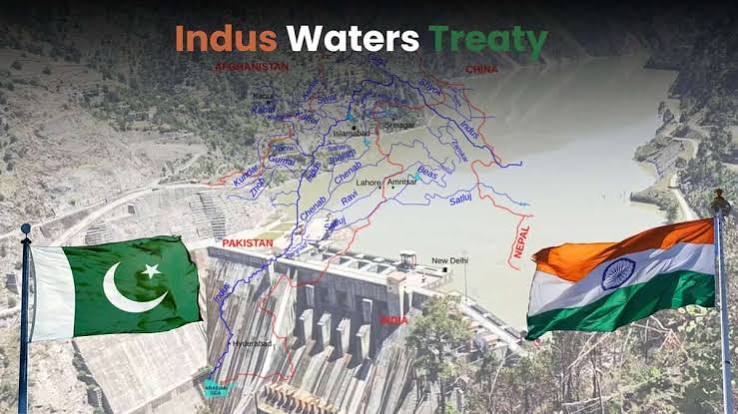

Pakistan’s Prime Minister Shehbaz Sharif has issued a stark warning to India at the United Nations, saying any attempt to stop, block or divert Pakistan’s share of the Indus river waters would be considered an act of war. He made the remarks while addressing the UN General Assembly in New York on Friday, escalating a dispute that has simmered since India suspended the decades-old water-sharing treaty last year.
Background
The Indus Waters Treaty was signed in 1960 and has long been seen as one of the most durable water-sharing agreements between two rival nations. It divides the six rivers of the Indus system, giving India control over the three eastern rivers while reserving the three western rivers mainly for Pakistan’s irrigation and hydropower needs.
The current crisis began in April 2025, when India placed the treaty in abeyance following a militant attack in Pahalgam that killed civilians in Indian-administered Kashmir. India has said the treaty will remain suspended until Pakistan ends its alleged support for cross-border militancy, a charge Islamabad denies.
Details
Speaking at the UN General Assembly’s General Debate, Sharif described the Indus river system as the lifeblood not just of Pakistan but of the wider region. He argued that India’s move to suspend the treaty has no legal grounding and said Islamabad continues to regard the agreement as valid and binding.
Sharif told delegates that any attempt to stop, impede or divert Pakistan’s share of the waters would be treated as an act of war, adding a blunt warning that India should not misjudge the seriousness of that statement. He also said water should never be used as a weapon between neighbouring countries.
The prime minister’s remarks came just weeks after the Permanent Court of Arbitration in The Hague ruled, on August 31, 2026, that India’s suspension of the treaty was not permissible under international law. India has rejected that ruling, with its foreign ministry describing the arbitration body’s authority as invalid.
Pakistan’s agricultural heartlands in Punjab and Sindh depend heavily on the western rivers covered by the treaty for irrigation and drinking water, meaning any sustained disruption to those flows would directly affect food security and the rural economy.
Quotes
Sharif told the assembly that rivers should nourish nations rather than divide them, framing the dispute as a matter of principle as much as policy. On the Indian side, Home Minister Amit Shah has previously said the treaty will “never” be restored, and that water once meant for Pakistan would instead be redirected for use within India.
Impact
The exchange marks a significant hardening of rhetoric between two nuclear-armed neighbours already at odds over multiple issues, including Kashmir. Framing water diversion explicitly as a potential trigger for war raises the stakes considerably, since the Indus system underpins roughly 90% of Pakistan’s agriculture and a large share of its hydropower generation.
For the wider region, the standoff highlights how water scarcity and transboundary river disputes are becoming security flashpoints rather than purely technical or environmental issues. Analysts have pointed to the Indus dispute as an example of water increasingly being treated as a lever of geopolitical pressure rather than a shared resource managed through cooperation.
Conclusion
With India rejecting the Hague ruling and showing no sign of restoring the treaty, and Pakistan continuing to describe any diversion as a red line, the two countries remain far from resolving the underlying dispute. Whether this reaches a genuine crisis point will likely depend on India’s next moves on the ground, particularly around any new canal or diversion projects, and whether international pressure or mediation efforts gain traction in the months ahead.
Frequently Asked Questions
What is the Indus Waters Treaty?
The Indus Waters Treaty is a water-sharing agreement signed by India and Pakistan in 1960, with the World Bank acting as a broker and guarantor of the deal. It divides the six rivers of the Indus basin between the two countries, allocating the three eastern rivers, the Ravi, Beas and Sutlej, to India, while reserving the three western rivers, the Indus, Jhelum and Chenab, primarily for Pakistan’s use. For more than six decades the treaty was considered a rare example of successful cooperation between the two rivals, surviving multiple wars and periods of severe tension, until India moved to suspend it in 2025.
Why did India suspend the Indus Waters Treaty?
India placed the treaty in abeyance in April 2025 following a militant attack in Pahalgam, in Indian-administered Kashmir, that killed a number of civilians. New Delhi blamed cross-border militancy linked to Pakistan for the attack, a claim Islamabad has consistently denied, and said it could not continue honouring a water-sharing arrangement while facing what it described as sustained hostility from across the border. Indian officials, including Home Minister Amit Shah, have since said the suspension is permanent and that water previously allocated to Pakistan will instead be diverted for use within India, such as through new canal projects to Rajasthan.
What did the Court of Arbitration rule on the Indus Waters Treaty?
On August 31, 2026, the Permanent Court of Arbitration in The Hague issued a ruling stating that India’s unilateral suspension of the Indus Waters Treaty was not permissible under the terms of the treaty or international law. The court held that the agreement remains legally binding despite India’s abeyance decision, effectively backing Pakistan’s long-standing position that the treaty cannot be suspended outside its own dispute-resolution mechanisms. India, however, has rejected the ruling entirely, with its Ministry of External Affairs arguing that the arbitration court’s authority to hear the case in the first place was not valid, leaving the practical dispute unresolved despite the legal decision