
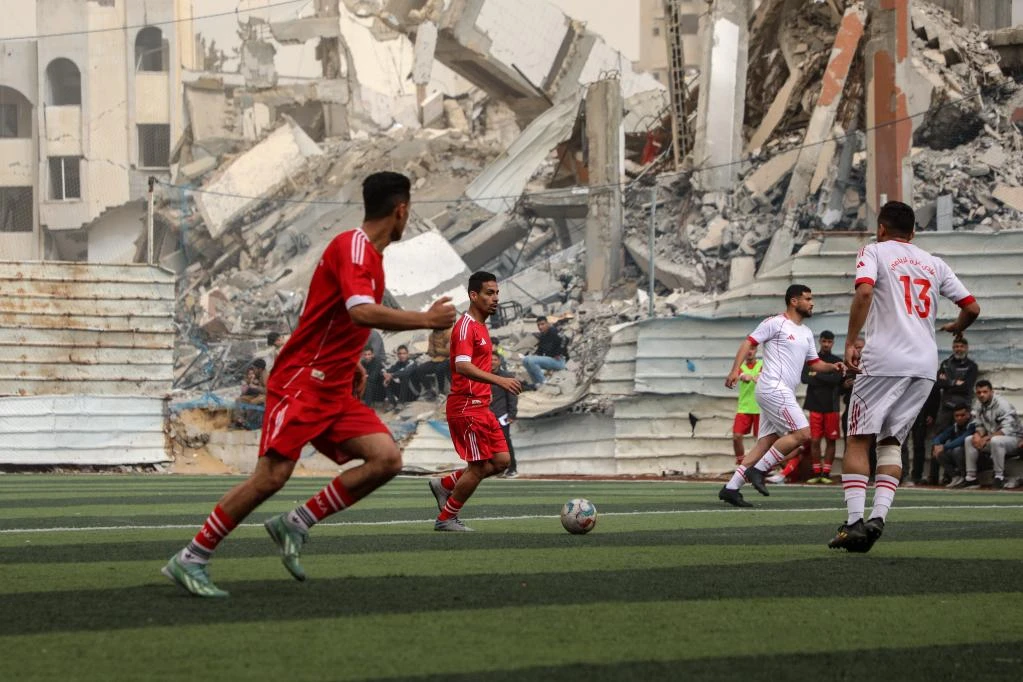

Palestinian football officially resumed this week after a nearly three-year halt caused by the war in Gaza, with a new tournament dedicated to the memory of over 1,000 Palestinian athletes killed since October 2023. The opening match took place at Faisal Al-Husseini Stadium in Al-Ram, West Bank, drawing thousands of fans back to the stands for the first time in years.
Background: Football Frozen by War
Palestinian professional sports came to a standstill after the Hamas-led attack on Israel on October 7, 2023, and the war that followed in Gaza. According to the Palestinian Football Association’s own count, 1,014 Palestinian athletes lost their lives during that period, a toll that touched clubs, youth academies, and refereeing staff alike.
Much of Gaza’s sporting infrastructure was damaged or destroyed in the process. Some football fields in the territory have been repurposed entirely, turned into makeshift shelters for displaced families rather than places to play.
Details: A Tournament Named for the Fallen
The Palestinian Football Association organized its first tournament in three years, naming it the 1,000 Martyrs Cup in honour of the athletes who died. More than 200 teams are taking part, with matches held simultaneously across the West Bank, Gaza, and Palestinian refugee camps in Lebanon.
The opening game unfolded with a mix of celebration and mourning. At the ten-minute mark, the referee paused play for a moment of silence, and stadium screens displayed the words “Football returns to Palestine” as the crowd’s energy returned afterward. Thousands attended, with families, women, and children seated in a designated section of the stands.
Not every team has it easy getting there, either. West Bank clubs have to cross Israeli military checkpoints just to travel between host cities, something teams playing elsewhere in the tournament simply don’t deal with.
Quotes From Players and Officials
Khalil Jadallah, a longtime Palestinian sports commentator, was back behind the microphone for the opening match after spending three years mourning colleagues and players lost to the war. He described the moment as bittersweet, telling AFP he felt “a feeling of joy at returning after such an absence, but also a feeling of loss.”
“We lost players… fans, administrators and referees,” Jadallah said, reflecting on how deeply the war cut into the sport’s community, not just its athletes.
Khalil Matar, who plays for Khadamat Rafah, said football had meant everything before the war and that its absence afterward left a real void in daily life. He pointed to the tournament running simultaneously across the West Bank, Gaza, and Lebanon’s refugee camps as a sign of what he called national unity among Palestinians.
Abdullah Abu Ghassan of the Shabab Jaba club struck a determined tone despite the ongoing travel obstacles, saying his team remains committed to continuing sporting activity and developing younger players regardless of the hurdles ahead.
Among the fans, Maysan Suleiman, a 35-year-old attendee from Al-Ram, said she hadn’t come to cheer for either side on the pitch. She was there, she said, to commemorate the athletes who died and to support the tournament’s purpose rather than any particular team, “since they’re all sons of Palestine.”
Impact: More Than a Sporting Event
For a community that lost over a thousand athletes, this isn’t just about the scoreline. It’s a memorial as much as a tournament, a way of saying ordinary life is still trying to happen even under strain. Organizers also put up a memorial outside the stadium listing the names of athletes killed during the war.
Timing matters here too. This comeback lands right in the middle of ongoing arguments within global football over whether federations tied to the conflict should keep competing, so the sport’s connection to the war isn’t going away from the headlines any time soon.
Conclusion: What Comes Next
With matches now under way across three separate regions, the tournament is expected to continue as clubs work through the logistics of travel, checkpoints, and rebuilding what the war interrupted. For players and fans alike, simply completing the season may be as significant as who ends up winning it.
FAQs
Did FIFA suggest suspending Israel over the war in Gaza?
The Palestinian Football Association formally asked FIFA to suspend the Israel Football Association from international competition, arguing that the war violated FIFA’s own statutes. FIFA repeatedly delayed a decision on that request, deferring instead to its European counterpart, UEFA, on the matter. As of late 2025, FIFA’s ruling council had taken no formal action against Israel and instead called for peace, with the debate continuing to shift depending on the state of ceasefire negotiations.
Does Real Madrid support Palestine?
Real Madrid’s charitable arm, the Real Madrid Foundation, has run a humanitarian partnership with UNRWA since 2011, funding sports programmes for Palestinian refugee children in Gaza and the West Bank. That said, the club itself has not taken an official political position on the Israel-Palestine conflict, and reports of Palestinian flags being turned away at the Santiago Bernabéu were addressed by La Liga’s president, who denied any league-wide ban was in place. The two things, humanitarian outreach and political stance, shouldn’t be conflated.
Does FIFA recognize Palestine?
Yes. The Palestine Football Association has been a full FIFA member since 1998, giving it the same voting rights and eligibility to compete in FIFA-sanctioned tournaments as any other national federation. That membership is also why the PFA has standing to formally petition FIFA on matters like its request to suspend Israel, since both associations sit within the same governing body.