

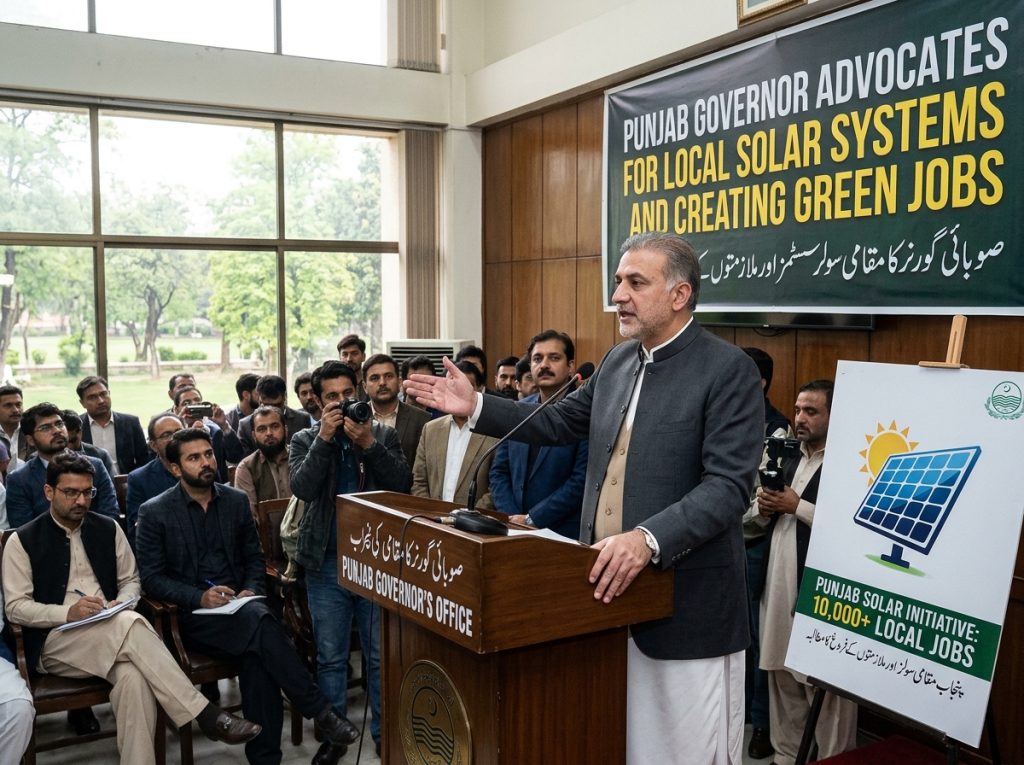

Punjab Governor Sardar Saleem Haider Khan has called on Pakistan’s solar industry to begin manufacturing solar systems domestically rather than waiting for a government policy. Speaking at a major energy conference in Lahore on Friday, he said local production could create millions of jobs, lower electricity costs and open new export opportunities for the country.
Background
The governor made his remarks while addressing the 3rd national Solar Power Conclave and Solar Technology Excellence Awards 2026. The event was organised by Energy Update in partnership with the Pakistan Solar Association, the Renewable Energy Association of Pakistan and the Pakistan Alternative Energy Association.
Pakistan has seen explosive growth in solar adoption over the past few years as households and businesses turned to rooftop panels to escape rising grid electricity prices. However, the country still imports almost all of its solar equipment, mainly from China, since no formal policy exists yet to support local manufacturing.
Details
The governor said it was unfortunate that solar manufacturing had not taken off in Pakistan simply because of the absence of a clear government policy. He described sunlight as a resource that should be put to use both to ease the burden of electricity bills and to protect the environment.
He pointed out that Pakistan’s solar business community had already succeeded in bringing solar technology into the country largely without state support, and argued that a similar grassroots push could now help build a domestic manufacturing base. According to him, local production would let Pakistan meet its own rising demand while also exporting solar systems to earn foreign exchange.
The governor also highlighted how visible solar adoption has already become, noting that panels now cover a large share of rooftops in Pakistani cities. He referenced government efforts already underway, including the distribution of free solar panels to livestock farmers and flood-affected communities in Sindh.
Other speakers raised concerns about policy setbacks slowing the sector’s momentum. Punjab Energy Minister Faisal Ayub noted that Pakistan’s worst load-shedding crisis began in 2009-10 and that the country now faces a different problem: expensive electricity rather than a shortage of it. Pakistan Solar Association President Adil Mahmood said the recent removal of net metering and new taxes on solar equipment had created fresh obstacles for the industry after years of rapid growth.
Quotes
The governor stressed that Pakistan’s abundant sunlight represented a resource that should directly benefit ordinary citizens. Energy Minister Faisal Ayub added that regardless of government policy, both consumers and industry would keep shifting toward solar power simply because of its economics, and said policy needed to catch up with that shift rather than resist it.
Impact
If local manufacturing does take shape, the impact could be significant for Pakistan’s economy. Officials at the conclave suggested it could reduce the country’s heavy reliance on imported solar equipment, ease pressure on foreign currency reserves currently spent on imports, and create large-scale employment in a growing green energy sector.
The renewed policy debate also comes at a sensitive time for Pakistan’s energy supply chain. The governor noted that recent regional tensions have disrupted LNG shipments, increasing load-shedding and underlining why expanding domestic solar capacity, ideally through local manufacturing, matters for the country’s long-term energy security.
Conclusion
For now, the call for local manufacturing remains an appeal to industry rather than a fixed government commitment. Ayub said the Punjab government would engage the federal energy ministry and bring industry representatives on board to help shape a workable policy, while PSA officials pushed for the removal of duties and taxes on batteries and for setting up local lithium battery production. Whether these discussions translate into an actual manufacturing policy will likely shape how quickly Pakistan can reduce its dependence on imported solar equipment in the coming years.
Frequently Asked Questions
What is the 20% rule for solar?
The 20% rule is a common sizing guideline used when planning a solar power system rather than a legal requirement. It suggests designing a solar setup that generates roughly 20% more electricity than a household’s average monthly usage, so that the system has a buffer against cloudy days, seasonal changes, dust build-up and the gradual efficiency loss that all solar panels experience over time. In practice, this means taking your average monthly electricity consumption in kilowatt-hours and multiplying it by 1.2 to get a target production figure. For example, a home using 1,000 kWh a month would ideally have a system capable of producing about 1,200 kWh, giving it enough headroom to stay reliable even when conditions aren’t ideal.
Is it hard to manufacture solar panels?
Manufacturing solar panels is technically demanding and capital-intensive, which is a major reason why Pakistan and many other countries still rely heavily on imports rather than local production. The process involves several specialised stages, starting with refining raw polysilicon, growing and slicing silicon ingots into wafers, converting those wafers into solar cells, and finally assembling and laminating the cells into finished modules. Each stage requires precision equipment, clean-room conditions, and significant upfront investment in machinery and skilled labour. This is exactly the kind of barrier that officials like the Punjab governor are referring to when they call for a supportive government policy, since building a manufacturing base from scratch is far more complex than simply importing and installing finished panels.
Who is the biggest manufacturer of solar panels?
The solar panel manufacturing industry is dominated by a handful of large Chinese companies, though the exact ranking shifts depending on whether you look at annual shipment volumes, production capacity or revenue. Companies frequently cited among the world’s largest include JinkoSolar, LONGi, Trina Solar, Tongwei Solar, JA Solar and Canadian Solar, with Chinese manufacturers together accounting for the vast majority of global solar panel output. This heavy concentration in China is part of why countries like Pakistan, the United States and several in Europe have been exploring policies to support their own domestic solar manufacturing, in order to reduce dependence on a single dominant supply chain.