

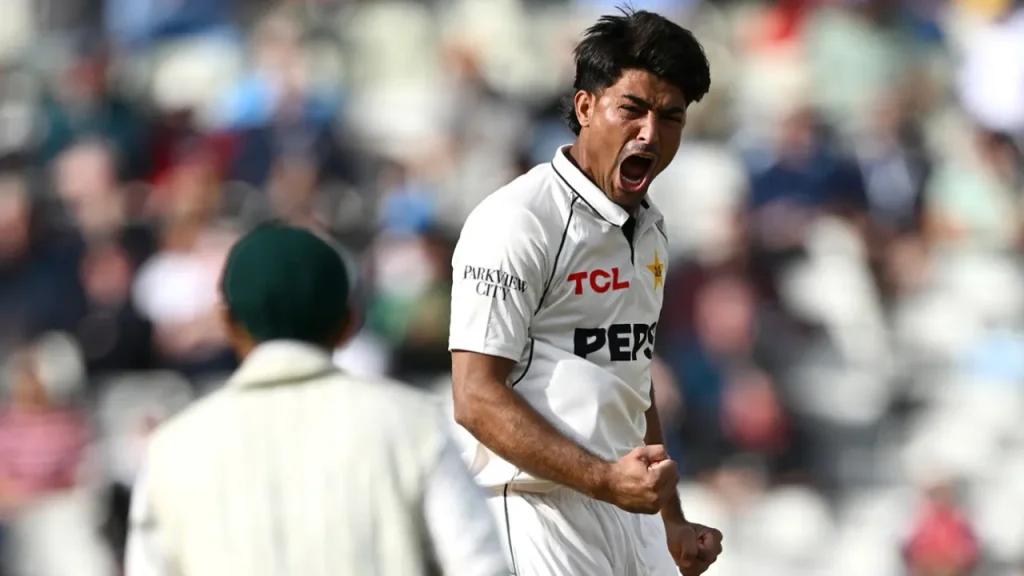

A 21-year-old with just eight first-class matches to his name walked out at Edgbaston last week and left English cricket talking about him within a session. Razaullah Khan Mashwani, unknown outside domestic circuits until now, took four wickets bowling close to 90mph, then smashed 81 runs off 63 balls with nine sixes numbers that would be remarkable from a specialist batter, never mind a fast bowler on debut.
Summary: A Debut Nobody Saw Coming
Pakistan were staring down a heavy defeat in the third Test against England when Razaullah walked in at number nine and changed the entire mood of the match. His innings didn’t save the Test, but it gave Pakistan cricket its most talked-about moment of an otherwise miserable tour, and it’s why his name is now attached to every conversation about the country’s fast-bowling future.
Background: From Tape-Ball Cricket to the National Team
Razaullah’s path to Pakistan‘s Test side began nowhere close to a stadium. He grew up playing tape-ball cricket in Mardan after his family moved there from Nehag Dara in Upper Dir when he was barely two years old. There was no elite academy pipeline behind him, just years of persistence in domestic cricket that most fans never noticed.
Coach Akmal Khan, who runs a cricket academy in Mardan and has watched Razaullah’s progress closely, described him as someone whose focus stayed almost entirely on his game rather than the recognition around it. That description matches the long, quiet climb Razaullah took to get here.
His rise through the ranks wasn’t smooth. An elbow injury interrupted his early senior career after just two matches for Mardan’s district team. He came back from that setback to take 28 wickets in a season with MIT Solutions, followed by another 27-wicket campaign that helped the team reach a final it ultimately lost. Selectors eventually noticed enough to include him among 30 players shortlisted for Abbottabad Region, and a guest appearance arranged by Peshawar Region coach Rafatullah gave him another crucial opportunity to be seen.
By 2026, Razaullah was representing Abbottabad Region in the National T20 competition, which the team went on to win, and that performance earned him a call-up to a white-ball camp at the National Cricket Academy. From there, his name entered the conversation for the England tour, and in August 2026 he was named in Pakistan’s Test squad.
Details: What Actually Happened at Edgbaston
Razaullah made his Test debut on September 9, 2026, against England at Edgbaston in Birmingham, and he didn’t wait long to make an impact. He took four wickets in the first innings, consistently touching around 90mph, pace that put him in rare company: since 2010, only Mark Wood, Jofra Archer, Dale Steyn, Anrich Nortje, and Shannon Gabriel have bowled faster spells in England.
But it was his batting that turned him into a genuine story. Coming in at number nine, Razaullah reached his maiden Test half-century off just 43 balls before going on to score 81 runs from 63 deliveries, hitting nine sixes along the way. That tally of nine sixes in a single innings is the joint-most ever recorded in a Test innings played in England, matched only by Ben Stokes’ famous 155 against Australia during the 2023 Ashes. For context, Razaullah’s nine sixes also equalled the number Geoffrey Boycott hit across his entire 108-match Test career.
His dismissal, when it finally came, drew as much attention as the innings itself, with the crowd fully invested in what had become the most entertaining passage of an otherwise deflating series for Pakistan.
Quotes: What People Are Saying
Former England captain Michael Vaughan didn’t hold back his admiration for what he’d just watched, predicting that Pakistan had discovered a player who could become a long-term star even though England were still favourites to win the match. His comments echoed a broader sentiment across English media that Pakistan had unearthed a rare talent almost by accident.
Coach Akmal Khan, who has tracked Razaullah’s career from its early domestic days, said the young all-rounder has the tools to go a long way in the sport, a view now shared by plenty of former players and pundits assessing what they saw at Edgbaston.
Impact: What This Means for Pakistan Cricket
Razaullah’s performance landed inside a brutal stretch for Pakistan’s Test side. The team went on to lose the series 3-0, their first whitewash in England in 72 years, and one of eleven defeats in their last twelve away matches. Pakistan currently sit at the bottom of the ICC World Test Championship standings, having lost 19 consecutive away Tests across Australia, England, New Zealand, and South Africa.
Conclusion: What Comes Next
Pakistan’s cricket board now faces a familiar problem: does a single breakout performance get followed up with a real, sustained chance, or does it fade the way past flashes of promise have before? What Razaullah does next, whether that’s back in domestic cricket or another national call-up, will say a lot about which one this turns out to be.
What’s clear already is that a player almost nobody had heard of two months ago is now part of the national conversation, and Pakistan’s selectors are under real pressure to make sure his talent doesn’t slip back into obscurity the way it nearly did before this tour.
FAQs
Who is the fastest bowler in Pakistani history?
That distinction still belongs to Shoaib Akhtar, whose delivery clocked at 161.3 km/h against England in 2003 remains the fastest ball ever officially recorded in cricket history. Razaullah’s pace, sitting around 90mph, is genuinely rare for a modern Pakistani quick and has drawn comparisons to Waqar Younis, but he’s not currently operating in the same speed bracket as Akhtar’s record-breaking spells.
Has anyone scored 400 in Tests?
Yes, West Indies legend Brian Lara remains the only player to score 400 runs in a single Test innings, finishing unbeaten on 400 against England in Antigua back in 2004. It’s widely regarded as one of the most extraordinary individual feats in the format’s history and hasn’t been seriously threatened since.
What is Imran Khan’s fastest bowling ball?
Imran Khan, one of Pakistan’s greatest all-rounders, was known for consistently bowling in the high 80s to low 90s mph range during his peak years, though speed guns weren’t as precise or widely used during his era as they are today. His reputation was built as much on skill, swing, and match-winning spells as on outright pace, which is part of why comparisons between him and newer fast bowlers like Razaullah tend to focus more on style and impact than exact numbers.