

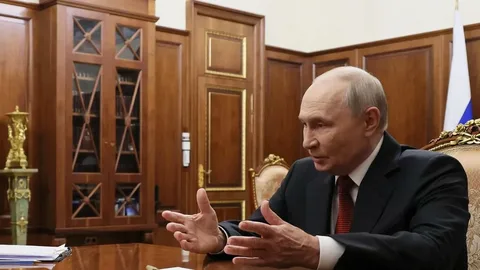

Russian President Vladimir Putin has warned Ukraine of a “catastrophic scenario” after accusing Kyiv of opening a “Pandora’s box” by striking Russian economic infrastructure, vowing retaliation against Ukraine’s most sensitive economic sectors. The comments mark one of the sharpest escalations in rhetoric in months, adding a new layer of uncertainty to the more than four-year-old war.
Background
Ukraine has spent this summer intensifying a long-range drone campaign against Russian economic targets, striking oil refineries and major logistics hubs, including warehouses belonging to Russian e-commerce giant Wildberries. Kyiv has argued these facilities are central to sustaining Russia’s war effort and therefore legitimate military targets.
Russia has responded in kind, striking Ukrainian economic infrastructure, particularly grain export facilities and port terminals along the Black Sea that Moscow says are being used to support Ukraine’s military logistics. The tit-for-tat targeting of civilian-linked economic assets marks a shift from earlier phases of the war that focused more heavily on direct front-line combat and energy grid attacks.
Details
Putin’s Latest Warning to Ukraine
In comments published Saturday, Putin told Russian state television that Ukraine “set out to damage our economy” and had instead “opened this Pandora’s box itself,” warning Kyiv to “expect a response targeting your most sensitive economic sectors.” It was Putin’s first extended interview with Russian state media since the drone campaign against economic targets began several weeks ago.
Putin said Kyiv had let the “genie out of the bottle” and suggested Russian military operations would become “significantly more noticeable and destructive” going forward. He also addressed Ukraine’s targeting of Russian grain export infrastructure, saying the strikes had jeopardized Ukraine’s own agricultural exports but insisting Russia could fill any gap in global food supply left by disrupted Ukrainian grain shipments.
Russian Losses in Ukraine and Recent Casualty Figures
Independent verification of Russian losses in Ukraine remains difficult given restricted access to front-line reporting, but recent strikes tied to this economic escalation have produced confirmed civilian casualties on both sides. Reports from the weekend’s overnight attacks indicate at least 13 people were killed, including four deaths inside Russia, two in Russian-annexed Crimea, and seven in Ukraine. It’s a sign of how the economic-target campaign has increasingly blurred into attacks affecting civilian populations.
Russia vs Ukraine: Who Is Winning the Economic War?
Neither side has secured a decisive advantage in this latest phase of economic targeting. Ukraine’s strikes have disrupted Russian oil refining capacity and logistics networks, while Russian counterstrikes have hit Ukrainian grain infrastructure critical to the country’s export economy. Analysts note that both economies remain functional despite mounting damage, meaning the conflict’s economic dimension is shaping up as a war of attrition rather than a quick knockout blow for either side.
Ukraine Military News Today and the Broader War Map
Beyond the economic strikes, front-line positions across eastern and southern Ukraine have remained largely static in recent weeks, with neither Russian nor Ukrainian forces reporting major territorial shifts. Military analysts tracking the Russia-Ukraine war map say the conflict has increasingly moved toward long-range strikes on infrastructure rather than large-scale ground offensives, a pattern consistent with the economic warfare Putin referenced in his latest comments.
Quotes
Putin’s most pointed remarks centered on responsibility for the current escalation, stating directly: “The Kyiv regime set out to damage our economy. What did it do? It opened this Pandora’s box itself. Well then, expect a response targeting your most sensitive economic sectors.”
He also addressed pressure from hardline voices inside Russia pushing for a tougher military response, saying Russian operations would become more forceful going forward, a comment widely interpreted by Western outlets as a signal that further economic strikes are likely rather than a one-off warning.
Ukraine’s president has previously described Russian strikes on civilian and economic infrastructure as attempts to break Ukrainian resolve rather than legitimate military operations, a position Kyiv has repeated consistently throughout the war whenever Russian strikes have hit non-military targets.
Impact
The economic dimension of this war carries consequences well beyond the two countries directly involved. Disruptions to Ukrainian grain exports have periodically driven up global food prices in the past, and further escalation risks similar ripple effects for countries in Africa and the Middle East that depend heavily on Black Sea grain shipments.
For Russia, sustained drone strikes on oil refineries and logistics infrastructure add pressure to an economy already strained by years of Western sanctions, even as Putin has publicly downplayed the impact. The exchange of economic strikes also complicates any near-term prospect of ceasefire talks, since both sides now have fresh grievances tied to civilian and economic damage rather than purely military engagements.
Conclusion
With Putin explicitly warning of further retaliation and Ukraine showing no sign of scaling back its own economic strike campaign, the coming weeks are likely to bring continued attacks on infrastructure targets from both sides. Whether this escalation eventually pushes either side toward renewed negotiations, or just deepens the current stalemate, is one of the most closely watched questions in Russia-Ukraine war coverage heading into autumn.
Frequently Asked Questions
Why can’t Russia join NATO?
Russia is not a NATO member largely due to a long history of mutual distrust between Moscow and Western alliance members, dating back to the Cold War and continuing through more recent disputes over NATO’s eastward expansion into Eastern Europe. While Russia held limited cooperative arrangements with NATO in the 1990s and early 2000s, relations deteriorated sharply following Russia’s 2008 war with Georgia, its 2014 annexation of Crimea, and its full-scale invasion of Ukraine in 2022, all of which NATO members viewed as violations of international law and direct threats to regional security. Russia itself has also historically viewed NATO’s expansion as a security threat along its borders, making genuine membership talks unrealistic under current geopolitical conditions.
Who is Vladimir Putin’s best friend?
Putin does not have a single publicly confirmed “best friend” in the conventional sense, but he has maintained particularly close personal and political relationships with a small circle of longtime associates, including businessman and former judo partner Arkady Rotenberg, as well as Belarusian President Alexander Lukashenko, with whom Russia maintains its closest formal alliance among world leaders. Putin has also cultivated a notably warm diplomatic relationship with Chinese President Xi Jinping in recent years, frequently describing the Russia-China partnership in personal, friendly terms during official visits and joint statements, though this reflects a strategic alliance more than a personal friendship in the traditional sense.
Is Russia still a superpower?
Russia’s status as a superpower is a matter of ongoing debate among international relations analysts. Russia retains superpower-level military capability, particularly through its large nuclear arsenal, permanent UN Security Council seat, and significant conventional armed forces, all of which continue to give it substantial global influence. However, its economy has struggled under years of sanctions tied to the Ukraine war, and its conventional military has suffered significant losses and reputational damage during the conflict, leading many analysts to describe Russia today as a regional power with global military reach and nuclear deterrence, rather than a full superpower on par with the United States or China.