
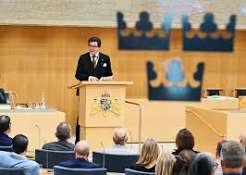

Sweden’s parliament speaker, Andreas Norlen, held a fresh round of talks with party leaders on Wednesday to decide who should make the next attempt at forming a government. The move comes after the Social Democrats’ Magdalena Andersson abandoned her own effort earlier in the week, leaving the country without a clear path to a new administration more than two weeks after its general election.
Background
Sweden held a general election on September 13, 2026, and the result left neither major political bloc with a comfortable majority. The left-wing bloc, led by the Social Democrats, won 176 seats, just three more than the right-wing bloc headed by outgoing prime minister Ulf Kristersson, which includes the Sweden Democrats.
Andersson was formally tasked with forming a government on September 18 and was given until the end of the month to put together a cabinet. She had hoped to bring together the Social Democrats, the Left Party, the Centre Party and the Greens, but deep ideological disagreements between those parties, particularly over the Left Party’s demand for cabinet posts, made that effort difficult from the start.
Details
Andersson gave up her attempt on Monday after more than a week of negotiations failed to produce an agreement her coalition partners could accept. That left Speaker Norlen to decide who should try next, and Wednesday’s meetings were aimed at making that call.
One option on the table is giving outgoing prime minister Ulf Kristersson another chance. Kristersson, whose Moderate-led coalition has governed since 2022 with support from the Sweden Democrats, said after the election that he wanted to explore forming a so-called non-socialist government. For that to work, he would likely need backing from the Centre Party, which currently sits within the left-wing bloc.
However, Centre Party leader Elisabeth Thand Ringqvist has made clear she will not support any government that relies on influence from parties at either the far left or far right. That stance significantly narrows Kristersson’s options, since his bloc alone falls short of the seats needed for a majority.
Under Sweden’s constitution, the speaker has up to four opportunities to put a candidate for prime minister to a vote in parliament before a fresh election must be called. Many observers expect that if Kristersson is given a chance and fails, Norlen would likely turn back to Andersson, who may ultimately be able to unite her bloc under the pressure of avoiding another election.
Quotes
Kristersson has previously said his coalition would offer the Sweden Democrats cabinet positions for the first time if the right-wing bloc won the election, though he has stepped back from that position in recent days as talks have evolved. Andersson, for her part, described the task of forming a government as one she would approach with humility when she was first asked to attempt it in September, stating she would act constructively to build a new administration.
Impact
The prolonged uncertainty has real consequences for Sweden’s governance and its standing within the European Union, where the country has recently pushed, alongside several allies, for tighter spending controls on the EU budget. A caretaker government, led for now by Kristersson, continues to handle day-to-day affairs, but major policy decisions are typically put on hold during periods of political deadlock.
The standoff also highlights the lasting impact of the Sweden Democrats on the country’s politics. The party’s rise over the past decade has made both traditional blocs wary of coalition arrangements that depend on parties at the ideological fringes, a dynamic that is central to the current impasse between Kristersson and the Centre Party.
Conclusion
Sweden has a track record of lengthy coalition negotiations, with government formation taking 37 days after the 2022 election and 134 days following the 2018 vote. With Wednesday’s talks now underway, attention turns to whether Norlen hands the task to Kristersson, returns it to Andersson, or considers another candidate altogether. Until a government secures enough support to survive a parliamentary vote, the country is likely to remain in a period of political limbo.
Frequently Asked Questions
What is the current political crisis in Sweden?
Sweden is currently without a confirmed new government more than two weeks after its September 13, 2026 general election produced no clear majority for either political bloc. The left-wing bloc, led by the Social Democrats’ Magdalena Andersson, won 176 seats, only three more than the right-wing bloc under outgoing prime minister Ulf Kristersson, which includes the Sweden Democrats. Andersson’s initial attempt to form a coalition collapsed after disagreements among her prospective partners, and the parliament speaker is now holding fresh talks to determine who should try next. Until a candidate wins enough parliamentary support, Kristersson continues to lead a caretaker government handling routine affairs.
Why is Sweden struggling to form a government?
The core problem is that neither bloc can easily assemble a stable majority on its own. Andersson’s left-wing coalition needs the Social Democrats, Left Party, Centre Party and Greens to agree, but the Left Party has pushed for cabinet seats, an idea the Centre Party firmly opposes. On the other side, Kristersson’s right-wing bloc has governed with support from the Sweden Democrats since 2022, but the Centre Party, despite sitting within the left-wing bloc, has ruled out backing any government that gives influence to parties at either political extreme. This leaves both potential prime ministers short of a workable coalition, prolonging the deadlock.
How is Sweden trying to resolve its political crisis?
Sweden’s constitution gives the speaker of parliament, currently Andreas Norlen, up to four separate chances to put forward a candidate for prime minister and have that candidate approved by a parliamentary vote before a new election becomes necessary. Norlen is using this process to hold rounds of consultations with party leaders, weighing whether to task Kristersson with another attempt or return the job to Andersson. Sweden has navigated similarly long negotiations before, taking over a month to form a government in 2022 and more than four months in 2018, so a resolution, while not immediate, is expected once one party leader can secure enough support to survive a confidence vote.