

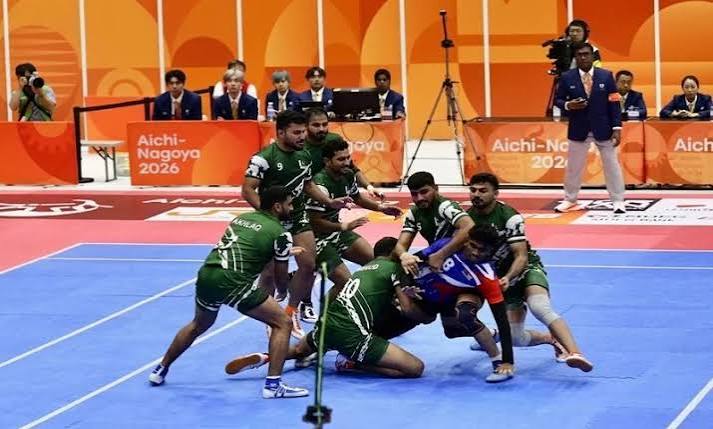

Thailand produced a major upset at the Asian Games on Wednesday, edging Pakistan 48-45 in a closely fought Group B men’s kabaddi match. The contest was played at the Tokai Citizen Gymnasium in Nagoya, Japan. The result handed Pakistan their first defeat of the tournament and shook up the standings in Group B.
Background: Pakistan’s Strong Start
Pakistan had entered the match on a high note, having opened their campaign with a dominant 65-22 victory over Malaysia. They followed that up with another comfortable win over Nepal, positioning themselves as one of the group’s frontrunners heading into the Thailand fixture.
Thailand meanwhile had quietly built momentum of their own. They opened the tournament with a 59-48 win over Nepal, signaling that they would not be easy opponents despite entering the event as underdogs against the more fancied Pakistani side.
Match Details: A Second-Half Turnaround
Pakistan looked in control for large parts of the match, leading Thailand 32-31 at halftime. That advantage suggested another comfortable win was on the cards for the Pakistani side, who had dominated their first two group games.
The defeat now leaves Pakistan needing a strong response in their remaining Group B fixture. They face Iran in what has become a do-or-die encounter, since only the top two teams from each group advance to the knockout stage.
Quotes: Federation Reacts to the Loss
Pakistan Kabaddi Federation (PKF) secretary Mohammad Sarwar addressed the defeat directly, pointing to a dip in intensity after the break. “Our players did not play the way they should have after half time,” he said, speaking to The Express Tribune from Japan.
Sarwar also linked the result to a broader gap in preparation between the two sides. He noted that Pakistan lacks the same level of international exposure that teams like Thailand have built up through regular matches abroad, adding that this kind of match experience matters at the highest level of competition.
Impact: A Shake-Up in Group B
The result carries real weight for the rest of the tournament. Pakistan, who have won bronze in the men’s kabaddi event at each of the last three Asian Games, now face genuine pressure to beat Iran and secure their place in the knockout rounds.
The upset also adds an extra layer of intrigue to the closing stages of the group phase, with Pakistan, Thailand, Nepal, Iran, and Malaysia all still jostling for the two qualification spots available.
Conclusion: What’s Next for Pakistan
Pakistan’s campaign now hinges on Thursday’s clash with Iran. A win would likely be enough to keep their semifinal hopes alive, while another defeat could end their medal ambitions at the group stage for the first time in recent memory.
Thailand, buoyed by back-to-back wins, will look to carry their momentum into their remaining group matches as they chase an unexpected run toward the knockout stage. The next 24 hours are set to be decisive for both teams in Group B.
Frequently Asked Questions
Which country is best in kabaddi?
India is widely regarded as the strongest nation in international kabaddi, particularly at the Asian Games. The Indian men’s team has won the gold medal at nearly every edition of the Games since kabaddi was introduced, missing out only once, when they settled for bronze at the 2018 Jakarta Asian Games. Iran is generally considered the second-strongest kabaddi nation and remains the only country to have denied India the men’s title at the Asian Games.
Does Pakistan have a kabaddi team?
Yes, Pakistan fields competitive men’s kabaddi teams at major international events, including the Asian Games. The Pakistan Kabaddi Federation oversees the sport in the country, and the national team has a strong recent record, having won bronze medals at the men’s event in each of the last three Asian Games editions. Pakistan is considered the second most decorated nation in Asian Games kabaddi history after India, although a gold medal has so far eluded them.
Who is the kabaddi world champion?
India has traditionally dominated the Kabaddi World Cup, winning the majority of editions held since the tournament’s inception. The format and frequency of the World Cup have varied over the years, with Iran also emerging as a strong competitor in recent editions. For the most current champion, it is best to check the latest results from the International Kabaddi Federation, since world championship outcomes can change with each new tournament cycle.