
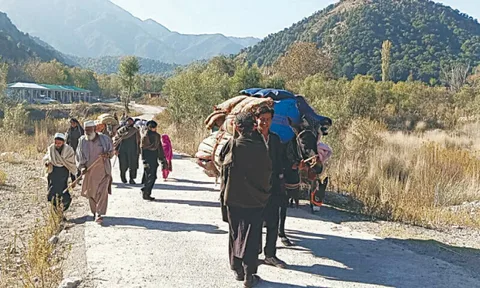

Tirah Valley in Khyber district, Khyber Pakhtunkhwa, remains at the centre of one of Pakistan’s most prolonged humanitarian and security crises. Thousands of displaced families are still waiting for compensation, rehabilitation, and a confirmed return date. Tribal elders, political parties, and rights groups continue to press the provincial government for action.
Summary
Since January 2026, tens of thousands of residents fled Tirah Valley amid fears of a large-scale military operation against militant networks. Nearly a year later, displacement, unresolved compensation claims, and sporadic militant clashes continue to define daily life for people from the valley. The Khyber-Pakhtunkhwa government has promised relief, but victims say most of their demands remain unmet.
Background of the Tirah Valley Crisis
Tirah Valley sits along Pakistan’s border with Afghanistan in Khyber district. For decades, it has struggled with instability linked to armed groups, including the banned Tehreek-i-Taliban Pakistan (TTP) and Lashkar-e-Islam.
Large counter-insurgency campaigns swept through the region in the mid-2010s. Many families who returned after that displacement say compensation for their destroyed homes was never fully paid.
Details of the Displacement and Ongoing Unrest
The scale of the exodus overwhelmed local infrastructure almost immediately. A journey from Maidan Tirah to the registration point at Mandi Kas that would normally take about two hours stretched into days because of congestion and lengthy verification procedures.
The security situation inside Tirah has also remained volatile through the year. Clashes between militants and security forces have continued intermittently in areas such as Maidan, with reports describing exchanges involving heavy weapons and damage to local markets. Casualty figures in such clashes are frequently disputed, and official confirmation from the military’s media wing is often delayed.
The valley also has a painful recent history of civilian casualties tied to unrest. In mid-2025, protesters gathered outside a Frontier Corps headquarters in Bagh-Maidan after a young girl was reportedly killed by stray mortar fire. The protest turned deadly when unidentified assailants opened fire on the crowd, killing several people and injuring more than a dozen others.
Statements From Officials and Community Representatives
Tribal representatives and political leaders have used press conferences and jirgas to press the government on unmet promises. Community leaders from the Awami National Party in Khyber district have said that a detailed, multi-point charter of demands covering compensation, rehabilitation, and the restoration of civilian institutions has seen little real progress, despite months of talks with the provincial administration.
Representatives of displaced families have told officials that government compensation has often been reduced far below what was originally promised, with some households receiving only a fraction of the announced relief package. They argue that a cash payment alone cannot make up for the loss of homes, businesses, and months of lost income.
A return date for displaced residents has already been postponed more than once. It was initially set for April 2026, then pushed back after a joint committee of elders, security officials, and district administrators agreed on a later timeline, with families now told to expect return closer to October 2026, subject to security conditions.
Regional and National Impact
The Tirah crisis has strained relations between the federal government, the provincial administration, and Pakistan’s military establishment over how counter-terrorism operations should be conducted in tribal districts. It has also renewed scrutiny of Operation Azm-e-Istehkam, the broader counter-insurgency and stabilisation campaign approved in 2024 to combat resurgent militancy along the Afghan border.
That operation was designed to combine renewed security action with economic and diplomatic measures, rather than repeat the scale of displacement seen in earlier campaigns such as Zarb-e-Azb. Critics argue that, in practice, communities in areas like Tirah have again borne the heaviest cost through prolonged displacement and delayed relief.
Human rights organisations that visited the region have urged authorities to ensure that any eventual return of displaced families is safe, voluntary, and properly informed, and have called for a functioning grievance mechanism so that genuinely affected households are not excluded from assistance due to paperwork disputes.
Conclusion and What Comes Next
The situation in Tirah Valley remains fluid heading into the final months of 2026. A second high-level meeting between district authorities and community representatives has been announced to address outstanding demands, including full compensation, verified damage surveys, and job opportunities for displaced residents.
Whether the tentative October return date holds will depend heavily on the security situation in Tirah, the completion of promised development work, and whether pending compensation payments are finally released in full. For now, thousands of families remain in limbo, watching closely for the next official update from Peshawar.
Frequently Asked Questions
What is Operation Azm-e-Istehkam?
Operation Azm-e-Istehkam, meaning “Resolve for Stability,” is a counter-insurgency and stabilisation initiative approved by Pakistan’s government in June 2024. Unlike earlier large-scale military campaigns, it was designed to combine continued intelligence-based security operations with socio-economic development, legal reforms, and diplomatic pressure on Afghanistan’s Taliban administration to curb cross-border militancy. The operation has faced criticism from analysts who argue it has not yet produced clear, measurable results and that communities in border districts, including Tirah, have still experienced significant disruption and displacement.
What is the Tirah Valley?
Tirah Valley is a mountainous region in Khyber district, Khyber Pakhtunkhwa province, located near Pakistan’s border with Afghanistan. It has historically been home to several tribal communities and has, for decades, been affected by the presence of armed groups, including the Tehreek-i-Taliban Pakistan and Lashkar-e-Islam. The valley has seen repeated cycles of military operations, civilian displacement, and rehabilitation efforts, with the most recent major displacement beginning in January 2026 amid fears of a fresh security operation.
Why are Tirah Valley residents still displaced in 2026?
Displacement has continued largely because promised compensation, rebuilt infrastructure, and confirmed security guarantees have not been fully delivered. Community representatives say that while some financial assistance has reached registered families, verification disputes, delayed payments, and unfinished development work have repeatedly pushed back the return timeline originally planned for early 2026.