

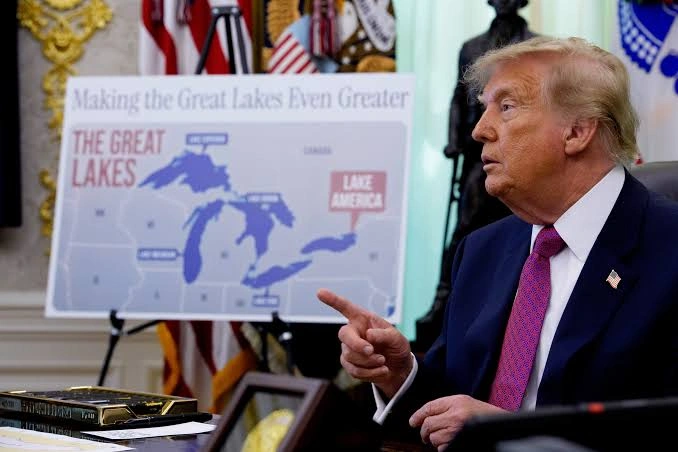

US President Donald Trump has signed an executive order seeking to rename Lake Ontario as Lake America, in another controversial move involving the naming of a shared North American waterway.
The announcement comes amid growing tensions between the United States and Canada following the collapse of recent trade talks. Washington has also imposed new 50% tariffs on around $20 billion worth of Canadian goods, while Canada has announced plans for matching counter-tariffs.
Trump said the Lake America name change would take effect immediately. However, the order applies to how the landmark is officially recognised by the US government and does not require Canada or other countries to adopt the new name.
Lake Ontario Name Change Sparks Canadian Opposition
Canadian Prime Minister Mark Carney rejected the proposed Lake Ontario renaming, saying the lake has a long-established historical name that should remain unchanged.
“Things must be called by their name, and this lake is called Lake Ontario — today and forever,” Carney said.
He noted that the name Lake Ontario dates back more than 400 years and existed before both the Canadian Confederation and the US Declaration of Independence.
The executive order gives the US Department of the Interior 30 days to update the name in the Geographic Names Information Service, the official US database for domestic geographic names.
Canadian officials have strongly dismissed the move. Ontario Premier Doug Ford also said the body of water would remain Lake Ontario for Canadians and the rest of the world.
Trump’s Previous Geographic Name Change
The proposed Lake America name follows a similar decision by Trump in 2025 involving the Gulf of Mexico.
Trump signed an executive order seeking to change the gulf’s name to the Gulf of America. Mexico rejected the move, arguing that one country cannot unilaterally rename a shared international body of water.
The dispute also affected how the name appeared on digital maps. Google Maps displayed different names depending on the user’s location, showing “Gulf of America” in the US and “Gulf of Mexico” in Mexico.
The naming dispute also contributed to tensions between the Trump administration and the Associated Press after the news agency declined to use “Gulf of America” in its reporting. The AP later sued the administration, with the legal dispute continuing.
Lake America Move Comes Amid US-Canada Tensions
The latest Lake Ontario to Lake America proposal comes at a sensitive time in US-Canada relations.
Trade tensions have increased after negotiations between Washington and Ottawa broke down. The US has imposed significant tariffs on Canadian products, while Canada has prepared retaliatory measures.
Lake Ontario is particularly sensitive because it is shared by the United States and Canada. The lake borders the Canadian province of Ontario and several US areas, making the proposed name change a matter of both political symbolism and international disagreement.
There is no single international organisation with universal authority to determine the names of shared international waters. As a result, the US can update its own official geographic records, but Canada and other countries are not legally required to recognise the proposed Lake America name.
Canadian Leaders Reject ‘Lake America’
Canadian political leaders have responded firmly to Trump’s announcement.
Carney reiterated that Lake Ontario is the lake’s established name and said Canada would continue using it.
Ford echoed that position, saying Canadians would continue to call it Lake Ontario.
The dispute highlights broader disagreements between the two neighbouring countries at a time when their trade and diplomatic relations are facing renewed pressure.
For now, the US government may use Lake America in its official domestic geographic records, while Canada is expected to continue using Lake Ontario. The disagreement means the lake could effectively have different official names depending on which country’s government or mapping system is being used.