

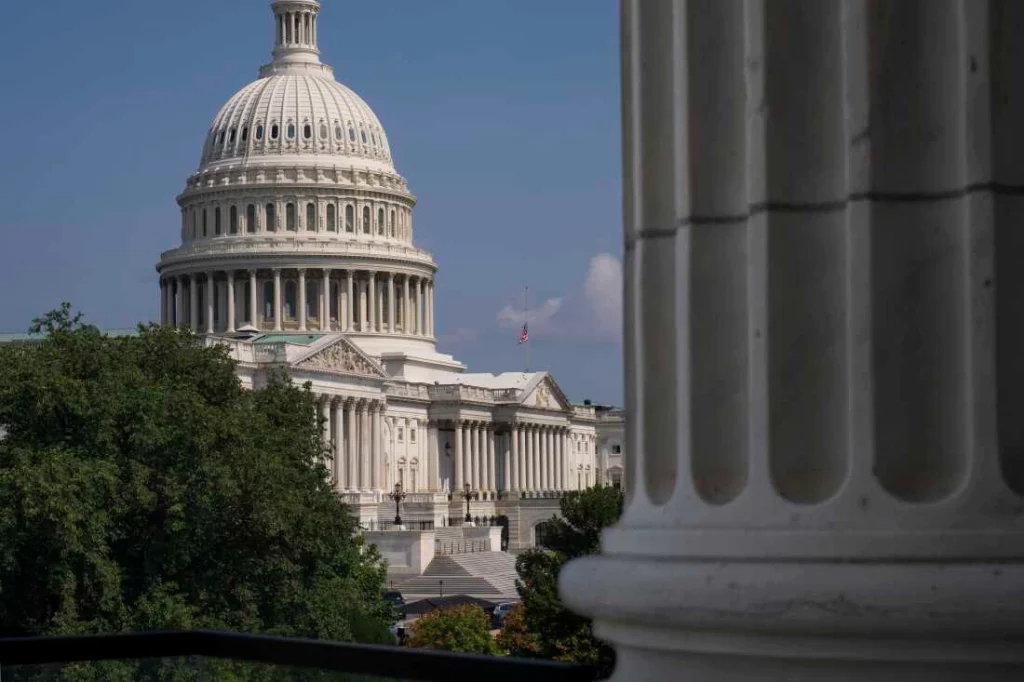

WASHINGTON: The US House of Representatives on Thursday approved a resolution calling on President Donald Trump to end military action against Iran unless he first receives formal authorisation from Congress, marking another challenge to the administration’s handling of the ongoing conflict.
The resolution was passed by a 214-208 vote, with four Republican lawmakers joining Democrats in supporting the measure.
However, the effort suffered a setback just hours later when the US Senate rejected a separate but similar war powers resolution by a 49-47 vote, preventing Congress from presenting a united position on the issue.
The House measure was introduced by Representative Pramila Jayapal, a Democrat from Washington state, under the War Powers Resolution, which seeks to limit a president’s ability to engage US forces in military conflicts without congressional approval.
The resolution directs President Trump to withdraw US armed forces from hostilities involving Iran unless lawmakers explicitly authorise continued military action.
Supporters argued that Congress—not the president alone—has the constitutional authority to decide whether the United States should enter or continue a war.
Despite the House vote, the Senate declined to advance its own version of the war powers resolution later the same day.
The upper chamber voted 49-47 against the proposal, effectively blocking further congressional action on the issue for now.
The outcome highlighted continued divisions within Congress over the United States’ military involvement in the conflict with Iran.
Although the House resolution represents a political rebuke of the Trump administration, it is largely symbolic and does not automatically end US military operations.
Congress has approved similar war powers measures several times since the conflict between the United States, Israel and Iran escalated earlier this year, but those actions have not resulted in any suspension of military operations.
The White House has maintained that President Trump has the authority to protect US national security interests, while critics argue that prolonged military engagement requires explicit approval from Congress under the US Constitution.
The latest votes underscore the continuing debate in Washington over presidential war powers and congressional oversight as tensions in the Middle East remain high.