

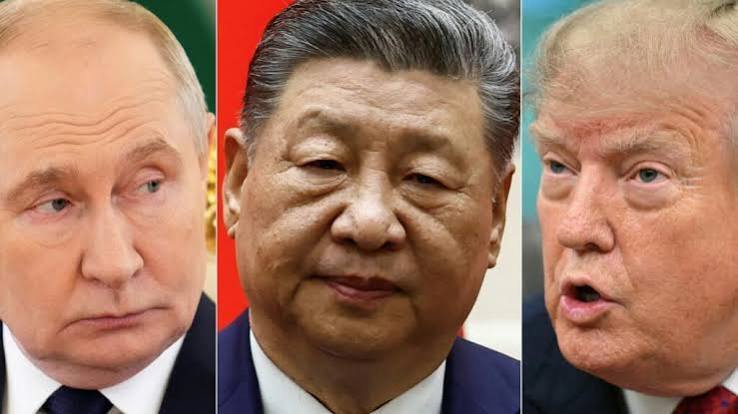

The Xi Trump Putin summit will take place this week in the Chinese city of Shenzhen, and Beijing says “world peace” is the main item on the table. Chinese President Xi Jinping, US President Donald Trump and Russian President Vladimir Putin are due to meet on Thursday, November 19. It will be the first time the three leaders have sat down together in a trilateral format.
The meeting is set to happen on the sidelines of the Asia-Pacific Economic Cooperation (APEC) leaders’ meeting, which runs from November 18 to 19. China’s foreign ministry confirmed the talks on Monday, but it has shared very few details about the agenda. Beijing only said the leaders would hold “in-depth exchanges” on safeguarding peace and keeping relations between major powers stable.
How the Shenzhen Trilateral Summit Came Together
The idea of a three-way meeting was first floated in early September, when Kremlin aide Yuri Ushakov said it could happen at APEC. A few days later, Kremlin spokesman Dmitry Peskov said Putin and Trump had discussed the idea during a phone call. At that stage, neither Washington nor Beijing had confirmed anything, and reports suggested the biggest hurdle was agreeing on what the leaders would actually talk about.
By early November, China said discussions were under way, and the White House later confirmed that Trump would attend the Shenzhen meeting. Trump had earlier said he was open to a joint meeting and wanted nuclear arms control to be a central topic. Analysts also noted that Xi, as host, would want to be seen as the broker who brought the Russian and American leaders into one room.
What the Three Leaders Are Expected to Discuss
Foreign ministry spokeswoman Mao Ning said the summit would be of “ground-breaking significance”. Her briefing gave little else away, which has left analysts to piece together the likely agenda from remarks by Chinese, American and Russian officials. Two subjects keep coming up: nuclear denuclearisation and the war involving Iran.
Washington has said it wants China to be part of any future nuclear arms control deal, especially as Beijing expands its own arsenal. China has long argued that the United States and Russia, which hold far larger stockpiles, should cut their weapons first. A US-Russia nuclear treaty expired in February, and Trump has since called for a “better agreement” that includes China.
Nuclear Arms Control and the Iran War
Diplomatic contacts in the past week suggest both sides see some room for discussion. China’s top diplomat Wang Yi and US Secretary of State Marco Rubio recently spoke by phone, and the US State Department said they agreed on the importance of leader-level talks on peace and denuclearisation. That does not mean a deal is close, but it shows that the subject is firmly on the agenda.
Trump has also said Iran will come up. “We’re trying to end the war in Iran,” he told reporters on Sunday, adding that other topics would be raised too. China is one of Iran’s biggest economic partners and has spent recent weeks hosting Middle Eastern leaders and diplomats. Beijing says avoiding a return to hostilities is a top priority, since the crisis has disrupted shipping and pushed oil prices sharply higher.
Why Ukraine Could Stay Off the Table
Russia’s war in Ukraine is likely to be the most awkward subject. A senior US official has said Ukraine is not on the agenda, and Trump is not expected to raise it. Media reports last month claimed Putin hoped the summit would produce a peace outcome favourable to Moscow, but that looks unlikely to happen in Shenzhen.
German President Frank-Walter Steinmeier said Xi appeared irritated when the idea of covering Ukraine was raised with him. According to Steinmeier, Xi pointed out that it is a European conflict and that Europeans must be at the table. For readers following the Russian leader’s domestic position, our report on Putin’s United Russia party winning a supermajority in the 2026 Duma elections offers useful background.
Reactions From Kyiv and the United Nations
Ukraine has reacted with open concern. President Volodymyr Zelensky warned that the meeting could resemble the Yalta conference of 1945, where three big powers redrew borders with little regard for smaller countries. Foreign Minister Andriy Sybiha went further and said a meeting of the three leaders would only encourage Putin to continue the war.
UN Secretary-General Antonio Guterres struck a more hopeful tone. Speaking at an Asean summit in the Philippines, he said that if the three leaders truly commit to meaningful denuclearisation, it would be a great achievement for the world. He repeated the UN’s long-standing position that the world will only be fully safe without nuclear weapons.
Global and Regional Impact
For the world, the biggest question is whether three nuclear-armed powers can find even a small amount of common ground. Any progress on arms control would ease fears about a new arms race, while even a vague joint message on stability could calm financial markets. Oil traders will also be watching closely for signs of movement on the Iran conflict.
For Asia and Europe, the stakes are more complicated. Smaller countries often worry when major powers meet without them, and Ukraine’s reaction shows how strong that anxiety is. The summit would also be a diplomatic win for Moscow, which has faced international isolation since 2022, and for Beijing, which would be seen as hosting the world’s most powerful leaders. More of our wider coverage is available in the World and International sections.
What Happens Next
Expectations should stay modest. China has not published an agenda, no joint statement has been promised, and the leaders may not even agree on what counts as success. A short statement on peace, stability and arms control talks is probably the most realistic outcome from a first meeting.
Still, the fact that Xi, Trump and Putin are meeting at all is significant. If the talks go smoothly, follow-up meetings or working-level negotiations on nuclear weapons could be announced. If they go badly, the tension over Ukraine and Iran could harden positions further. Either way, the next few days will shape the tone of major-power relations heading into 2027.
Frequently Asked Questions (FAQs)
When and where will the Xi Trump Putin summit take place?
The summit is scheduled for Thursday, November 19, 2026, in the southern Chinese city of Shenzhen. It will be held on the sidelines of the APEC leaders’ meeting, which runs from November 18 to 19. China is hosting this year’s APEC gathering, so Xi is effectively the host of the trilateral talks as well. It is the first time the leaders of China, Russia and the United States have met together in this format.
What will Xi, Trump and Putin discuss at the summit?
China says the leaders will exchange views on safeguarding world peace and keeping relations between major powers stable. Beyond that official wording, nuclear arms control is expected to feature prominently, since Washington wants China included in any future deal. Trump has also said the war involving Iran will be raised. China has offered few other details, so the final agenda may only become clear once the meeting begins.
Will the Ukraine war be part of the talks?
It is unlikely to be a main topic. A senior US official has said Ukraine is not on the agenda, and Trump is not expected to bring it up. Reports suggest Xi has been reluctant to discuss it without European participation. Ukraine’s leaders have warned that any big-power meeting on the subject without Kyiv would be unacceptable, which is why they are watching the summit so closely.
Why is this summit considered historic?
No meeting has ever brought together the leaders of China, Russia and the United States in a three-way format. The three countries hold enormous military and economic influence, and they are the world’s major nuclear powers. Chinese officials have called the event ground-breaking. Even if no major agreement emerges, the meeting itself signals that all three sides still see value in direct dialogue.
Why is nuclear arms control important to this meeting?
The US-Russia nuclear treaty expired in February, leaving the world without a major limit on the two largest arsenals. Washington wants China, whose arsenal is growing quickly, to join any new arrangement. Beijing argues that the US and Russia should cut their much bigger stockpiles first. This disagreement is one of the biggest obstacles to a new deal, so any sign of movement in Shenzhen would be closely watched.
How could the summit affect Pakistan and South Asia?
Pakistan has close ties with China and working relations with both Washington and Moscow, so a calmer relationship between the three powers would reduce regional pressure. Progress on the Iran crisis would also help Pakistan, which is directly affected by oil prices and instability in neighbouring regions. However, no South Asian country is a member of APEC, so the region will be following events from the sidelines.