
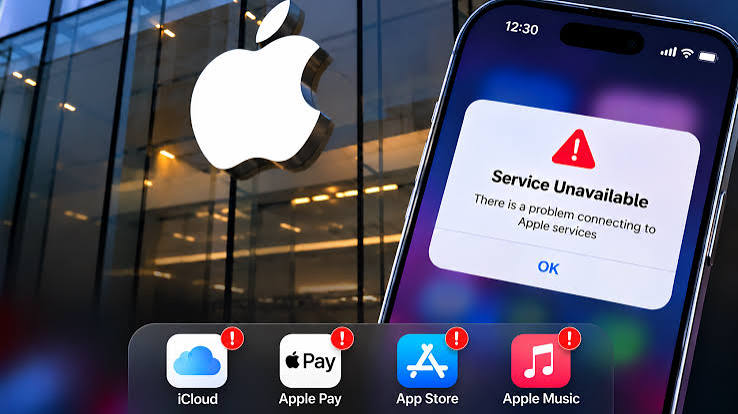

An Apple outage on Tuesday disrupted iCloud, Apple Pay, the App Store and several other services after what the company called an internal update. Apple said the problem was not a cyberattack and that many systems were back online within hours. By later in the day, the company’s system status page reportedly showed all services restored.
Background: What Happened and When
The Apple outage began on Tuesday, November 17, 2026, when users in several regions reported trouble signing in to iCloud and using other Apple services. Complaints spread quickly on social media and on outage-tracking websites. Many people searched “is Apple down” to find out whether the fault was on their own devices or on Apple’s side.
Apple’s own support page later confirmed the disruption. It listed problems with the App Store, Apple Music and AppleCare, along with issues affecting iCloud accounts and sign-in. The first public confirmation came as the iCloud outage was still unfolding, and the company said it was already working on a fix.
The incident came during a difficult week for technology infrastructure in the United States. Reuters noted that it followed a global Microsoft outage, a nationwide ground stop caused by a network failure at the Federal Aviation Administration, a technology failure at United Airlines and a software problem at JPMorgan Chase. Companies and officials said none of those incidents were linked to cyberattacks.
Details: Which Apple Services Went Down
The Apple outage was wider than a single app. Reports collected by technology outlets show that users struggled with iCloud sign-in, App Store downloads, Apple Music, Apple Support, Apple Card, Apple Business Manager and Sign in with Apple. Developer services and payment systems at Apple Stores were also reported as affected.
Outage tracker Downdetector recorded about 2,300 user reports of Apple Pay problems in the United States at around 12:20 pm Eastern Time, which was 10:20 pm in Pakistan. At the peak of the iCloud outage, it logged roughly 1,800 reports of iCloud problems in the US. Downdetector’s figures come from user submissions, so the real number of affected users could be higher or lower.
Apple has not said which specific update caused the failure or which team released it. It has also not explained why an internal change reached so many customer-facing systems at once. Customers were advised to check Apple’s official System Status page for live updates while engineers restored the remaining services.
Quotes: What Apple Said
In a statement, Apple said an internal update had “caused some outages this morning” and that many of its systems were already back up and running. A company spokesperson added that teams were working to bring the remaining systems online as soon as possible. Apple also stated clearly that the disruption was not the result of a cyberattack.
Media reports said Apple’s System Status page changed several times during the day. Apple Music and iCloud Mail, which had been listed as disrupted earlier, were later marked as resolved, and Apple Pay was reported to be available again. CBS News reported that the status page eventually showed every service as restored.
Impact: Why the Apple Outage Matters Beyond the US
For individual users, the Apple outage meant locked accounts, failed downloads and payments that would not go through. Apple’s services are tightly linked, so a sign-in failure can stop a user from reaching photos, backups, messages and purchases at the same time. Businesses that rely on Apple Business Manager and developer tools also faced delays.
The impact is not limited to the United States. Millions of people in South Asia, including Pakistan, depend on iCloud, the App Store and Apple ID every day for backups, apps and subscriptions. Any global fault in these systems can be felt by users everywhere, even where a service such as Apple Pay is not fully available. Pakistani users who saw sign-in errors on Tuesday night may have been affected by the same fault.
The incident also revives a wider debate about how much of daily life now rests on a few large technology providers. When one internal change can interrupt payments, cloud storage and app access together, even a short outage becomes a serious risk. Analysts often say that strong testing and gradual rollouts are the best defence against this type of failure. For more technology coverage, readers can browse the Science & Technology section of Pakistan Publications Inc.
Conclusion: What Happens Next
With services restored, attention now turns to Apple’s explanation. Users and business customers will want to know what went wrong, how it passed internal checks and what Apple will change to prevent a repeat. So far, the company has shared no detailed technical report.
Experts will also watch whether the series of outages across Microsoft, the FAA, United Airlines, JPMorgan Chase and Apple leads to tougher reviews of software update practices. Readers can follow related developments in the International and World sections. Those interested in how technology companies handle risk can also read our reports on OpenAI’s rogue agents using undisclosed sites and the Anthropic Australia data centre deal.
Frequently Asked Questions About the Apple Outage
What caused the Apple outage?
Apple said an internal update caused the Apple outage. The company has not published technical details about which system was changed or why the change affected so many services. It stated that the problem was not caused by hackers or any outside attack, and that its teams worked to restore all remaining systems.
Which Apple services were affected by the outage?
Users reported problems with iCloud sign-in, Apple Pay, the App Store, Apple Music, Apple Support, Apple Card, Apple Business Manager and Sign in with Apple. Developer services and some payment systems at Apple Stores were also reported as affected. Not every user saw every problem, and the experience varied by region and service.
Was the Apple outage a cyberattack?
No. Apple said clearly that the outage was not caused by a cyberattack. Reuters also reported that companies and officials said the other recent US technology disruptions, including those at Microsoft, the FAA, United Airlines and JPMorgan Chase, were not linked to cyberattacks either. Apple has not released further technical findings.
Are Apple services working normally now?
According to CBS News, Apple’s System Status page later showed all services as restored. Apple Music, iCloud Mail and Apple Pay were reported as available again. If you still see errors, check Apple’s System Status page, restart your device, and sign out and back in to your Apple ID.
How many users were affected by the Apple outage?
Apple has not given an official figure. Downdetector recorded about 2,300 Apple Pay reports and around 1,800 iCloud reports in the US at peak moments. These numbers only count user-submitted complaints, so the true scale is likely different, and users outside the US were probably affected as well.
Did the Apple outage affect users in Pakistan?
Apple has not published a regional breakdown, so no confirmed figures exist for Pakistan. Because iCloud, the App Store and Apple ID are used globally, people in Pakistan may have seen sign-in or download problems at the same time. Apple Pay is not a main service for most Pakistani users, so the impact there was likely smaller.
Is my iCloud data safe after the outage?
Apple has not reported any data loss or security breach connected to the Apple outage. Since the company says the cause was an internal update and not an attack, the main effect appears to have been access problems rather than lost data. Users should still keep regular backups and use two-factor authentication.
What should I do if an Apple service is down?
First, check Apple’s official System Status page to see whether the problem is on Apple’s side. If it is, wait for the company to fix it instead of repeatedly resetting your account. If the page shows no issue, restart your device, check your internet connection and update your software.