

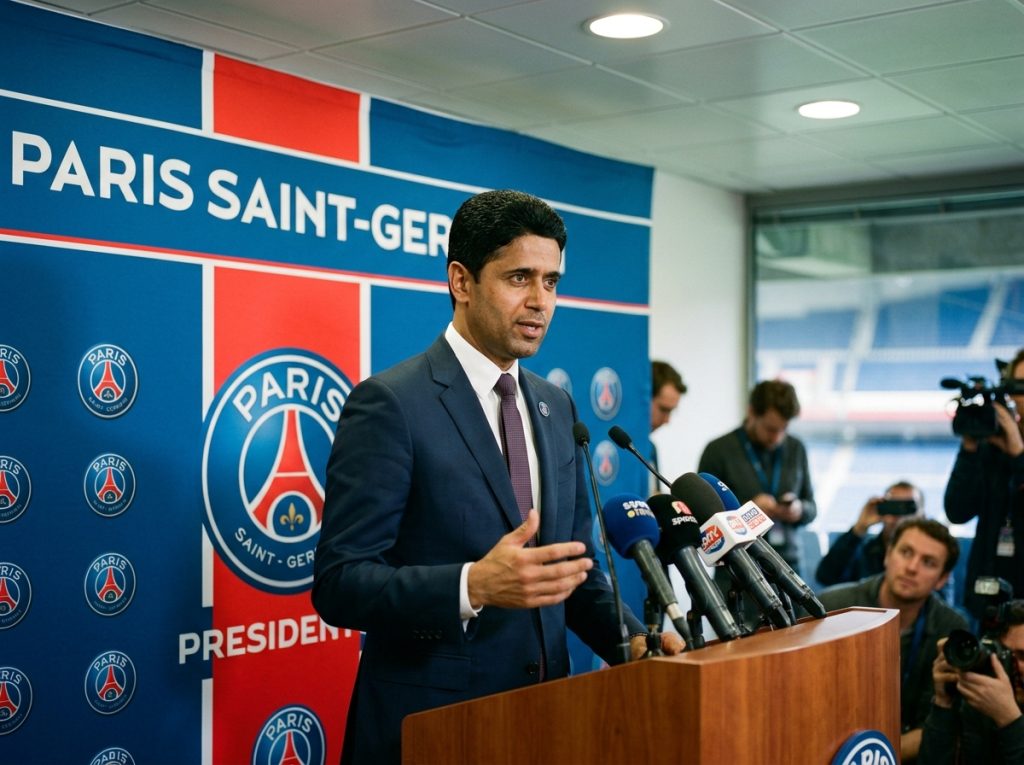

Nasser Al-Khelaifi: The Qatari Executive Behind Paris Saint-Germain’s Rise to European PowerNasser Al-Khelaifi has served as president of Paris Saint-Germain since 2011, when Qatar Sports Investments took control of the French club. Over more than a decade, he has turned PSG into one of the most recognisable brands in world football, culminating in the club’s first UEFA Champions League title. Beyond football, he chairs a media empire and holds senior roles across European and global sports governance.
Background
From Squash Player to Sports Executive
Before becoming a football executive, Al-Khelaifi was a professional squash player who represented Qatar internationally. His move into sports administration began through Qatar Sports Investments (QSI), the state-linked investment vehicle that has driven much of Qatar’s expansion into global sport.
The Qatar Sports Investments Takeover
QSI acquired Paris Saint-Germain in 2011, and Al-Khelaifi was installed as club president shortly after. The takeover marked the start of a new era for a club that had spent years outside France’s football elite, backed instead by one of the wealthiest sovereign-linked investment groups in the world.
Details
His Role and Titles
Al-Khelaifi’s full name is Nasser bin Ghanim Al-Khelaifi. He is president of Paris Saint-Germain and chairman of Qatar Sports Investments, the company that owns the club on behalf of Qatari interests, which means Al-Khelaifi runs PSG as its chief executive rather than holding personal individual ownership of the club outrigh.
Football Governance Positions
Beyond PSG, Al-Khelaifi chairs the European Club Association (ECA), representing more than 800 clubs across the continent, and sits on UEFA’s Executive Committee as the ECA’s representative. He has also represented the ECA on the FIFA Council since October 2025, giving him direct influence over decisions made by football’s two most powerful governing bodies.
Net Worth: What Is Actually Known
Public estimates of Al-Khelaifi’s personal net worth vary enormously, ranging from a few hundred million dollars to several billion, depending on the source. This inconsistency exists because his wealth is closely tied to state-linked Qatari investment vehicles rather than a single, publicly disclosed personal fortune, and neither Al-Khelaifi nor QSI has released an official figure. Any specific number circulating online should be treated as an unverified estimate rather than a confirmed fact.
Quotes
Al-Khelaifi has repeatedly downplayed speculation linking him to the FIFA presidency, a subject that resurfaced in 2026 amid governance controversies surrounding incumbent Gianni Infantino. Responding to the rumours, Al-Khelaifi said he remained fully committed to his current role,stating that he was happy to continue as president of Paris Saint-Germain.He has also spoken publicly about PSG’s coaching setup, praising manager Luis Enrique’s contribution to the club’s recent European success as central to the team’s transformation under his leadership.
Impact
PSG’s Transformation Under His Leadership
Under Al-Khelaifi, PSG has won a record-extending number of Ligue 1 titles and, in 2025, claimed its first-ever UEFA Champions League trophy. The club has become a dominant force in French football while steadily building a stronger reputation in European competition, a shift widely credited to the financial backing and long-term strategic planning driven by QSI’s ownership.
Influence Across Global Football
Al-Khelaifi’s combined roles at PSG, the ECA, UEFA, and now the FIFA Council place him among the most influential individuals in world football governance. Decisions on club competition formats, revenue distribution, and international calendar planning increasingly involve his input, extending his influence well beyond Paris.
Conclusion
With PSG continuing to compete at the top of European football and Al-Khelaifi’s name periodically linked to even bigger roles in global sports governance, his influence shows no sign of shrinking. Whether or not he eventually pursues a position such as the FIFA presidency, his existing footprint across club football, broadcasting, and international sports politics already makes him one of the sport’s most closely watched figures heading into the coming seasons.
FAQs
What is Nasser Al-Khelaifi’s religion?
Nasser Al-Khelaifi is a citizen of Qatar, a Muslim-majority country, and is generally described in profiles and biographical sources as Muslim. However, he has not made detailed public statements about his personal religious practice, and like many public figures, he keeps that aspect of his private life largely out of the media. Readers should treat this as general background rather than a personal confirmation from Al-Khelaifi himself, since he has not addressed the topic directly in interviews.
Who is the head of PSG?
Nasser Al-Khelaifi has been the president of Paris Saint-Germain since 2011, making him the club’s top executive and public-facing leader. He oversees the club’s overall direction, including major decisions on transfers, coaching appointments, and commercial strategy, while day-to-day football operations are managed by the coaching staff and sporting directors beneath him. His position stems from his role as chairman of Qatar Sports Investments, the company that owns PSG, rather than from personal individual ownership of the club.
What is Luis Enrique’s monthly
Nasser Al-Khelaifi has been the president of Paris Saint-Germain since 2011, making him the club’s top executive and public-facing leader His position stems from his role as chairman of Qatar Sports Investments, the company that owns PSG, rather than salary at PSG?
Luis Enrique signed a contract extension with PSG in September 2026, keeping him at the club until 2030 after leading the team to consecutive European successes. Before that extension, reports in the French sports press had placed his pay at around one million euros gross per month, making him the highest-paid coach in Ligue 1 at the time.